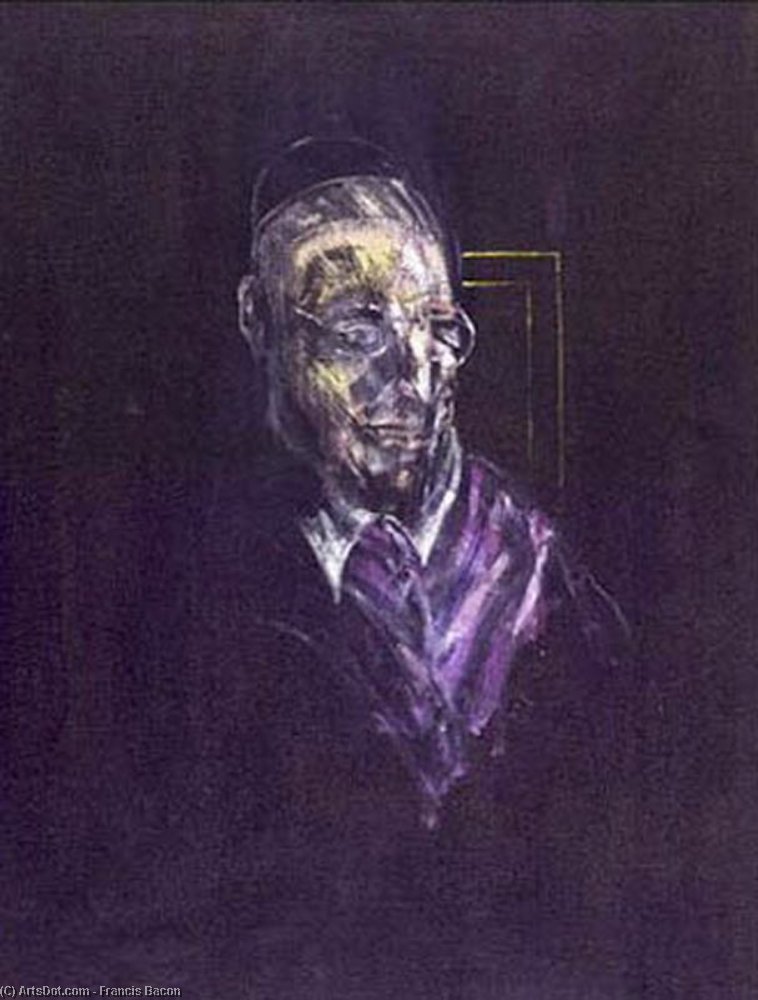
A Study in Existential Anguish: Francis Bacon’s ‘Study for Head of Cardinal with Glasses’
Francis Bacon's 'Study for Head of Cardinal with Glasses,' painted during the artist’s intensely productive period, offers a profoundly unsettling glimpse into the anxieties and alienation that defined his oeuvre. This seemingly simple depiction – a man in a hat, spectacles perched upon his nose, gazing into an indeterminate distance – is anything but straightforward. It's a distilled essence of Bacon’s preoccupation with human vulnerability, the grotesque beauty of decay, and the inherent loneliness of modern existence. The painting speaks volumes about the artist’s own turbulent life, marked by instability and a deep-seated sense of unease, mirroring the broader societal anxieties following World War II.
The Raw Expressionism of Bacon's Technique
- Monochromatic Palette: The stark black and white execution amplifies the painting’s emotional impact. The absence of color intensifies the sense of isolation and emphasizes the textures – the rough fabric of the hat, the wrinkles around the eyes, the unsettling distortion of the face.
- Distorted Forms: Bacon's signature technique is evident here; the figure is rendered with a deliberate lack of anatomical precision. The head is elongated, the features exaggerated, creating a sense of unease and suggesting a psychological rather than literal representation. This distortion reflects the artist’s rejection of traditional academic realism.
- Rough Brushwork: Visible brushstrokes contribute to the painting's visceral quality, conveying a feeling of immediacy and urgency. It’s as if Bacon is attempting to capture not just an image but also the very essence of his subject’s tormented state.
Symbolism and the Weight of History
The ‘Cardinal,’ a recurring motif in Bacon's work, represents a figure burdened by authority, faith, and ultimately, disillusionment. The glasses suggest a searching intellect, attempting to make sense of a chaotic world – an attempt that is inherently futile. The man’s averted gaze speaks volumes about the difficulty of confronting uncomfortable truths or finding solace in belief. The painting resonates with the post-war atmosphere of Britain, where traditional values were crumbling and existential questions dominated public discourse. Bacon's work can be seen as a visual embodiment of this period’s profound sense of uncertainty.
Emotional Resonance and Artistic Legacy
'Study for Head of Cardinal with Glasses' is more than just a portrait; it’s an exploration of the human condition. Bacon masterfully captures a moment of intense contemplation, tinged with melancholy and dread. The painting’s enduring power lies in its ability to evoke a deeply personal response from the viewer – a recognition of our own vulnerabilities and anxieties. As one of Francis Bacon's earliest works, it provides a crucial insight into the development of his distinctive style and foreshadows the monumental scale and emotional intensity that would characterize much of his later output. This piece is a testament to Bacon’s ability to transform personal struggle into universally resonant art.