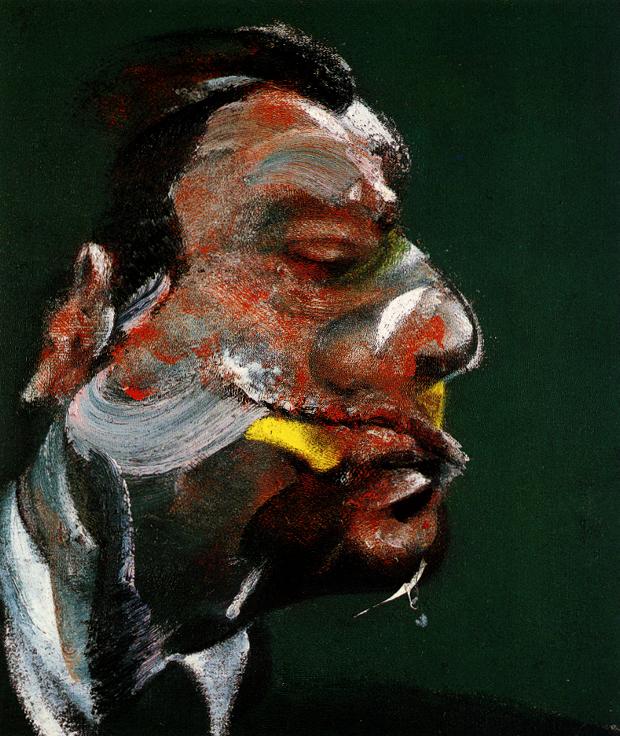
Study for Head of George Dyer, 1967 - This unsettling portrait by Francis Bacon captures the artist's signature style—a grotesque depiction of human anatomy rendered with muted colors and a palpable sense of psychological torment.
Explore Francis Bacon's (1909-1992) emotionally charged figurative paintings. Known for distorted forms, existential themes & bold expressionism, he remains a cornerstone of modern art. Discover key works & legacy.
A Visceral Confrontation with the Human Psyche
In the hauntingly intimate Study for Head of George Dyer, 1967, Francis Bacon presents a gaze that refuses to look away. The painting is far more than a mere portrait; it is a raw, psychological landscape where the boundaries between the physical body and emotional trauma begin to dissolve. As the viewer encounters the distorted features of the subject, there is an immediate sense of unsettling realism clashing with a profound, expressive abstraction. The man’s wide, staring eyes seem to pierce through the canvas, forcing a direct confrontation with themes of vulnerability and the inescapable weight of human suffering. This close-up composition strips away all external distractions, leaving only the fractured essence of a soul caught in a moment of intense psychological distress.
The Alchemy of Distortion and Decay
To achieve such profound emotional resonance, Bacon employed a technique that prioritized raw sensation over meticulous anatomical accuracy. Utilizing his signature “squeeze” method, he applied paint with a heavy, textured urgency, minimizing blending to create surfaces that evoke the appearance of bruised or decaying flesh. The palette is deliberately unsettling, dominated by sickly yellows and muted ochres that suggest an atmosphere of illness and existential unease. Through jagged, uneven lines and a fractured perspective, Bacon disrupts our spatial understanding, mirroring the fragmented nature of memory and consciousness. For the collector or designer, this piece offers a powerful focal point, where the very texture of the paint serves as a tactile representation of emotional turmoil.
Existential Shadows in a Post-War World
The historical weight of this work is inseparable from the era in which it was conceived. Emerging from the profound disillusionment of post-World War II Britain, the painting breathes the air of existentialism—a period defined by the questioning of meaning and the confrontation with mortality. The subject, George Dyer, was not merely a model but a pivotal figure in Bacon’s life, serving as a catalyst for the artist's exploration of identity and the grotesque. In this study, the interplay of light and shadow becomes a metaphor for the struggle to find stability in an unstable world. Owning a high-quality reproduction of such a seminal work allows one to bring a piece of art history’s most profound explorations of the human condition into a contemporary space, offering a timeless meditation on the beauty found within the broken.