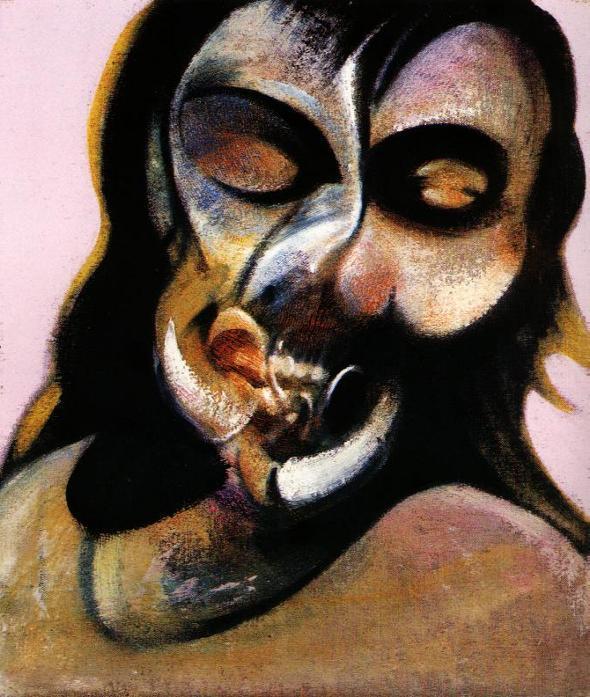
A visceral expressionist portrait of raw emotion, Francis Bacon's 1969 study of Henrietta Moraes captures a haunting blend of joy and vulnerability through distorted forms, inviting you to explore this masterpiece.
Explore Francis Bacon's (1909-1992) emotionally charged figurative paintings. Known for distorted forms, existential themes & bold expressionism, he remains a cornerstone of modern art. Discover key works & legacy.
A Fragmented Moment of Joy and Terror
To encounter Francis Bacon’s Study of Henrietta Moraes Laughing, 1969 is to be pulled into a whirlwind of raw, unadulterated human emotion. The canvas does not merely present a portrait; it presents a psychological event. At the center of this visceral storm is Henrietta Moraes, her face captured in a state of profound transition—a moment where laughter and a grimace become indistinguishable. Her head, turned slightly away from the viewer, suggests a sense of deep isolation, as if we are witnessing a private eruption of feeling that refuses to be fully known. The exaggerated features and the wide, open mouth create a tension that is both captivating and unsettling, making it a piece that demands an emotional response from anyone standing before it.
The Texture of Existential Turmoil
Bacon’s mastery lies in his ability to translate the invisible tremors of the soul into tangible, heavy textures. Through the use of thick impasto, he builds a surface that feels alive, almost pulsating with an inner, restless energy. The application of paint is deliberate and heavy, creating a landscape of ridges and valleys that catch the light and cast subtle shadows across the subject's face. This technique is complemented by a palette of intense, vibrant hues—crimson, ochre, and brilliant yellows—that evoke a sense of heat and urgency. These colors do not seek to please the eye with traditional beauty; instead, they serve to amplify the underlying themes of vulnerability and intensity. For the collector or interior designer, this tactile quality offers a profound depth, ensuring the artwork remains a commanding and transformative focal point in any sophisticated space.
A Legacy of Unflinching Truth
Born from the shadows of the post-war period, this work carries the weight of an era defined by nuclear anxiety and the search for meaning in a fractured world. Bacon rejects the polished surfaces of classical portraiture in favor of a truth that is much more difficult to face: the truth of our own fragility. By distorting form and embracing the grotesque, he captures the very essence of the human condition—the paradox of finding life within the midst of decay. This painting serves as a powerful testament to the resilience of expression, making it an invaluable acquisition for those who appreciate art that challenges the status quo and invites deep, contemplative dialogue.