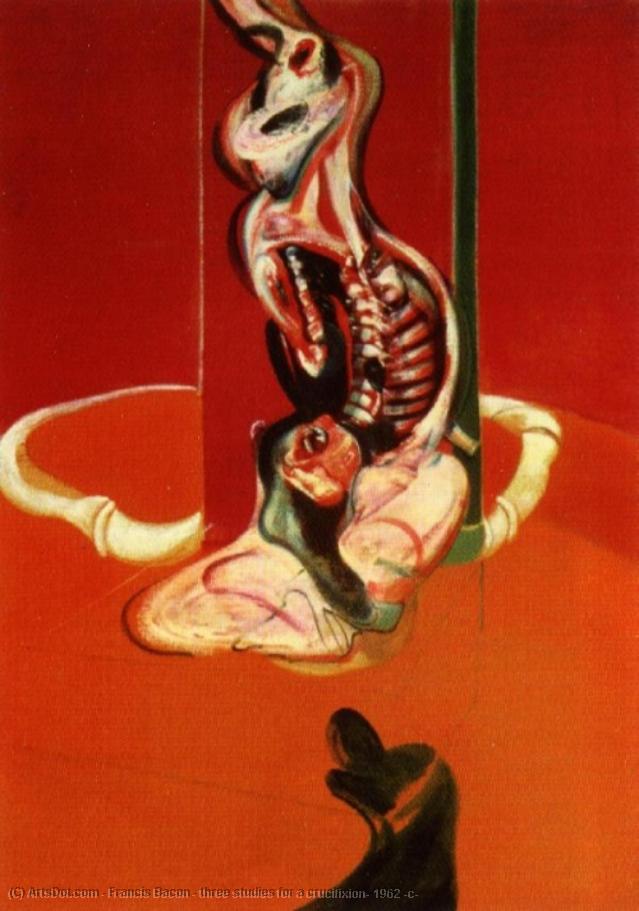
A Visceral Exploration of Existence: Francis Bacon’s *Three Studies for a Crucifixion* (1962)
This powerful triptych by Francis Bacon is not a traditional depiction of religious suffering, but rather a raw and unsettling exploration of the human condition – its fragility, pain, and ultimate isolation. Created in 1962, it stands as a pivotal work within Bacon’s oeuvre, marking a return to form after a period of artistic searching and solidifying his position as one of the most important figurative painters of the 20th century.
Subject & Composition
The artwork presents three separate panels, each featuring a distorted, fragmented figure suspended within an ambiguous space against a searing red background. These are not easily identifiable individuals; they are visceral embodiments of anguish and vulnerability. The figures appear partially dissected or exploded, revealing skeletal structures and internal organs – a deliberate act by Bacon to confront the viewer with the physicality of existence and mortality. The composition deliberately avoids narrative clarity, instead focusing on the emotional impact of the fragmented forms.
Style & Technique
Bacon’s style is immediately recognizable for its expressive distortion and brutal honesty. *Three Studies for a Crucifixion* exemplifies his signature approach:
- Expressionism: The work embodies Expressionist principles, prioritizing emotional intensity over realistic representation.
- Impasto & Texture: Thickly applied oil paint – an impasto technique – creates a rough, tactile surface that amplifies the sense of chaos and disintegration.
- Distortion & Fragmentation: The figures are grotesquely distorted, their bodies contorted into unnatural poses, reflecting inner turmoil.
- Color Palette: The dominant use of intense red evokes feelings of violence, passion, and primal energy.
Historical Context & Influences
Francis Bacon (1909-1992) lived through a period marked by immense social and political upheaval – two World Wars, the Cold War, and profound shifts in philosophical thought. His work reflects this anxiety and disillusionment. While titled *Crucifixion*, the artwork moves away from traditional religious iconography. Bacon drew inspiration from diverse sources:
- Velázquez’s Portrait of Pope Innocent X: Bacon repeatedly revisited Velázquez's masterpiece, using it as a springboard for his own explorations of power and isolation.
- Eadweard Muybridge’s Motion Studies: The fragmented forms and sense of movement in Bacon’s figures echo Muybridge’s pioneering photographic studies of human locomotion.
- Sergei Eisenstein's Films: The screaming mouth, a recurring motif in Bacon’s work, is directly inspired by the nurse’s scream in Eisenstein’s film *Battleship Potemkin*.
Symbolism & Emotional Impact
Beyond its immediate visceral impact, *Three Studies for a Crucifixion* operates on multiple symbolic levels. The exposed anatomy can be interpreted as a confrontation with the raw reality of existence and the loss of control. The fragmented figures represent the disintegration of identity in the face of suffering. The red background acts as both a visual assault and a metaphorical representation of blood, violence, and primal instinct.
Ultimately, the artwork is not about religious faith but about the fundamental human experience of pain, vulnerability, and mortality. It evokes feelings of unease, anxiety, and profound empathy.
For Collectors & Interior Designers
A reproduction of *Three Studies for a Crucifixion* serves as a powerful statement piece, adding depth and intellectual weight to any collection or interior space. Its bold color palette and dramatic composition demand attention, while its underlying themes invite contemplation. The artwork’s intensity makes it particularly well-suited for modern and contemporary settings, offering a striking contrast to minimalist aesthetics. It is a work that will undoubtedly spark conversation and inspire reflection.