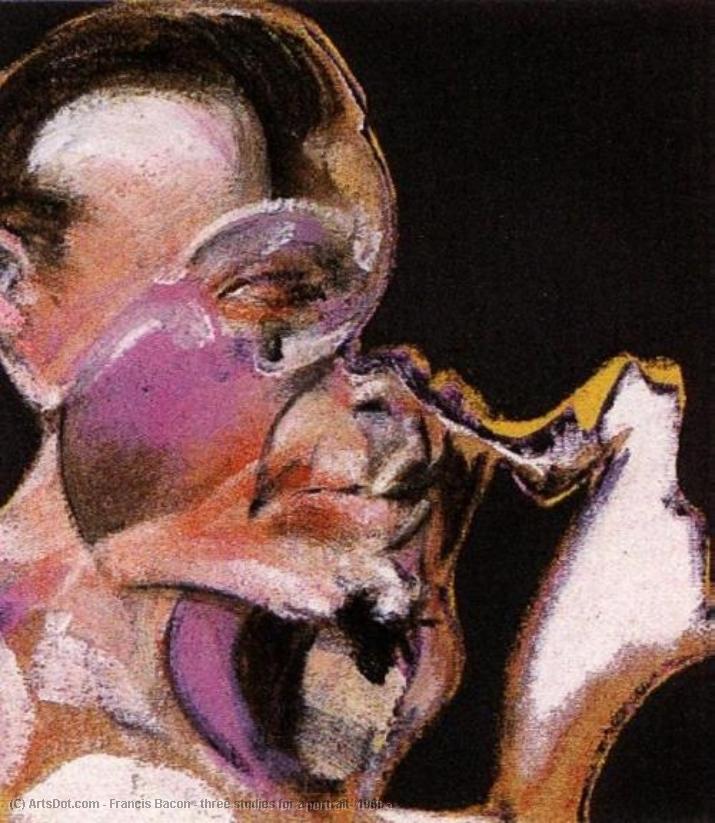
Experience Francis Bacon’s intensely emotional ‘Three Studies for a Portrait,’ 1968 – an expressionist masterpiece featuring a hauntingly rendered man with a purple background and wide eyes, capturing the artist's visceral style. Discover this iconic work and bring it into your collection.
A Descent into the Human Condition: Francis Bacon’s ‘Three Studies for a Portrait’, 1968
Francis Bacon's 'Three Studies for a Portrait', painted in 1968, is not merely a depiction of a man; it’s an excavation of the human psyche – a raw and unsettling exploration of isolation, anxiety, and the inherent grotesqueness lurking beneath the surface of civilized existence. This work, created during a period of profound social and political upheaval following World War II, embodies Bacon's signature style: a brutal honesty rendered with a visceral intensity that continues to resonate powerfully today. The painting’s stark simplicity – a single figure against a pulsating purple backdrop – immediately confronts the viewer with an uncomfortable truth about our own vulnerability.
- Subject and Form: The central subject, a man with a pronounced beard and mustache, is rendered in a fragmented, almost skeletal form. Bacon deliberately avoids idealization, presenting instead a figure stripped bare of any comforting illusion. His wide-open eyes, fixed on an unseen point beyond the canvas, convey a sense of profound unease and perhaps even terror.
- Color Palette: The dominant purple hue is crucial to the painting’s emotional impact. Purple has long been associated with royalty, spirituality, and mourning – elements that contribute to the work's complex layering of meaning. It amplifies the feeling of confinement and psychological distress.
Expressionism and the Trauma of the 20th Century
Bacon’s artistic approach is firmly rooted in Expressionism, a movement that sought to convey subjective emotions rather than objective reality. However, unlike many of his contemporaries, Bacon didn't simply express angst; he channeled the anxieties of an era defined by unprecedented violence and technological advancement. The post-war world was saturated with disillusionment, and Bacon’s art reflects this pervasive sense of loss and uncertainty. His work is a direct response to the horrors witnessed during the conflict, translated into a visual language that refuses easy interpretation.
The painting's fragmented form mirrors the shattered state of European society at the time. The distorted features and unsettling gaze suggest a breakdown of traditional values and a growing sense of alienation. Bacon’s deliberate rejection of conventional portraiture – abandoning the idealized beauty favored by earlier artists – underscores his commitment to portraying the darker aspects of human experience.
Technique and Materiality: A Dance with Chaos
Bacon's technique is characterized by its seemingly haphazard application of paint. He employed a layering process, often applying multiple layers of oil paint in rapid succession, creating a sense of movement and instability. The surface of the canvas appears to writhe with energy, reflecting the turmoil within the subject’s psyche. His use of thick impasto – building up the paint into raised ridges – adds to the tactile quality of the work, inviting viewers to engage with its physicality.
- Brushwork: Bacon's brushstrokes are deliberately rough and uneven, contributing to the painting’s unsettling effect. They suggest a struggle for control, mirroring the subject’s internal conflict.
- Surface Texture: The textured surface of the canvas is integral to the work’s emotional impact, adding another layer of complexity to its visual language.
Symbolism and Emotional Resonance
'Three Studies for a Portrait' transcends a simple portrait; it becomes a meditation on mortality, isolation, and the fragility of human existence. The figure’s open eyes suggest a desperate plea for connection or perhaps a final, agonizing realization. The painting’s ambiguity invites viewers to project their own anxieties and fears onto the canvas, creating a deeply personal experience. It is a testament to Bacon's ability to tap into universal themes with unflinching honesty, solidifying his place as one of the most significant artists of the 20th century.