The Visceral Echo of Human Suffering
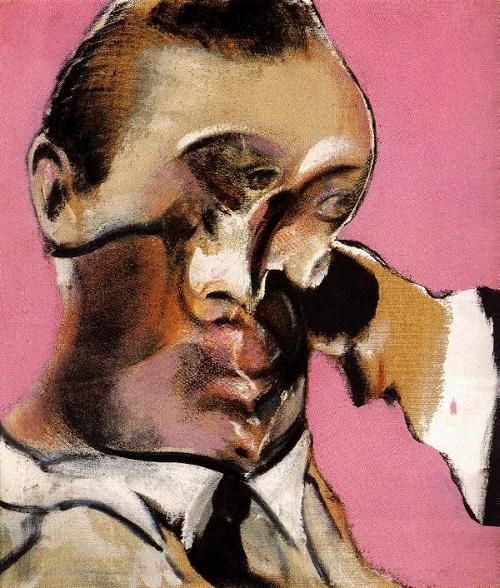
In the hauntingly evocative "Three Studies for a Portrait," created in 1968, Francis Bacon invites the viewer into a profound confrontation with the rawest elements of the human psyche. This is not merely a portrait of a man; it is a visceral exploration of anxiety, fear, and the terrifying disintegration of identity. The painting serves as a chilling testament to Bacon’s enduring legacy, capturing a moment where the boundaries between the physical body and psychological torment begin to dissolve. Through his uniquely distorted lens, the subject becomes a vessel for universal existential dread, making this piece an essential cornerstone for any collection focused on the transformative power of 20th-century Expressionism.
The technique employed in this masterpiece is as turbulent as its subject matter. Eschewing the comforts of academic realism, Bacon utilizes a deliberate, expressionist distortion to sculpt emotion directly onto the canvas. The figures are rendered with thick, impasto oil paint, applied with such intensity—often using palette knives—that the surface gains a palpable, sculptural depth. This heavy layering creates a luminous yet unsettling sheen, where fleshy pinks and vibrant tones clash against dark, suffocating recesses. The result is a texture that feels alive, almost breathing, forcing the observer to grapple with the physical presence of the distorted features, such as the mouth caught in a silent, agonizing scream or the blurring of facial anatomy.
A Reflection of Postwar Existentialism
To understand the profound emotional impact of this work, one must look toward the historical landscape of postwar Britain. Emerging from the shadows of World War II, the era was defined by a pervasive sense of disillusionment and the loss of traditional certainties. Bacon’s work resonates deeply with the intellectual currents of thinkers like Sartre and Camus, reflecting an age gripped by existential crisis. The painting captures that specific period's preoccupation with trauma and the fragility of the human condition, where the self feels perpetually on the brink of fragmentation.
For the discerning collector or interior designer, "Three Studies for a Portrait" offers more than just visual intrigue; it provides a powerful focal point for spaces that demand depth and intellectual weight. The painting’s ability to provoke thought and evoke a spectrum of complex emotions makes it an incomparable piece for curated environments. Whether placed in a contemporary gallery setting or a sophisticated private study, this reproduction brings with it the heavy, beautiful gravity of art history, serving as a permanent dialogue between the viewer and the enduring mysteries of human existence.