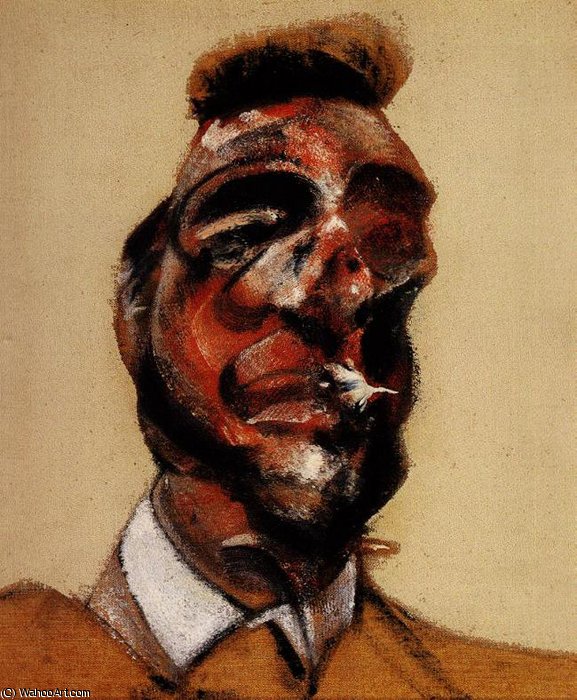
The painting showcases a man with a grotesquely distorted face, reflecting Bacon's signature style and exploring themes of psychological torment and vulnerability. Its unsettling imagery captures the artist’s profound engagement with human emotion.
Explore Francis Bacon's (1909-1992) emotionally charged figurative paintings. Known for distorted forms, existential themes & bold expressionism, he remains a cornerstone of modern art. Discover key works & legacy.
A Descent Into Darkness: Exploring Francis Bacon’s “Three Studies for Portr. of G.Dyer on Light Ground Left”
The painting by Francis Bacon, "Three Studies for Portrait of G.Dyer on Light Ground Left," isn't merely a depiction of a man; it’s an excavation into the depths of human emotion—a confrontation with primal fear and psychological torment rendered in unsettling detail. Completed in 1953, during the bleak aftermath of World War II, this artwork embodies the pervasive anxiety that gripped Europe at the time, reflecting not just geopolitical instability but also a profound crisis of faith and identity. Bacon himself described it as “a portrait of terror,” a statement that encapsulates the very essence of what compels us to gaze upon its fractured surface.
Style and Technique: The Brutal Beauty of Expressionism
Bacon’s style is undeniably expressionist, prioritizing emotional intensity over realistic representation. He eschewed traditional methods of painting—avoiding meticulous blending and striving for spontaneity—instead employing a technique he termed “squeeze,” where he applied paint directly to the canvas with his hands or palette knife. This physicality isn't accidental; it serves as a conduit for conveying visceral feelings, mirroring the artist’s own turbulent inner life. The resulting canvases are characterized by jagged lines, distorted shapes, and a disconcerting lack of tonal gradation—a deliberate rejection of illusionistic perspective that forces viewers to confront the image head-on. Thick impasto creates palpable texture, emphasizing the physicality of the act of painting itself and amplifying the emotional impact of the depicted scene.
Historical Context: The Shadow of War and Existential Angst
The painting’s genesis lies in Bacon's fascination with portraiture—specifically his desire to capture not just likeness but also psychological state. He began working on this piece shortly after G.Dyer, a fellow artist and friend, suffered a debilitating stroke. Bacon sought to portray Dyer’s suffering, attempting to translate the experience of physical pain into visual terms. However, the painting transcends mere biographical representation; it speaks to broader anxieties about mortality, trauma, and the fragility of human existence—themes that resonated deeply with artists and intellectuals grappling with the existential implications of the postwar era. The pervasive sense of dread is palpable, mirroring the collective disillusionment following the horrors of Auschwitz and Hiroshima.
Symbolism: Fractured Faces and Unspeakable Horror
The central figure’s grotesque visage – a skull-like head contorted in agony – is laden with symbolic significance. Bacon deliberately distorted the face to convey not just physical pain but also psychological torment—representing the inescapable confrontation with death and decay. The fragmented form echoes the shattered psyche of Dyer, mirroring the artist's own preoccupation with themes of trauma and disintegration. Furthermore, the pale yellow background serves as a stark contrast to the dark hues dominating the composition, amplifying the sense of unease and highlighting the figure’s vulnerability. Bacon deliberately avoided explicit references to religious iconography, opting instead for visual metaphors that evoke primal fears—a deliberate rejection of comforting narratives in favor of confronting the darkest recesses of human experience.
Emotional Impact: A Confrontation with Darkness
Ultimately, “Three Studies for Portrait of G.Dyer on Light Ground Left” compels viewers to engage in a profound emotional reckoning. It’s not an artwork designed to elicit pleasure or admiration; rather, it demands attention—forcing us to confront uncomfortable truths about human suffering and the inevitability of mortality. The painting's unsettling aesthetic – its jagged lines, distorted shapes, and palpable texture – generates visceral responses, mirroring the artist’s own emotional turmoil. It lingers in the mind long after viewing, prompting reflection on the nature of fear, trauma, and the enduring power of art to grapple with existential anxieties. Bacon’s masterpiece remains a testament to the transformative potential of expressionism—a chilling reminder that beauty can coexist with horror, and that confronting darkness is essential for achieving genuine insight.