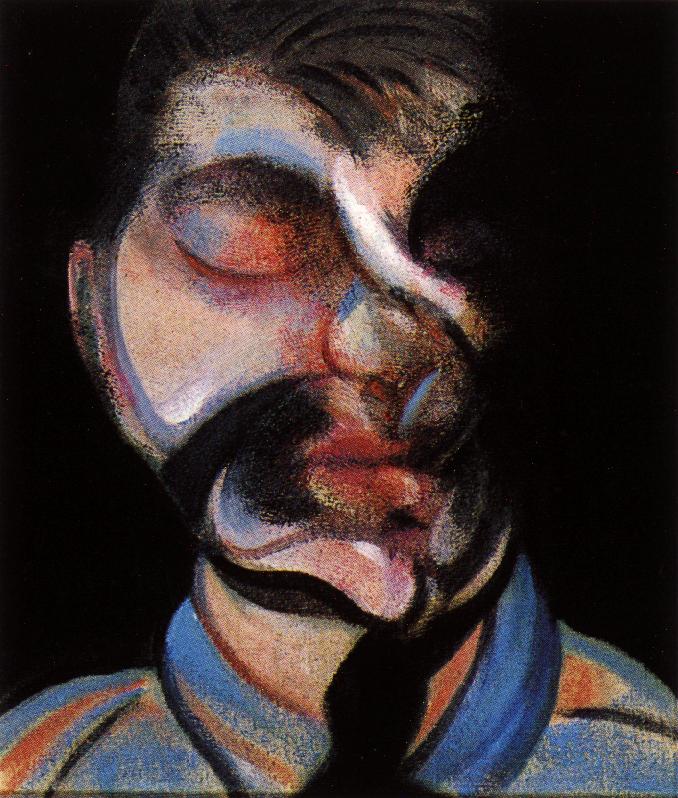
The painting depicts a man with closed eyes and a distorted face, wearing a tie. It’s an unsettling expressionist piece by Francis Bacon titled "Three Studies for Self-Portrait, 1972 Right." The composition evokes tension and unease.
Explore Francis Bacon's (1909-1992) emotionally charged figurative paintings. Known for distorted forms, existential themes & bold expressionism, he remains a cornerstone of modern art. Discover key works & legacy.
A Haunting Encounter with the Self
To stand before Francis Bacon’s Three Studies for Self-Portrait, 1972 Right is to confront a mirror that refuses to reflect a coherent reality. The painting presents a figure caught in a moment of profound vulnerability, where the boundaries between life and death, or sleep and dissolution, seem to blur. With eyes closed and features contorted by an unseen force, the subject’s face appears fragmented, as if the very essence of identity is being stripped away. A prominently visible tie provides a stark, almost mundane contrast to the visceral distortion of the flesh, grounding this existential nightmare in a recognizable, yet deeply unsettling, human form. It is a work that does not merely depict a man; it depicts the sensation of existing within the grip of profound anxiety, making it an arresting piece for any collection focused on the power of psychological depth.
The Brutality of Expression and Technique
Bacon’s mastery lies in his rejection of academic precision in favor of what can only be described as expressionist brutality. Eschewing meticulous detail, he utilized a technique he famously referred to as the “squeeze,” applying paint with a raw, physical urgency using his fingers and palette knives. This method imbues the canvas with a palpable, sculptural texture, where thick layers of pigment create a landscape of decay. The color palette is intentionally unsettling, dominated by bruised reds, sickly yellows, and muted browns—hues that evoke the fragility of organic matter and the weight of mortality. Through this heavy, gestural application, Bacon transforms the act of painting into a visceral struggle, mirroring the internal emotional turmoil that defines the subject’s very existence. For the interior designer, this texture offers a commanding presence, providing a sophisticated yet raw focal point for modern, avant-garde spaces.
Echoes of a Fractured World
Beyond its personal intensity, this work serves as a profound reflection of the historical shadows cast during the early 1970s. Created against the backdrop of the Vietnam War and the shifting landscape of post-colonial Britain, the painting captures a collective sense of loss and the fragility of human life. Bacon draws upon the psychological depths explored by Surrealists like Salvador Dalí, yet he strips away their dreamlike whimsy to reveal something much more primal and unsettling. The piece functions as a powerful symbol of existential angst, making it an essential acquisition for collectors who seek art that challenges the viewer and commands attention. This reproduction offers a window into the rawest corners of the human psyche, providing a centerpiece that is as intellectually stimulating as it is visually arresting.