A Descent Into Visceral Emotion
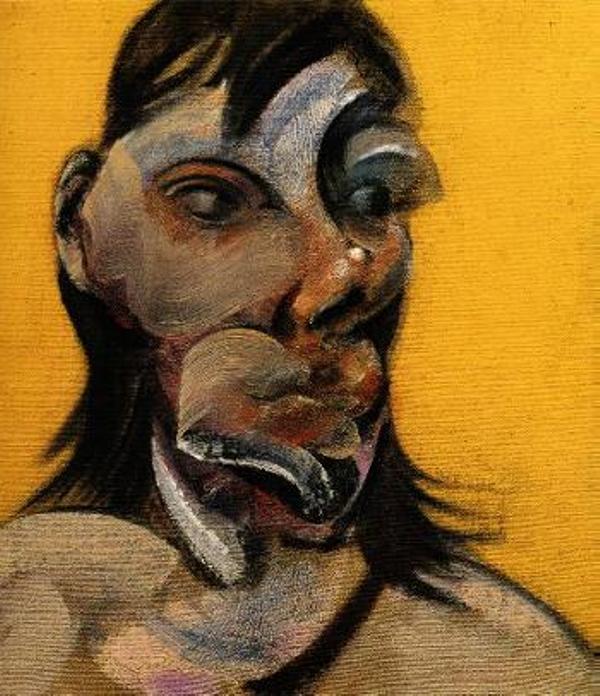
The painting "Three Studies of Henrietta Moraes II," created in 1969 by the legendary Francis Bacon, stands as a monumental testament to the artist's unflinching confrontation with human suffering and psychological torment. More than just an image, it is a profound experience—a plunge into a realm where beauty clashes violently with brutality, mirroring the deep-seated anxieties of a generation grappling with the existential shadows of the post-war era. Bacon himself famously described his artistic process as being “not about what I see but about what I feel,” a philosophy that is perfectly embodied in this unsettling and unforgettable masterpiece.
In this work, the viewer is met with a face that appears distorted, almost as if the very essence of the subject is being unraveled by an invisible force. The composition focuses intensely on the head and facial features, stripping away the comfort of a full body to force a direct, unavoidable encounter with the subject's vulnerability. Through his signature use of fragmented forms and a rejection of traditional anatomical accuracy, Bacon creates a sense of profound unease. The predominant use of vibrant, warm yellows provides a startling contrast to the grim subject matter, creating a tension that is both visually arresting and emotionally destabilizing.
The Mastery of Expressionist Horror
Bacon’s technique is a masterclass in Expressionist Horror, prioritizing raw emotional intensity over realistic representation. Utilizing oil paint on canvas, he employed a heavy impasto technique, where pigment is applied in thick, textured layers. This tactile quality adds a palpable physicality to the work; the ridges and grooves of the paint contribute to the sense of claustrophobia and the visceral, fleshy reality of the subject. The distortion of the features is not merely a stylistic choice but a deliberate tool used to amplify the psychological impact of the piece.
For collectors and interior designers, this painting offers a powerful focal point that demands attention. It is a work that does not merely decorate a space but transforms it, injecting a sense of profound intellectual and emotional depth. The interplay between the bright, energetic background and the scarred, distorted subject matter makes it an ideal piece for those seeking to curate a collection defined by strength, complexity, and the exploration of the human condition.
Historical Echoes and Symbolic Depth
To understand this painting is to understand the shadow of trauma that loomed over Europe in the mid-20th century. Emerging from a period scarred by the horrors of Auschwitz and Hiroshima, Bacon’s work reflects a pervasive disillusionment and a fractured sense of identity. The subject, Henrietta Moraes—a well-known Parisian model—becomes a vessel through which Bacon explores themes of pain, resilience, and the fragility of the human form. The distortions can be seen as symbols of the psychological fragmentation experienced by individuals in an era of unprecedented global upheaval.
Every brushstroke serves to bridge the gap between the physical world and the internal psyche. By eschewing academic conventions, Bacon liberated the portrait from being a mere likeness, turning it into a landscape of the soul. For anyone looking to acquire a high-quality reproduction of this work, they are not just bringing a piece of art into their home; they are inviting a dialogue about the enduring power of human emotion and the transformative nature of art in the face of adversity.