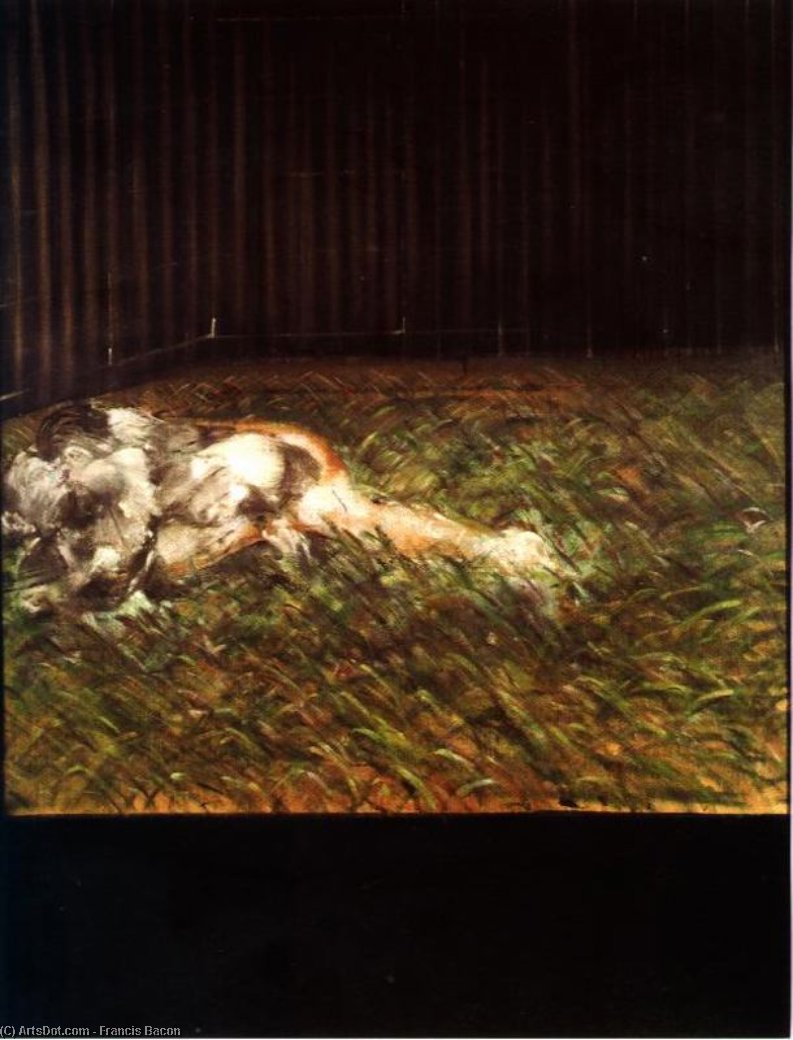
Two Figures in the Grass 1 by Francis Bacon – This evocative painting depicts two dogs resting on grass, accompanied by two people, capturing Bacon’s signature style of visceral emotion and unsettling imagery.
Explore Francis Bacon's (1909-1992) emotionally charged figurative paintings. Known for distorted forms, existential themes & bold expressionism, he remains a cornerstone of modern art. Discover key works & legacy.
An Encounter with Existential Shadows
Francis Bacon’s Two Figures in the Grass 1 is far more than a mere pastoral scene; it is a profound confrontation with the rawest elements of human existence. At first glance, the viewer encounters two dogs resting upon a verdant expanse, yet this tranquility is quickly subverted by the presence of figures that seem to emerge from a psychological fog. The painting captures a moment of profound vulnerability, where the boundary between the living and the decaying begins to blur. Through his masterful use of Brutal Minimalism, Bacon invites us into a space where the comfort of nature meets the unsettling reality of our own mortality, making it an arresting centerpiece for any collection focused on the depth of the human condition.
The Texture of Trauma and Technique
To behold this work is to witness the physical struggle of the artist himself. Eschewing the polished traditions of academic painting, Bacon utilized a technique he famously termed the squeeze, applying pigment directly onto the canvas with his hands to bypass the mediation of the brush. This method results in a surface that feels alive and wounded, riddled with punctures and incisions that mirror the artist's preoccupation with bodily trauma. The color palette is deliberately somber, dominated by muted reds, earthy browns, and sickly yellows—hues that evoke a sense of organic decay. For the interior designer or collector, this tactile quality offers an incredible depth, as the play of light across the textured surface creates a dynamic, ever-changing presence within a room.
A Reflection of a Fractured Era
The historical resonance of Two Figures in the Grass 1 is deeply rooted in the anxieties of postwar Britain. Painted in 1953, the work breathes the atmosphere of a world reeling from the shadows of nuclear threat and the disintegration of traditional social structures. The composition, which positions the figures in close, almost merging proximity, serves as a powerful symbol of human interdependence—the idea that we are inextricably linked to one another in our shared struggle for survival. By drawing on Surrealist influences, Bacon creates a dreamlike yet terrifyingly visceral landscape. This piece does not merely decorate a space; it challenges it, offering a sophisticated and intellectually stimulating addition to any curated environment.