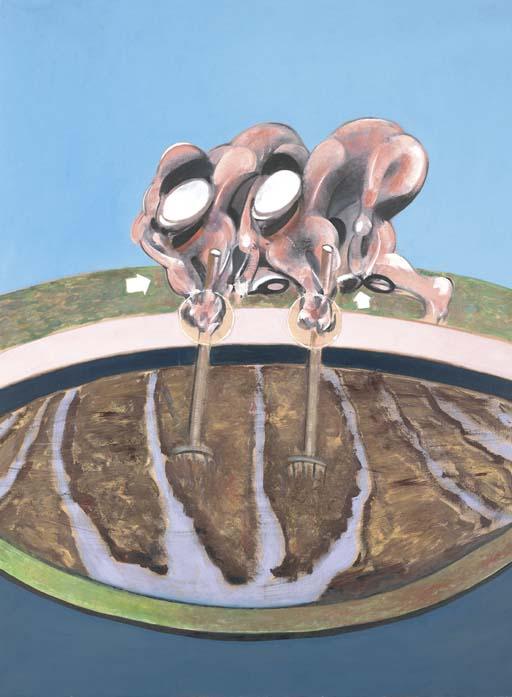
Two Men Working in a Field by Francis Bacon - This painting depicts three men laboring together in a field under a blue sky, punctuated by birds – a poignant exploration of human connection and vulnerability characteristic of Bacon’s style.
Explore Francis Bacon's (1909-1992) emotionally charged figurative paintings. Known for distorted forms, existential themes & bold expressionism, he remains a cornerstone of modern art. Discover key works & legacy.
A Portrait of Disquiet: Exploring Francis Bacon’s “Two Men Working in a Field”
The painting "Two Men Working in a Field," executed by Francis Bacon in 1953, isn't merely a depiction of agricultural labor; it’s a visceral embodiment of existential anxiety—a cornerstone of Bacon’s distinctive artistic vision. Situated firmly within the context of post-war Britain, this artwork reflects a pervasive mood of disillusionment and uncertainty that gripped European culture following the devastation of World War II. Bacon himself experienced considerable instability during his formative years, marked by frequent relocations stemming from his mother's debilitating illness—a circumstance that instilled in him a profound awareness of displacement and profoundly influenced his artistic sensibility.
Bacon’s stylistic approach defies easy categorization. He eschewed traditional academic conventions, prioritizing raw emotion over meticulous representation. His canvases are characterized by fragmented figures rendered in unsettlingly distorted perspectives—a technique he termed “psychological painting.” The figures themselves appear to be caught in moments of agonizing stillness, their bodies contorted and riddled with incisions that suggest both physical pain and psychological torment. This deliberate disruption of visual harmony serves not merely as aesthetic experimentation but as a powerful tool for conveying the artist’s inner turmoil. Bacon meticulously built up layers of paint—often employing encaustic wax alongside oil—creating surfaces that shimmer with an unsettling luminescence. The resulting textures are palpably uncomfortable, mirroring the anxieties simmering beneath the surface of the depicted scene.
The symbolism embedded within “Two Men Working in a Field” is multilayered and deliberately ambiguous. The two men laboring together represent humanity grappling with its own mortality—a preoccupation that dominated Bacon’s oeuvre throughout his career. Their postures convey not camaraderie but rather an oppressive sense of interdependence, hinting at the inescapable constraints imposed by circumstance and fate. Furthermore, the bleak landscape—dominated by a muted blue sky and sparsely populated with birds—underscores the desolate emotional terrain of the painting. The absence of vibrant color amplifies the feeling of isolation and despair, mirroring the artist’s own psychological state. Bacon's use of incisions is particularly significant; they symbolize wounds inflicted upon both the body and the soul—a motif recurrent throughout his work and indicative of his profound engagement with themes of trauma and suffering.
Ultimately, “Two Men Working in a Field” transcends its subject matter to become an unforgettable meditation on the human condition. It compels viewers to confront uncomfortable truths about vulnerability, mortality, and the inescapable burden of existence. Bacon’s masterful manipulation of technique—particularly encaustic wax—creates a surface that is both visually arresting and emotionally resonant. The painting's unsettling luminescence captures the flickering instability of consciousness itself, mirroring the artist’s own preoccupation with psychological exploration. It remains a haunting reminder of Bacon’s unwavering commitment to portraying the darkest recesses of human experience—a legacy that continues to inspire artists and captivate audiences worldwide.