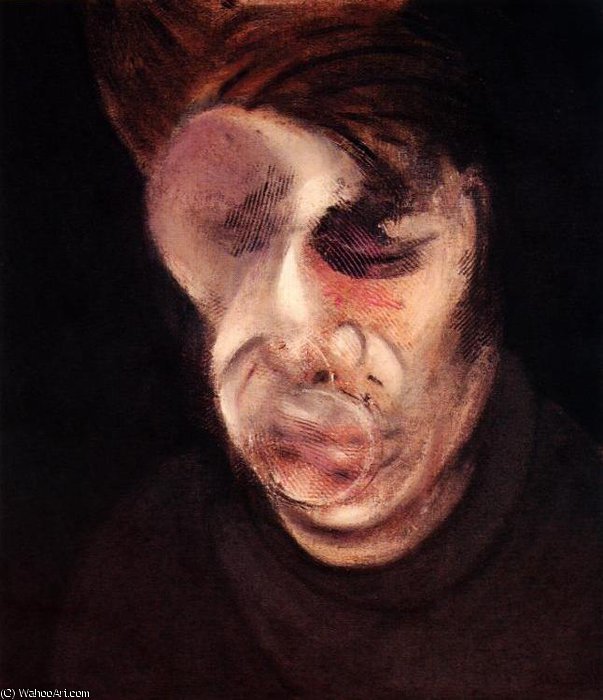
Two Studies for Self-Portrait, left - This haunting black and white painting by Francis Bacon depicts a man with a severely scarred face, capturing the artist's signature exploration of pain and psychological torment. A visceral portrayal of vulnerability and distortion.
Explore Francis Bacon's (1909-1992) emotionally charged figurative paintings. Known for distorted forms, existential themes & bold expressionism, he remains a cornerstone of modern art. Discover key works & legacy.
A Confrontation with the Self
To encounter Francis Bacon’s Two Studies for Self-Portrait, left is to step into a landscape of profound psychological unrest. Created in 1977, this work serves as a chilling testament to the artist's ability to render human suffering not merely as a concept, but as a visceral reality. The composition is strikingly stark; a solitary head dominates a void-like white background, stripping away all external context to force an intimate, almost claustrophobic encounter with the subject. There is no comfort in this portrait. Instead, we are met with a face marked by the topography of trauma—scars and burns that crisscross the skin like a map of internal devastation. Through this unflinching gaze, Bacon invites us to witness the raw vulnerability of the human condition, making the piece an essential cornerstone for any collection focused on the power of Expressionism.
The Mastery of Distortion and Texture
Bacon’s technique in this study transcends simple representation, moving into a realm where form is sacrificed to emotion. The artist employs jagged edges and fragmented forms to mirror a fractured psyche, utilizing a monochromatic palette that strips the image of any distracting color. This black and white medium serves a dual purpose: it focuses the viewer's eye entirely on the grotesque textures of the flesh while adding a dramatic, cinematic gravity to the subject's disfigured appearance. There is a sculptural quality to the work, achieved through a masterful manipulation of line and shadow that suggests the weight of every scar and the depth of every contour. The exaggerated features—the prominent nose and contorted musculature—do not aim for traditional likeness, but for an emotional truth. For the discerning collector or interior designer, this piece offers a dramatic focal point, providing a sophisticated yet provocative tension that can anchor a modern space with its intense, monochromatic presence.
An Enduring Legacy of Existential Truth
Beyond its visual shock, the work resonates with a deep-seated existential angst that has defined much of 20th-century art. Bacon, an artist whose life was shaped by displacement and the turbulent atmosphere of post-war Britain, captures a sense of isolation that is both timeless and deeply personal. The lack of a visible torso emphasizes this solitude, presenting the head as a vessel for all the world's accumulated pain. This study is more than a portrait; it is an exploration of the human condition in its most stripped-back state. For those seeking to curate art that provokes thought and demands engagement, Bacon’s work offers an unparalleled opportunity to possess a piece of history that continues to challenge, haunt, and inspire long after the first viewing.