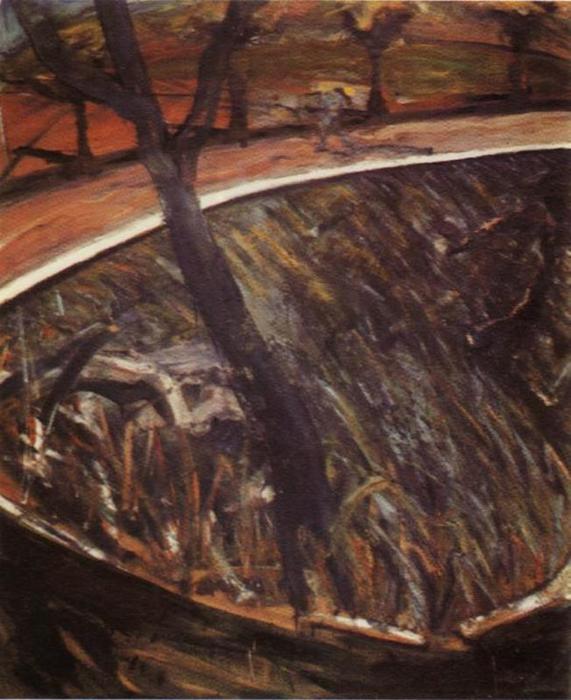
A Glimpse Through Time: Francis Bacon’s “Van Gogh dans un paysage”
Francis Bacon's "Van Gogh dans un paysage," painted in 1957, isn’t merely a portrait; it’s an intensely felt echo of a vanished world. This work represents a pivotal moment in Bacon’s artistic journey – a deliberate and deeply personal engagement with the spirit of Vincent van Gogh, a master he both revered and wrestled with on canvas. The painting captures not just a likeness, but a palpable sense of unease, isolation, and the haunting beauty of memory. It's a testament to Bacon’s ability to distill emotion into form, transforming a familiar image – Van Gogh’s “The Painter on the Road to Tarascon” (destroyed during World War II) – into something profoundly new.
Bacon’s fascination with this particular Van Gogh painting stemmed from its evocative power. He described it as a "ghost of the road," a fragment of a lost world imbued with a potent, almost unbearable sadness. The destroyed version fueled his desire to recreate and reinterpret the scene, not as a literal copy, but as an emotional response – a distillation of the original’s anguish. This impulse is immediately apparent in Bacon's technique: loose, agitated brushstrokes dominate the canvas, creating a sense of movement and instability. Colors are applied with feverish intensity, eschewing traditional representation for a raw expression of feeling. The palette leans towards bruised blues, ochres, and unsettling greens, mirroring the emotional landscape of the subject.
Deconstructing the Figure: Symbolism and Emotional Resonance
Within this turbulent landscape, Van Gogh himself is rendered as an almost spectral presence. He’s not depicted in a clear, defined form but rather emerges from the shadows, his features dissolving into the surrounding environment. This ambiguity speaks to Bacon's broader interest in the fragmented nature of memory and identity – how we reconstruct the past through subjective experience. The road itself becomes a symbolic artery, leading nowhere, suggesting a journey without resolution or destination. The trees that frame the scene aren’t comforting; they are gnarled and menacing, contributing to the overall sense of foreboding.
Crucially, Bacon isn't simply painting *Van Gogh*; he's exploring the *idea* of Van Gogh – the artist as a symbol of vulnerability, isolation, and the struggle for creative expression. The figure’s posture, slumped and withdrawn, embodies this sense of loneliness. The use of color is particularly significant here; the muted tones create an atmosphere of melancholy, while flashes of brighter hues—particularly in the sky—suggest fleeting moments of beauty or perhaps even madness.
Technique and Context: A Late-Career Masterpiece
“Van Gogh dans un paysage” was created during a period of intense experimentation for Bacon. It’s part of a series of eight paintings he produced in 1957, all directly inspired by Van Gogh's work. This project represents a significant shift in Bacon’s artistic practice – a move away from his earlier, more overtly figurative works towards a more abstract and emotionally driven style. The painting demonstrates a mastery of technique honed over decades; the layering of paint, the manipulation of texture, and the expressive use of color are all hallmarks of Bacon's mature style.
The work’s creation coincided with a period of personal reflection for Bacon, grappling with mortality and the legacy of his own artistic endeavors. It’s a deeply introspective piece, offering a glimpse into the artist’s psyche and his ongoing dialogue with the masters who had shaped his vision. “Van Gogh dans un paysage” remains a powerful example of Bacon's ability to transform personal experience into universal themes – loss, memory, and the enduring power of art.