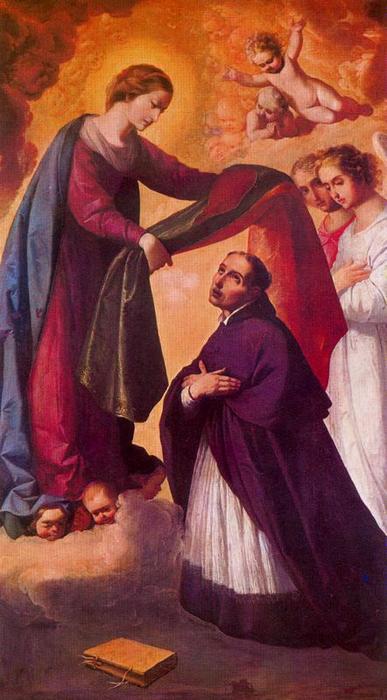
The Imposition of the Cassulon – A Testament to Faith and Zurbarán’s Mastery
Francisco de Zurbarán's "Imposición de la Casulla a San Ildefonso" is not merely a depiction of a religious ceremony; it is a profound meditation on faith, humility, and spiritual grace. Painted during the height of the Spanish Baroque period – roughly between 1620 and 1660 – this work exemplifies Zurbarán’s signature style: an austere realism that transcends mere representation to capture the very essence of devotion. The scene unfolds with a quiet intensity, focusing on the pivotal moment of the imposition of the cassulon, a liturgical vestment signifying the elevation of a cleric to higher office. The painting's power resides in its ability to transport the viewer directly into the heart of this sacred act, fostering a sense of reverence and contemplation.
Subject Matter and Composition
- The central figures – a kneeling man and a woman holding a cloth – are rendered with an almost sculptural quality. The man’s posture is one of complete submission, his gaze fixed on the woman, while her expression conveys both solemnity and profound respect.
- The presence of two angels flanking the scene adds to the sense of divine intervention and underscores the sacred nature of the event. Their wings are depicted with meticulous detail, a hallmark of Zurbarán’s technical prowess.
- The strategic placement of three books – one at the bottom left, another at the top right, and a third in the middle-right – is particularly significant. These aren't simply props; they represent knowledge, scripture, and spiritual learning—elements integral to the cleric’s journey of faith.
Technique and Style: Zurbarán’s Baroque Vision
Zurbarán was a master of *tenebrismo*, a technique popularized by Caravaggio that utilizes dramatic contrasts between light and shadow to heighten the emotional impact of his paintings. Here, the light source – likely from an unseen window – falls directly onto the figures, illuminating their faces and clothing with a stark brilliance. This intense illumination not only emphasizes their physical forms but also serves to isolate them within a realm of spiritual significance. The artist’s meticulous attention to detail is evident in every brushstroke, particularly in the rendering of textures: the rough fabric of the cassulon, the smooth skin of the figures, and the delicate folds of drapery. His use of *sfumato*, a subtle blurring of edges, further contributes to the painting's ethereal quality.
Symbolism and Historical Context
Painted around 1630, “Imposición de la Casulla a San Ildefonso” reflects the deeply religious atmosphere of Spain during the Counter-Reformation. The Catholic Church was actively seeking to reaffirm its authority and inspire piety after the challenges posed by the Protestant Reformation. Zurbarán’s work aligns perfectly with this context, offering a powerful visual representation of faith and obedience. The scene is likely based on a specific liturgical rite, emphasizing the importance of ritual and ceremony in expressing religious devotion. The choice of San Ildefonso as the subject suggests a connection to the prominent figure within the Catholic Church.
Emotional Impact and Artistic Legacy
Beyond its technical brilliance, “Imposición de la Casulla a San Ildefonso” possesses a remarkable emotional resonance. The painting’s somber palette – dominated by browns, ochres, and blacks – contributes to its sense of solemnity and reverence. The figures' expressions convey a profound sense of humility and devotion, inviting the viewer to share in their spiritual experience. Zurbarán’s work continues to captivate audiences today, demonstrating his enduring ability to capture the essence of human faith and spirituality. A hand-painted reproduction offers an unparalleled opportunity to appreciate the full depth and beauty of this iconic masterpiece.