A Vision of Faith: Unveiling “Inmaculada 2” by Francisco de Zurbarán
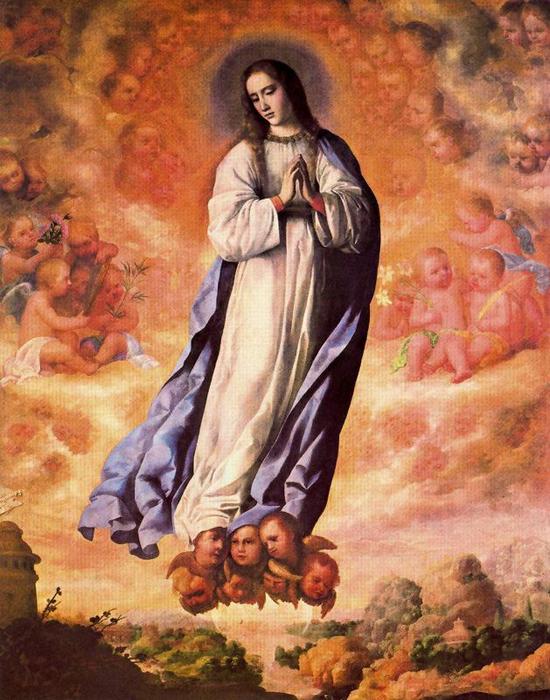
Francisco de Zurbarán’s “Inmaculada 2,” a work shrouded in the quiet reverence characteristic of his oeuvre, offers more than just a depiction of the Virgin Mary; it's an immersion into a world of stark spirituality and profound emotional intensity. Born in Extremadura in 1598, Zurbarán dedicated his life to capturing the essence of religious devotion through a masterful command of light, shadow, and detail – a style that earned him the moniker “Spanish Caravaggio.” This particular painting, though its exact dimensions remain unknown, exemplifies his signature approach: a deliberate restraint combined with an almost unbearable weight of feeling. The scene unfolds within a hazy, ethereal space, dominated by the central figure of Mary, bathed in a luminous glow that seems to emanate not from any external source but from her very being.
The composition is remarkably simple yet powerfully effective. Mary sits serenely, hands clasped together in prayer, her face an expression of quiet contemplation. The folds of her robe, rendered with meticulous realism – a hallmark of Zurbarán’s technique – cascade downwards, creating a sense of depth and volume that draws the viewer into the scene. Two angels flank her, their wings subtly suggested rather than explicitly depicted, contributing to the painting's overall atmosphere of hushed reverence. The use of white as the dominant color in the drapery is particularly striking; it amplifies the light, creating a sense of purity and holiness, while simultaneously emphasizing the textures and folds with astonishing accuracy.
The Baroque Influence & Extremaduran Roots
To understand “Inmaculada 2,” one must consider Zurbarán’s artistic formation. His early training in Extremadura instilled within him a deep appreciation for simplicity, austerity, and the spiritual—qualities deeply rooted in the region's religious traditions. This starkness is echoed in his use of tenebrism – a dramatic contrast between light and dark – which dominates the composition. The shadows are not merely absences of light; they actively shape the forms, adding to the painting’s sense of drama and mystery. While influenced by the burgeoning Baroque style he encountered in Seville under Alonso de Najera, Zurbarán never fully embraced its flamboyant excesses. Instead, he distilled the Baroque's emotional intensity into a more restrained and profoundly moving form.
The historical context is crucial to appreciating this work. “Inmaculada 2” was painted during a period of intense religious fervor in Spain – the Counter-Reformation. The Catholic Church sought to reassert its authority after the challenges posed by the Protestant Reformation, and art played a vital role in reinforcing faith and piety. Zurbarán’s paintings were commissioned by churches and wealthy patrons eager to display their devotion. The presence of the infant Jesus on the left side subtly references Mary's role as the Mother of God, further emphasizing the sacred nature of the scene.
Symbolism & Emotional Resonance
Beyond its religious subject matter, “Inmaculada 2” is rich in symbolic meaning. The skulls scattered beneath Mary’s feet – a detail often overlooked – serve as a poignant reminder of mortality and the transience of earthly life. They are not presented in a morbid way but rather as a gentle counterpoint to the Virgin's serene contemplation, suggesting that true faith offers solace even in the face of death. The clouds surrounding Mary represent her ascent into heaven, symbolizing hope, redemption, and eternal salvation. The painting’s emotional impact is profound; it evokes a sense of quiet awe, reverence, and perhaps even melancholy – a recognition of our own mortality and the enduring power of faith.
A Legacy in Reproduction
ArtsDot offers meticulously hand-painted reproductions of “Inmaculada 2,” allowing you to experience the artistry and emotional depth of this iconic masterpiece in your own home. Each reproduction is created by skilled artisans using traditional techniques, faithfully capturing Zurbarán’s masterful use of light, shadow, and detail. Whether displayed as a focal point in a chapel or a serene addition to a private study, a ArtsDot reproduction of “Inmaculada 2” will serve as a timeless reminder of the enduring power of faith and art.