The Profound Stillness of Faith: An Exploration of Zurbarán’s “Saint Luke”
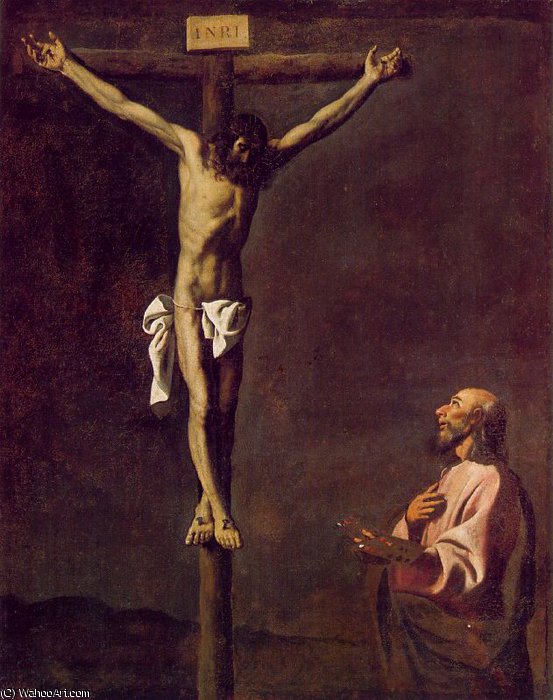
Francisco de Zurbarán's "Saint Luke as a Painter before Christ on the Cross" is not merely a depiction of a biblical scene; it’s an immersion into a world of austere piety and dramatic, almost theatrical, light. Painted around 1630-1632, during his most intensely productive period in Seville, this work exemplifies Zurbarán's signature style – a masterful blend of realism and spiritual intensity that secured him the moniker “Spanish Caravaggio.” The painting immediately commands attention with its stark contrasts: deep shadows enveloping the figures, punctuated by pools of radiant light focused solely on Saint Luke and Christ. This deliberate use of chiaroscuro isn’t simply an artistic technique; it serves to heighten the sense of drama, emphasizing the gravity of the moment and drawing the viewer into a contemplative space.

The Anatomy of Devotion: Style, Technique, and Context
Zurbarán’s approach to painting was deeply rooted in the religious traditions of Extremadura, his birthplace. He meticulously studied the bodies of monks and other figures within monastic settings, striving for an unparalleled level of anatomical accuracy – a characteristic that set him apart from many of his contemporaries. The rendering of Christ's body is particularly striking; it’s not idealized or romanticized but presented with a raw, almost brutal realism, reflecting the suffering endured on the cross. Note the subtle details: the veins visible beneath Christ’s skin, the texture of his garments, and the careful depiction of his outstretched limbs. Zurbarán's technique involved layering thin glazes of oil paint to achieve this remarkable luminosity and depth. He employed a limited palette – predominantly browns, blacks, and whites – further intensifying the impact of the light and shadow.
The painting’s setting is crucial to its meaning. The dark background, devoid of any extraneous detail, directs all attention towards the central figures. This deliberate simplicity mirrors the austerity of monastic life and underscores the spiritual focus of the scene. It's important to consider this within the broader context of the Spanish Golden Age – a period marked by intense religious fervor following the Reconquista. The Catholic Church was a powerful patron of the arts, commissioning works that reinforced its doctrines and inspired piety.
Symbolism and Narrative: Luke’s Role in the Drama
Saint Luke, depicted as an elderly man diligently sketching Christ on the cross, embodies the role of the Evangelist as both recorder and witness to this pivotal event. The act of painting itself is symbolic; it represents the preservation of memory and the faithful transmission of religious truth. The posture of Luke – kneeling in humble reverence – emphasizes his devotion and his commitment to documenting God’s grace. The presence of the unseen Christ, radiating light from the cross, highlights the divine source of inspiration for the Evangelist's work. The figure beside Christ is often interpreted as a disciple or perhaps even an angel, further reinforcing the sacred nature of the scene.
Furthermore, the painting’s composition—the strong diagonal line created by Christ’s body and the outstretched arms—draws the viewer’s eye directly to the central event. This compositional strategy is characteristic of Zurbarán's work and contributes significantly to the painting’s dramatic impact.
A Legacy of Light: The Enduring Power of “Saint Luke”
“Saint Luke as a Painter before Christ on the Cross” remains a profoundly moving artwork, demonstrating Zurbarán’s extraordinary ability to capture both the physical and spiritual realities of faith. Its masterful use of light and shadow, combined with its meticulous realism and symbolic depth, continues to resonate with viewers today. Reproductions by ArtsDot offer an exceptional opportunity to experience this masterpiece in stunning detail, bringing the intensity of Zurbarán’s vision into your home or studio. Explore our collection of high-quality reproductions and discover how this iconic work can enrich your space with its timeless beauty and spiritual significance.