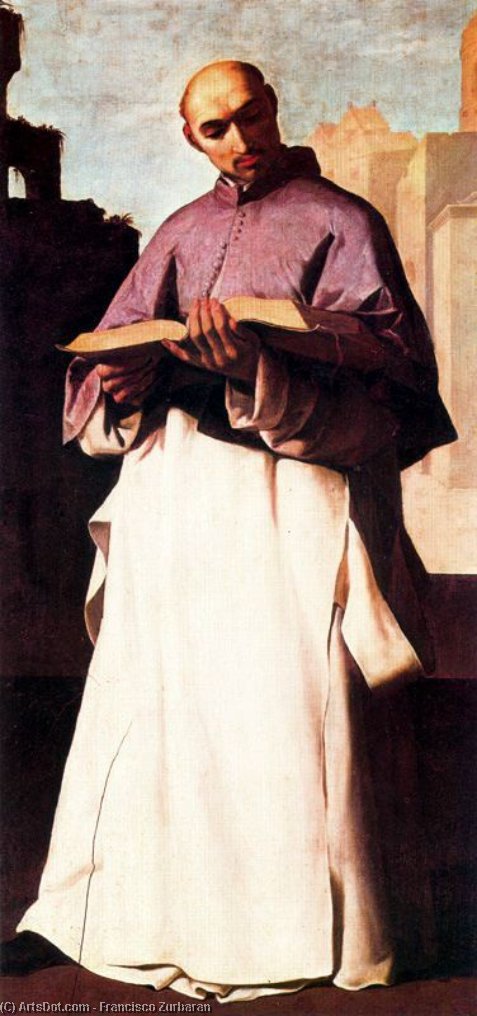
A Portrait of Solitude: Unveiling San Artoldo
Francisco de Zurbarán’s “San Artoldo” is not merely a depiction of a man; it's an immersion into the profound stillness and spiritual contemplation characteristic of the Spanish Baroque. Painted likely around the mid-17th century, this work transcends the conventional portraiture of its time, offering instead a glimpse into the soul of a devout figure—a testament to Zurbarán’s mastery of capturing not just likeness but also an atmosphere of intense inner life.

The subject, identified as Saint Arnold (also known as Saint Martin of Tours), stands bathed in a dramatic chiaroscuro – the masterful use of light and shadow that defines Zurbarán’s signature style. The stark illumination focuses intently on his face, highlighting the lines etched by age and contemplation, while the surrounding darkness envelops him in an aura of solemnity. He is presented with a quiet dignity, his hands clasped together in a gesture of prayer or reflection, suggesting a deep connection to something beyond the visible world.
The Language of Light and Shadow: Zurbarán’s Baroque Technique
Zurbarán's technique is profoundly rooted in the principles of tenebrism, a dramatic lighting style popularized by Caravaggio. However, unlike Caravaggio’s often theatrical use of light, Zurbarán employs it with a more restrained and contemplative quality. The shadows are not simply absences of light; they actively shape the form, emphasizing texture and creating a sense of depth and volume within the figure. Notice how the folds of his robe seem to emerge from the darkness, adding a tactile dimension to the image.
The artist’s meticulous attention to detail is equally remarkable. The rough texture of the fabric, the subtle variations in tone on the skin, and the delicate rendering of the book—open and inviting—all contribute to an astonishingly realistic portrayal. This realism, however, is not intended to be merely superficial; it serves to heighten the emotional impact of the scene, drawing us into the subject’s inner world.
A Spiritual Landscape: Context and Symbolism
“San Artoldo” was created during a period of intense religious fervor in Spain—the Counter-Reformation. The Catholic Church actively sought to inspire piety through art, and Zurbarán's works were commissioned for monasteries and churches throughout the country. Saint Martin, known for his acts of charity and humility, became a potent symbol of Christian virtue. His depiction here embodies these ideals – a man stripped bare of worldly possessions, focused solely on his faith.
The background building, reminiscent of structures found in Toledo—a city steeped in religious history and architectural heritage (as evidenced by the Monasterio de San Juan de los Reyes), subtly anchors the scene within a specific time and place. It’s not merely a backdrop; it suggests a setting for contemplation, perhaps a quiet corner within a monastery or a humble dwelling dedicated to prayer.
A Legacy of Serenity: Zurbarán's Influence
Francisco de Zurbarán is often referred to as the “Spanish Caravaggio” – a comparison that acknowledges his shared mastery of tenebrism and his ability to evoke powerful emotions through dramatic lighting. However, while Caravaggio’s work is characterized by its dynamism and theatricality, Zurbarán's paintings possess a quieter, more introspective quality. His influence can be seen in the works of later Spanish artists, particularly those who sought to capture the spiritual essence of their subjects.
Today, “San Artoldo” stands as a powerful reminder of the enduring appeal of religious art and the ability of a single image to transport us to another time and place. ArtsDot offers meticulously crafted hand-painted reproductions that faithfully recreate Zurbarán’s masterpiece, allowing you to experience its beauty and depth in your own home.