Francisco de Zurbarán’s “San Ramón Nonato”: A Study in Spanish Baroque Devotion
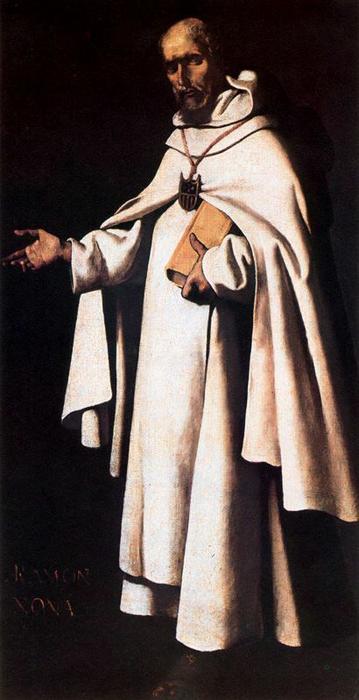
Francisco de Zurbarán's "San Ramón Nonato," a painting shrouded in the quiet solemnity of the Spanish Golden Age, offers a profound glimpse into the religious fervor and artistic sensibilities of 17th-century Spain. Executed around 1630, this work transcends mere portraiture; it’s a meticulously crafted meditation on faith, austerity, and the spiritual journey, deeply rooted in the austere landscapes of Extremadura where Zurbarán spent his formative years. The painting depicts San Ramón Nonato, a Spanish ascetic saint known for his devotion to penance and prayer, presented with an arresting realism that immediately draws the viewer into his contemplative world.
The composition is strikingly simple yet powerfully effective. San Ramón stands bathed in a dramatic chiaroscuro – a technique heavily influenced by Caravaggio – where deep shadows engulf much of the figure and background, intensifying the light focused on him. This stark contrast isn’t merely an aesthetic choice; it symbolizes the struggle between darkness and divine illumination, reflecting the saint's own internal battle with temptation and his unwavering commitment to God. His white robe, rendered with astonishing detail in its folds and textures, appears almost luminous against the muted tones of the wall behind him, suggesting purity and a connection to the heavens.
The Language of Light and Shadow: Zurbarán’s Baroque Technique
Zurbarán's mastery lies not just in his dramatic use of light but also in his incredibly precise rendering of detail. Observe the meticulous depiction of the saint’s hands – clasped around the book, a symbol of scripture and divine knowledge – each vein, wrinkle, and crease rendered with painstaking accuracy. This commitment to realism was unusual for the time, pushing beyond the idealized representations common in earlier Renaissance art. He achieved this through direct observation and careful study of anatomy, often using a life-sized wooden figure as a model to ensure accurate proportions and drapery folds. The subtle variations in tone within the white robe itself – from the deepest shadows to the brightest highlights – create an illusion of volume and texture that is remarkably convincing.
Furthermore, Zurbarán’s use of color is restrained yet deliberate. The palette is dominated by earthy tones—browns, ochres, and grays—reflecting the austerity of the saint's life and the landscape he inhabited. The limited use of white emphasizes its significance as a symbol of purity and holiness. This careful control over color contributes to the overall sense of solemnity and reverence that permeates the painting.
Symbolism and Spiritual Depth
Beyond the immediate depiction of San Ramón, the painting is rich in symbolic meaning. The book he holds represents not just religious texts but also the path to salvation through faith and contemplation. The gesture of pointing towards the viewer can be interpreted as an invitation – a call to join him in his spiritual quest. The bare walls behind him are deliberately plain, devoid of ornamentation, symbolizing the rejection of worldly distractions and the focus on divine matters. This simplicity reinforces the saint’s dedication to a life of asceticism and prayer.
Considering the context of the Spanish Golden Age, “San Ramón Nonato” reflects the Counter-Reformation's emphasis on religious piety and devotion. The painting served as a powerful visual reminder of the importance of faith and the rewards of a virtuous life – a message particularly relevant during a period when the Catholic Church was actively combating the spread of Protestantism. It’s a testament to Zurbarán’s ability to capture not just the outward appearance of religious figures but also the profound inner spirituality they represented.
A Legacy of Spanish Baroque Art
Francisco de Zurbarán's “San Ramón Nonato” stands as a cornerstone of Spanish Baroque art, showcasing his unique blend of realism, dramatic lighting, and spiritual depth. His work profoundly influenced generations of artists, earning him the moniker "Spanish Caravaggio" for his masterful use of tenebrism. Reproductions of this powerful image offer a tangible connection to a pivotal moment in European art history, allowing viewers to experience the intensity and emotional resonance of Zurbarán’s vision – a timeless meditation on faith, devotion, and the enduring power of the human spirit.