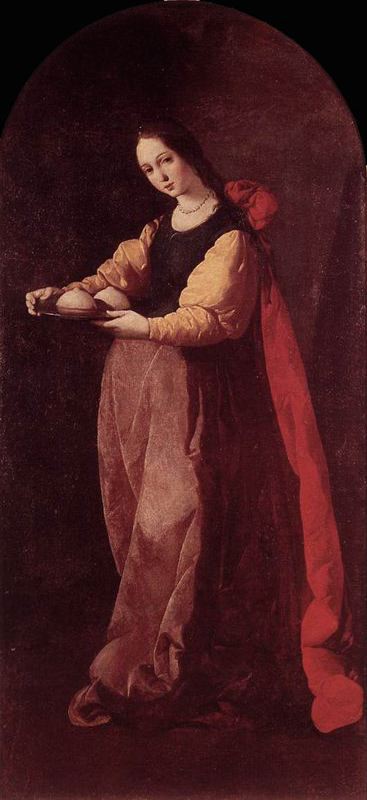
The Serene Figure of Santa Agueda
Francisco de Zurbarán’s “Santa Agueda” is not merely a depiction of a religious icon; it's a profound meditation on faith, humility, and the quiet strength found within spiritual devotion. Painted circa 1630-1640, this black and white image captures a moment of intense contemplation, drawing us into the heart of the Carmelite Order’s embrace of austerity and prayer. The subject, Santa Agueda – a 8th-century martyr known for her unwavering faith and dedication to God – stands before a simple wall adorned with a cross, a potent symbol of her sacrifice and commitment. Her posture is remarkably still, almost sculpted from the very fabric of the scene, radiating an inner peace that transcends the limitations of earthly existence.
Zurbarán’s mastery lies in his ability to imbue even the most austere subject matter with palpable emotion. He achieves this through a masterful deployment of tenebrism – a dramatic contrast between light and shadow – characteristic of the Baroque period. The figure is bathed in a luminous, almost ethereal glow, highlighting her face, hands holding the bowl, and the folds of her habit. This carefully orchestrated illumination draws our attention to the details that speak volumes about her character: the gentle curve of her lips, the subtle expression of serenity on her brow, and the delicate texture of her garment. The surrounding darkness, conversely, symbolizes the world outside her devotion, a realm of temptation and distraction from which she has deliberately withdrawn.
A Window into Spanish Baroque Art
To understand “Santa Agueda,” we must situate it within the broader context of Spanish Baroque art – a movement deeply rooted in religious fervor and influenced by both Italian Caravaggism and the austerity of the Flemish masters. Zurbarán, often dubbed the "Spanish Caravaggio," shared with his Italian counterpart a fascination with dramatic lighting and realistic portrayal, but he infused his work with a distinctly Spanish sensibility. Unlike Caravaggio’s vibrant colors and theatrical compositions, Zurbarán favored muted tones, stark contrasts, and an emphasis on spiritual intensity over mere visual spectacle. His paintings frequently depicted monks, saints, and scenes from the lives of Christ and Mary, reflecting the Counter-Reformation's desire to inspire piety and reaffirm Catholic dogma.
The painting’s setting – a simple wall with a cross – is deliberately devoid of extraneous details. This minimalist approach serves to heighten the focus on Santa Agueda herself, emphasizing her spiritual journey and the profound connection she has forged with God. The bowl in her hand, often interpreted as representing the Eucharist or simply a symbol of charity, further underscores her selfless devotion. It’s a scene stripped bare of worldly distractions, inviting viewers to contemplate their own relationship with faith and spirituality.
Symbolism and Emotional Resonance
Beyond its religious subject matter, “Santa Agueda” resonates deeply through its exploration of human emotion. The figure's gaze is fixed inward, suggesting a state of profound contemplation and inner peace. There’s no overt display of piety or ecstatic fervor; rather, her serenity emanates from an unwavering commitment to her faith. This quiet strength – the ability to find solace and purpose in solitude – is what makes the painting so compelling. It speaks to the universal human desire for connection with something greater than ourselves, a longing that transcends time and culture.
Furthermore, considering the historical context of Fort Santa Agueda, located on Guam, reveals an intriguing parallel. The fort’s construction during the Spanish colonial era highlights the enduring influence of religious iconography and symbolism in shaping landscapes and asserting cultural dominance. While geographically distant from Spain, the image of Santa Agueda – a symbol of unwavering faith – continues to resonate across continents and centuries.
ArtsDot offers meticulously crafted hand-painted reproductions of “Santa Agueda,” allowing you to bring this masterpiece into your home or office with unparalleled fidelity. Each reproduction is created by skilled artists using traditional techniques, ensuring that the painting’s rich details, dramatic lighting, and emotional depth are faithfully preserved.