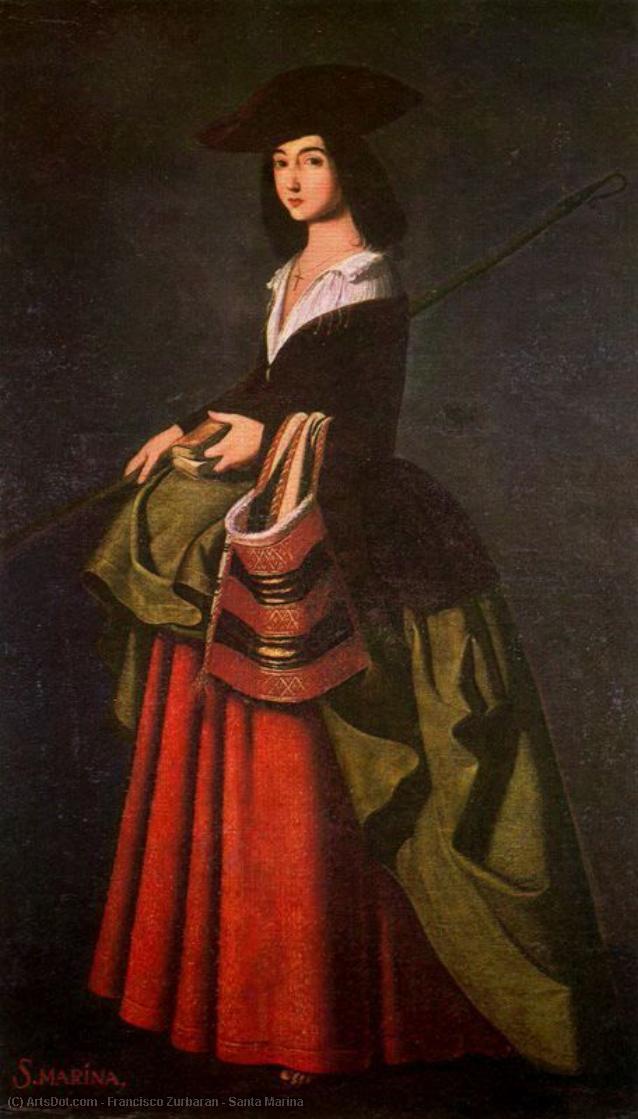
The Serene Figure: An Exploration of Santa Marina
Francisco de Zurbarán’s “Santa Marina” is not merely a portrait; it's an immersion into the austere spirituality that defined much of 17th-century Spanish art. Painted likely between 1630 and 1640, this work embodies the artist’s signature style – a dramatic interplay of light and shadow, known as tenebrism, combined with an almost unnerving realism. The subject, identified as Santa Marina (a figure associated with various saints and locations across Spain), is presented in profile, her gaze fixed and contemplative. She holds a staff, a symbol of authority and guidance, yet her posture exudes quiet dignity rather than forceful command. The simplicity of the composition – a single figure against a stark black background – amplifies the emotional impact, drawing the viewer into a space of profound stillness.
The Language of Light and Shadow – Zurbarán’s Technique
Zurbarán's mastery lies in his manipulation of light. It isn’t a gentle, diffused illumination; instead, it’s a concentrated beam that sculpts the figure, highlighting every wrinkle, fold of fabric, and strand of hair with exquisite detail. The black background serves as an intense void, intensifying the brilliance of the light and creating a sense of depth and drama. This technique was deeply influenced by Caravaggio, whom Zurbarán likely admired from afar, though he adapted it to his own distinct vision. The artist’s meticulous attention to detail extends beyond mere representation; he seems to be striving to capture not just the outward appearance but also the inner essence of Santa Marina – her piety, her devotion, and perhaps even a hint of sorrow.
- Tenebrism: The dramatic use of light and shadow is central to Zurbarán’s style.
- Realism: He meticulously renders textures—the rough fabric of her robe, the polished wood of the staff—with astonishing accuracy.
- Composition: The stark simplicity of the composition focuses attention entirely on the figure and her expression.
Historical Context – Spain in the Age of Faith
To understand “Santa Marina,” it’s crucial to consider the historical context in which it was created. 17th-century Spain was a nation deeply rooted in Catholicism, profoundly shaped by the Counter-Reformation following the Protestant Reformation. The Catholic Church exerted immense influence over all aspects of life, and art played a vital role in reinforcing religious beliefs and inspiring piety. Zurbarán’s work reflects this atmosphere – it's not celebratory or overtly dramatic; rather, it’s characterized by solemnity, introspection, and a profound engagement with the spiritual realm. The subject matter—a devout figure—was intended to evoke contemplation and encourage viewers to reflect on their own faith.
The painting also speaks to the artistic trends of the time, particularly the influence of the Carthusian monks who were known for their austere lifestyle and devotion to God. Zurbarán’s work shares a similar aesthetic – a focus on simplicity, humility, and the representation of religious figures in a realistic and unadorned manner.
Symbolism and Emotional Resonance
Beyond its technical brilliance, “Santa Marina” is rich in symbolism. The staff represents guidance and protection, while her contemplative gaze suggests a deep connection to something beyond the material world. The red dress, though striking against the black background, isn’t overtly flamboyant; it's a symbol of sacrifice and martyrdom—a common theme in depictions of saints. Ultimately, the painting evokes a sense of quiet reverence and invites viewers to contemplate the mysteries of faith and spirituality. It is a powerful testament to Zurbarán’s ability to capture not just a likeness but also the very soul of his subject.