The Serene Martyr: An Exploration of St. Apollonia
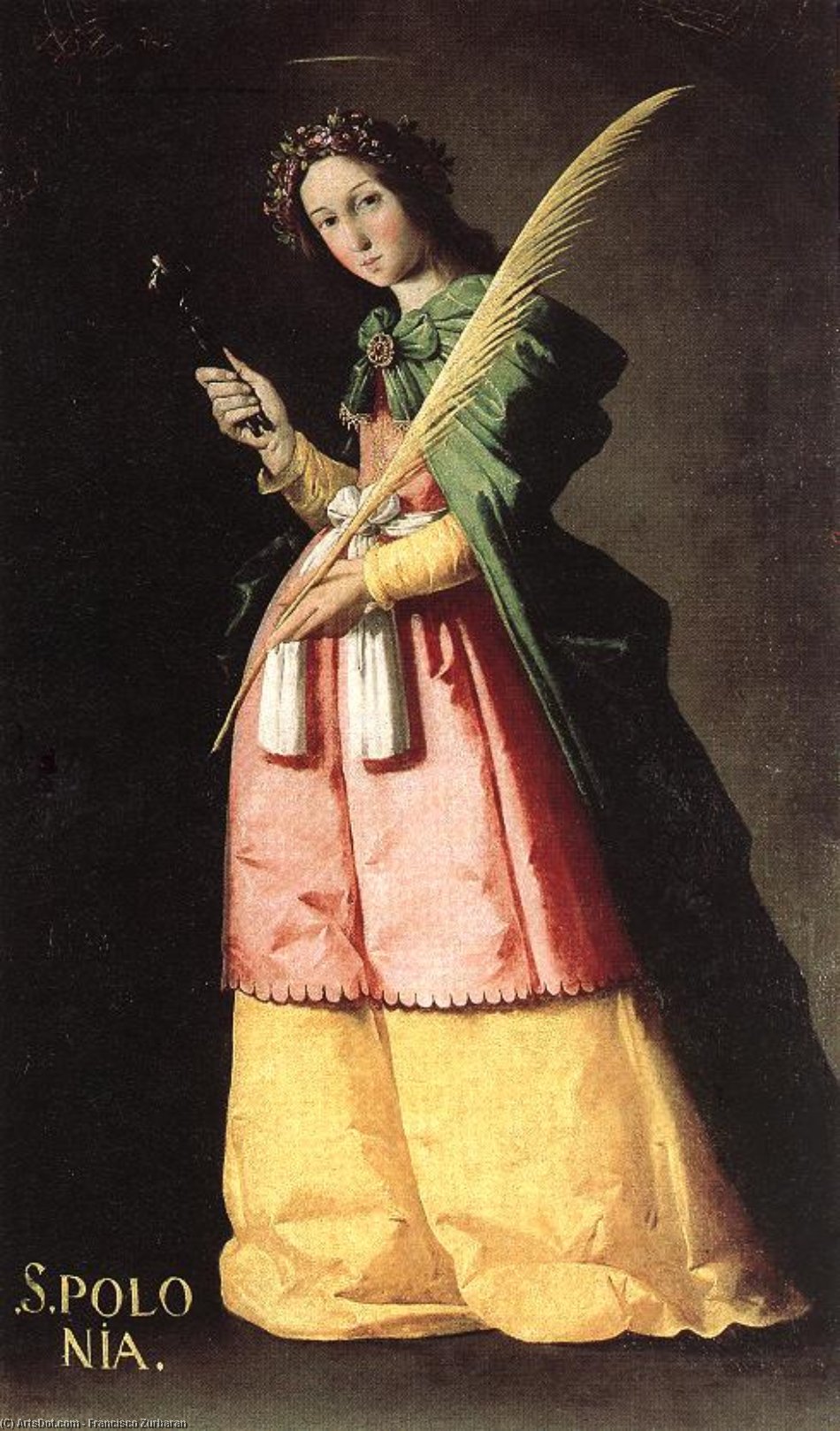
Francisco de Zurbarán’s “St. Apollonia,” painted circa 1636, is not merely a portrait; it's an immersion into the heart of devout suffering and unwavering faith. This arresting image, housed within WahooArt’s meticulously crafted hand-painted reproductions, immediately draws the viewer in with its stark contrasts and profound sense of stillness. The subject, a woman rendered with remarkable realism despite her ordeal, stands against a subtly textured wall – a deliberate choice that anchors her to both earthly reality and an ethereal realm.
The painting’s power resides largely in Zurbarán's masterful use of *tenebrism*, a technique borrowed from Caravaggio but refined with a uniquely Spanish sensibility. Deep blacks dominate the background, swallowing much of the space and intensifying the light that falls upon Apollonia’s figure. This dramatic lighting not only sculpts her form, emphasizing every line and curve, but also serves to heighten the emotional impact – drawing our attention solely to her face, etched with a quiet dignity and an almost unbearable sorrow. The muted pink of her dress provides a delicate counterpoint to the darkness, suggesting both vulnerability and resilience.
A Testament to Faith: Historical Context and Symbolism
To understand “St. Apollonia,” one must delve into the historical context surrounding her story. Apollonia was a Roman Christian martyr who endured horrific torture in Alexandria during the reign of Emperor Decius, including the brutal shattering of all her teeth. This harrowing ordeal became synonymous with her name and cemented her status as the patron saint of dentistry – a testament to the enduring power of faith even in the face of unimaginable pain. Zurbarán’s depiction powerfully conveys this narrative, transforming a gruesome event into an act of profound spiritual fortitude.
Beyond the specific story, the painting speaks to broader themes of sacrifice and endurance. The book held in Apollonia's hand is not simply an object; it represents knowledge, faith, and the unwavering commitment to her beliefs. Her gaze, directed towards something just beyond our view – perhaps a divine presence or a memory of her martyrdom – invites us to contemplate the mysteries of faith and the rewards of spiritual devotion. The simplicity of her pose, devoid of extraneous detail, reinforces this sense of inner focus and quiet contemplation.
Zurbarán’s Technique: Realism and Spiritual Depth
Zurbarán was renowned for his ability to capture the essence of his subjects with breathtaking realism. He achieved this through meticulous observation and a deep understanding of anatomy, particularly evident in the rendering of Apollonia's hands and face. However, he didn’t simply replicate reality; he imbued it with spiritual depth. His brushstrokes are deliberate and controlled, creating a sense of weight and solidity that anchors the figure within the composition. The subtle variations in texture – from the smooth skin to the rough fabric of her robe – contribute to the painting's tactile quality, drawing us into Apollonia’s world.
Furthermore, Zurbarán’s use of white drapery—a signature element of his style—is particularly striking. The stark whiteness of her robe contrasts dramatically with the surrounding darkness, further emphasizing her figure and creating a sense of purity and sanctity. This masterful manipulation of light and shadow is characteristic of the Spanish Baroque period, and it elevates “St. Apollonia” beyond a mere portrait into a powerful meditation on faith, suffering, and the enduring strength of the human spirit.
Bringing Zurbarán’s Masterpiece Home
WahooArt offers exquisite hand-painted reproductions of “St. Apollonia,” meticulously crafted to capture the essence of this iconic work. Each reproduction is created by skilled artisans who replicate Zurbarán's techniques and attention to detail, ensuring that you receive a faithful representation of this remarkable painting. Whether displayed in a private residence or a corporate setting, a WahooArt reproduction of “St. Apollonia” will serve as a timeless reminder of faith, resilience, and the enduring power of art.