Introduction to the Artist and his Work
Francisco José de Goya y Lucientes, known as
Francisco De Goya, was a Spanish romanticist painter and printmaker who lived from 1746 to 1828. He is considered one of the most important figures in art history, bridging the Old Masters and modernity with his forward-looking oeuvre. His work spans painting and printmaking, and his profound influence resonates through the late 18th and early 19th centuries.
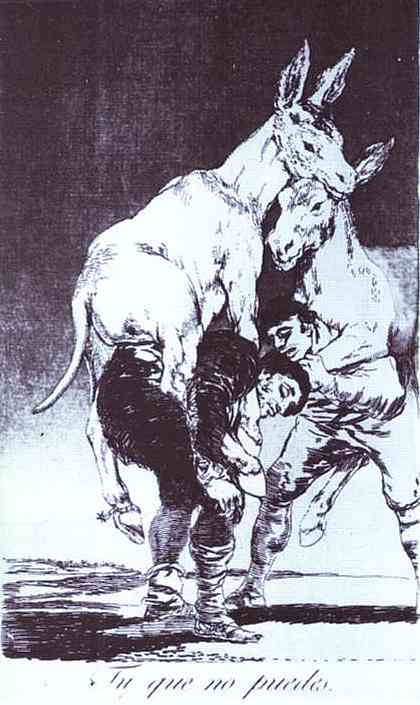
Capricho 42 'Tu que no puedes'
Capricho 42, titled '
Tu que no puedes', is a print created by Goya in the late 18th century as part of his series 'Los Caprichos'. This series consists of 80 prints that explore the human condition and society's vices. The title 'Tu que no puedes' translates to 'You who cannot', which suggests a critique of those who are unable or unwilling to see reality for what it is.
Interpretation
In this print, Goya depicts a scene where a group of people are gathered around a man who is holding a lantern, illuminating the darkness. The central figure appears to be a monk or a priest, and he seems to be pointing towards something outside the frame. The other figures in the scene appear to be in various states of confusion or fear. The interpretation of this print is open to debate, but it is often seen as a commentary on the role of religion in society. Goya may be suggesting that religious leaders can sometimes obscure the truth rather than illuminating it. The title 'Tu que no puedes' could also be interpreted as a challenge to the viewer, urging them to look beyond appearances and confront reality.
Conclusion
Capricho 42 'Tu que no puedes' is just one example of Goya's profound influence on art history. His work continues to inspire artists and collectors today, and it remains an important part of the cultural heritage of Spain and the world. If you are interested in learning more about Francisco De Goya or his work, please visit our
artist page or browse our collection of
hand-made oil painting reproductions.
Bibliography