Francisco Goya (1746-1828): Explore the life & work of Spain's Romantic master. Known for portraits, dark satire & 'Disasters of War'. A pivotal figure in art history.
Chained Prisoner – A Study in Gothic Expression
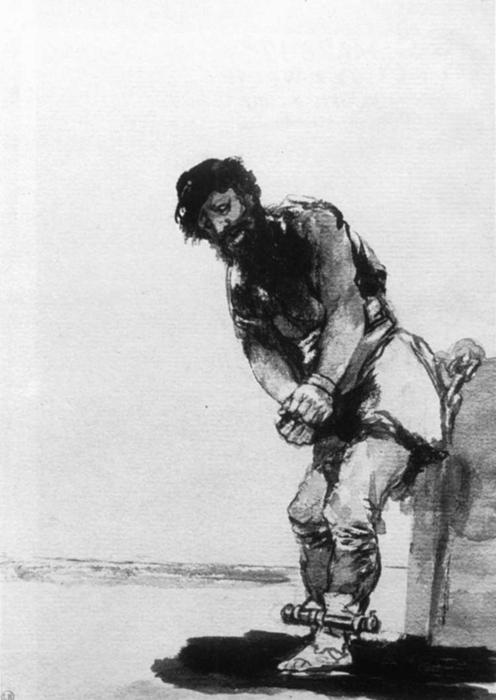
The drawing “Chained Prisoner,” executed by Francisco José de Goya y Lucientes in 1812, stands as a haunting testament to the Romantic spirit’s preoccupation with suffering and psychological torment. Born into a noble family in Fuendetodos, Spain, Goya’s artistic trajectory defied convention, propelling him from court painter to unflinching chronicler of social injustice—a path marked by both prodigious talent and profound disillusionment. This particular work embodies his signature style: a masterful blend of meticulous observation and emotionally charged rendering, firmly rooted in the traditions of Old Masters yet decisively pushing boundaries toward a more expressive form of art.
Composition and Technique – Mastering Line Drawing
The composition centers on a solitary figure imprisoned within chains—a motif recurrent throughout Goya’s oeuvre, particularly during his “Images of Spain” project. Positioned slightly off-center, the man’s posture exudes vulnerability and despair; his hands clasped behind his back emphasize the inescapable constraint imposed upon him. The background is deliberately muted, prioritizing the subject's presence and amplifying its dramatic impact. Goya achieves this effect through painstaking line drawing—primarily hatching and crosshatching—techniques that convey tonal variations with remarkable subtlety. Crisp lines delineate the contours of the man’s clothing and body, while denser hatching creates shadows that sculpt his form and imbue it with palpable emotion. The chains themselves are rendered with precision, symbolizing not merely physical imprisonment but also psychological oppression.
Symbolism – Echoes of Oppression and Human Vulnerability
Beyond its formal qualities, “Chained Prisoner” resonates deeply with symbolic significance. Inspired by the anxieties surrounding the Napoleonic Wars and the turbulent political landscape of Spain, Goya’s depiction aligns perfectly with his broader exploration of human vulnerability in the face of tyrannical power. The downward gaze of the imprisoned man—a characteristic gesture found across Goya's oeuvre—communicates profound sadness and resignation. More powerfully than any explicit statement, however, are the chains themselves: they represent restriction, loss of liberty, and the crushing weight of societal injustice – themes central to Romantic idealism and Goya’s unflinching critique of human condition.
Historical Context – The Shadow of Napoleon
Created during a period marked by Napoleonic invasion and political instability, “Chained Prisoner” reflects the pervasive atmosphere of fear and disillusionment that gripped Europe. Goya's artistic output during this era was profoundly influenced by his experiences witnessing the horrors of war firsthand—a formative influence evident in his unflinching portrayal of human suffering. The drawing’s stark monochrome palette underscores the bleakness of its subject matter, mirroring the emotional intensity of Romantic art’s preoccupation with darkness and despair. As a cornerstone of Goya's “Images of Spain,” it stands as an enduring emblem of artistic courage and a poignant reminder of humanity’s capacity for both cruelty and compassion.
Emotional Impact – A Portrait of Despair
Ultimately, "Chained Prisoner" succeeds in conveying a visceral emotional response. The artist’s masterful manipulation of line weight and shading captures the essence of anguish—a palpable sense of sorrow and hopelessness conveyed through subtle nuances of tonal variation. It's a piece that compels contemplation, inviting viewers to confront uncomfortable truths about human experience and prompting reflection on the enduring struggle for freedom against oppressive forces. This drawing exemplifies Goya’s ability to transform observation into profound artistic expression, securing its place as one of his most unforgettable creations.