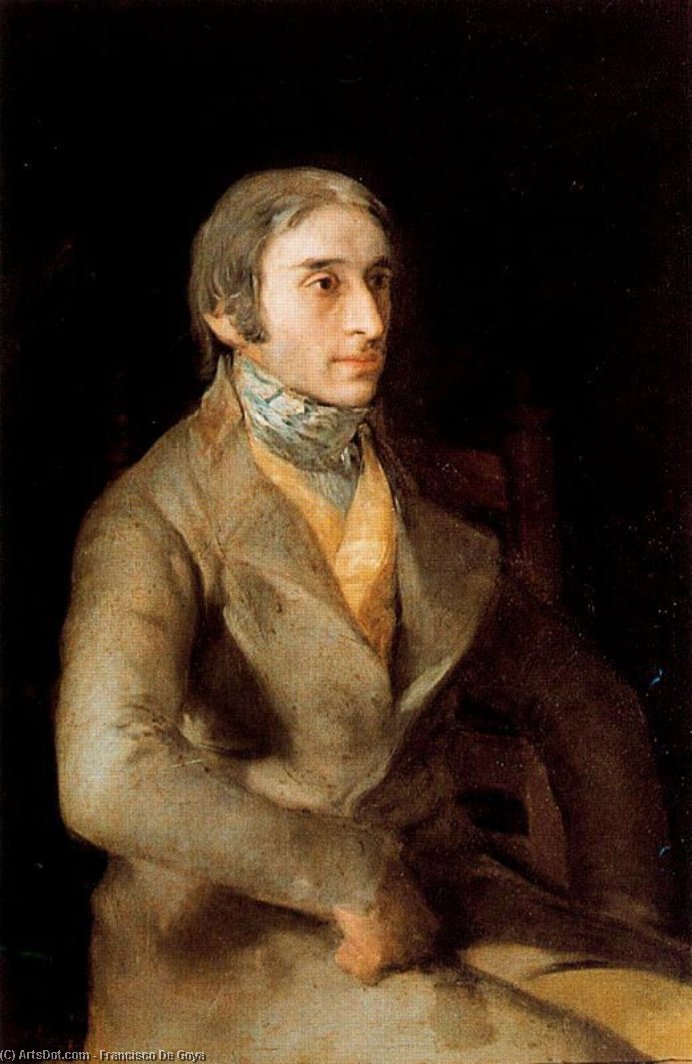
Don Manuel Silvela: A Portrait of Spanish Enlightenment
Francisco Goya’s *Don Manuel Silvela* (1812) is a compelling portrait that transcends mere representation, offering a glimpse into the intellectual and political climate of early 19th-century Spain. The painting depicts Don Manuel Silvela y García de Aragón, a prominent lawyer, writer, and magistrate, captured with Goya’s signature blend of realism and psychological insight.
Subject and Composition
The portrait presents Silvela seated, directly engaging the viewer with a confident gaze. He is dressed in formal attire – a dark suit and tie – suggesting his professional standing and perhaps alluding to an important occasion. The composition is relatively simple, focusing intently on the sitter. Two indistinct figures are visible in the background, subtly indicating Silvela’s social circle without distracting from the central subject. A couch and chair further define the interior setting, lending a sense of domesticity and intimacy despite the formality of the pose.
Style and Technique
Painted during Goya's mature period, *Don Manuel Silvela* exemplifies his evolving Romantic style. While retaining elements of Rococo elegance from his earlier court paintings, the work demonstrates a growing emphasis on psychological depth and emotional realism. Goya’s brushwork is loose and expressive, particularly in the rendering of the face and hands, conveying a sense of immediacy and vitality. His masterful use of light and shadow creates volume and emphasizes Silvela's features, highlighting his intelligence and character. The color palette is restrained yet rich, dominated by dark tones that contribute to the painting’s overall gravitas.
Historical Context
1812 was a pivotal year in Spanish history – the height of the Peninsular War and the brief period when Spain adopted its first liberal constitution. Silvela himself was a complex figure, navigating the turbulent political landscape as a magistrate during French occupation. He even established schools for exiled Spaniards in Bordeaux. Goya’s portrait, therefore, is not simply an individual likeness but also a reflection of this era of upheaval and change. It's believed that Goya and Silvela were both in exile in Bordeaux at the time, adding another layer to their connection.
Symbolism and Interpretation
The painting’s symbolism is subtle yet potent. Silvela’s direct gaze suggests intellectual honesty and unwavering conviction. His attire signifies his position within Spanish society, while the restrained background emphasizes his individual importance. The overall impression is one of a man of intellect, integrity, and quiet strength – qualities that would have been highly valued during a time of national crisis.
The portrait can be seen as an homage to Enlightenment ideals, representing reason, justice, and civic duty.
Emotional Impact & Collecting Considerations
*Don Manuel Silvela* evokes a sense of quiet dignity and intellectual power. The painting’s emotional resonance lies in its ability to capture the sitter's inner life – his thoughts, aspirations, and anxieties.
For collectors, this work represents a significant example of Goya’s portraiture, showcasing his technical skill and psychological insight.
Interior designers will appreciate the painting’s sophisticated color palette and its ability to add a touch of historical elegance to any space. A reproduction of *Don Manuel Silvela* would serve as a striking focal point in a study, library, or formal living room, inviting contemplation and sparking conversation. The artwork's enduring appeal lies in its timeless depiction of human character and its connection to a pivotal moment in Spanish history.
Further Exploration
- Explore other portraits by Goya to appreciate his evolving style.
- Research the historical context of early 19th-century Spain to gain a deeper understanding of Silvela’s life and times.
- Consider how Goya's work influenced subsequent generations of artists.