Francisco Goya (1746-1828): Explore the life & work of Spain's Romantic master. Known for portraits, dark satire & 'Disasters of War'. A pivotal figure in art history.
Gone for Good: A Study in Dramatic Monochrome
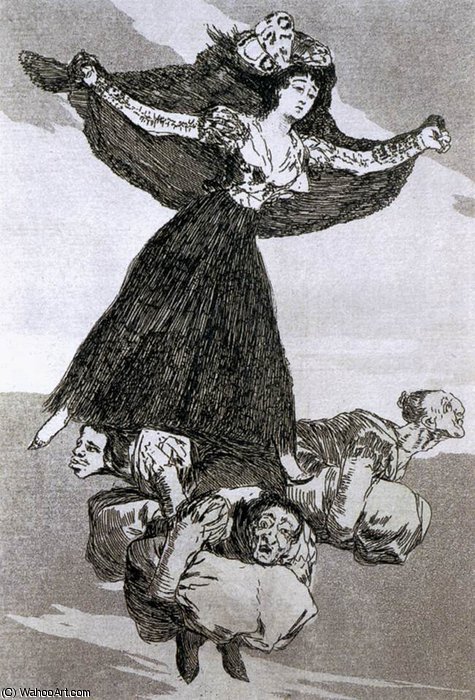
Francisco José de Goya y Lucientes’s “Gone for Good,” etched and aquatinted on paper, stands as a haunting testament to the artist's unflinching gaze upon human suffering and societal critique. Completed around 1799 during his prolific period of artistic experimentation—a time marked by both profound personal turmoil and an urgent engagement with the political landscape of Spain—the print embodies Goya’s signature Romantic style, characterized by expressive lines and a masterful manipulation of tonal gradation. It's more than just an image; it’s a psychological portrait rendered in stark grayscale, inviting contemplation on themes of dominance, oppression, and the precariousness of human existence.
Composition and Technique: Pyramidal Power and Textured Detail
The artwork employs a pyramidal compositional structure, elevating a woman—likely representing authority or power—to the apex. Below her lies a chaotic arrangement of figures, depicted in hatching and crosshatching techniques that imbue them with palpable texture – suggesting degradation and vulnerability. This deliberate imbalance underscores Goya’s intention to convey instability and challenge conventional notions of hierarchy. The artist's meticulous attention to detail is evident in the expressive lines defining forms and creating movement; jagged edges contribute to an unsettling atmosphere, mirroring the emotional intensity of the scene. Aquatint, a printing technique that utilizes resin particles embedded in etching plates, allows for nuanced tonal variations—from deep blacks to delicate grays—creating a visual depth that transcends mere representation.
Symbolism and Emotional Resonance: Allegory of Control
“Gone for Good” operates on multiple symbolic levels, prompting viewers to consider the broader implications of social commentary. The woman’s commanding posture speaks to themes of control and subjugation, while the figures beneath her represent the oppressed masses—a recurring motif in Goya's oeuvre. The grayscale palette amplifies the artwork’s emotional impact, stripping away color to heighten its psychological resonance. The diffused lighting reinforces this flatness, prioritizing graphic quality over illusionistic realism. The image evokes feelings of unease and discomfort, mirroring Goya’s own anxieties about the moral decay of his era.
Historical Context: Romanticism's Shadow
Goya produced “Gone for Good” during Spain’s tumultuous Napoleonic Wars—a period marked by political upheaval and social unrest. His artistic output reflects this turbulent climate, aligning with the broader currents of Romanticism—an aesthetic movement that championed emotion and individualism above reason and formalism. Like many Romantic artists, Goya sought to confront uncomfortable truths about human nature and societal injustices, utilizing art as a vehicle for critique and catharsis. The print’s enduring power lies in its ability to capture the spirit of its time—a moment of profound disillusionment and yearning for liberation.
Provenance and Legacy: A Masterpiece Revisited
“Gone for Good” entered the collections of Wildenstein and Minneapolis Institute of Art before finding its way into the NMWA's holdings, cementing its place as a cornerstone of Goya’s artistic legacy. Exhibited extensively throughout Europe and North America, it continues to inspire artists and scholars alike—a testament to Goya’s unparalleled ability to distill complex emotions into visually arresting images. Its meticulous etching and aquatint technique remains remarkably relevant today, demonstrating the enduring power of printmaking as a medium for conveying profound artistic vision.