J'Apprends Encore – A Reflection on Resilience and Artistic Evolution
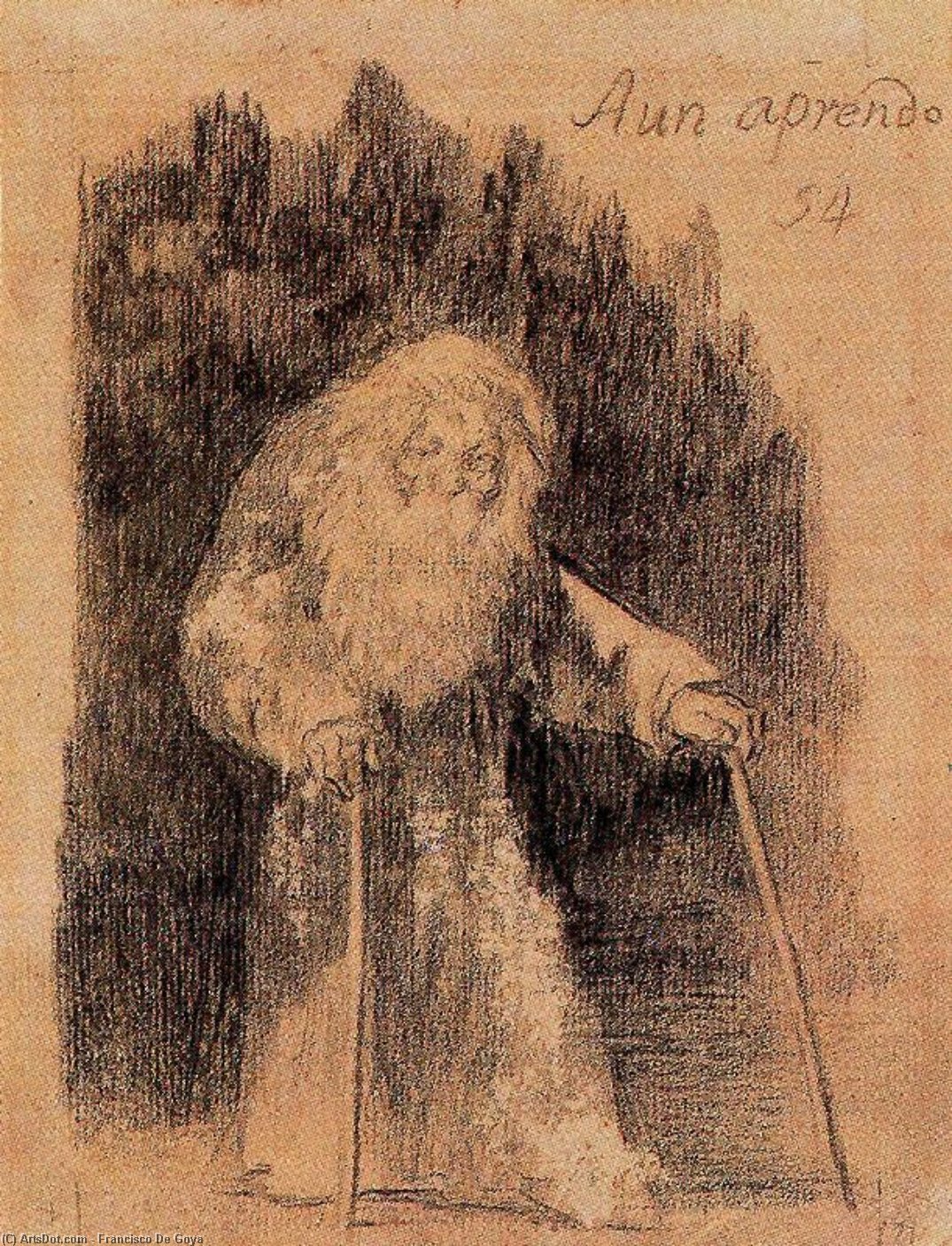
Francisco José de Goya y Lucientes’ “J’Apprends Encore,” a deceptively simple black and white drawing, transcends its modest dimensions (27 x 75 mm) to deliver a profound statement about the enduring spirit of creativity and confronting age. Executed in an exquisite filigree technique—specifically utilizing the Amsterdam shield motif with a cross of Saint Andrew—the artwork embodies Goya’s signature Romantic style, marking it as a cornerstone of Spanish art history.
The drawing depicts an elderly man, rendered with meticulous detail, leaning heavily on two canes. His gaze is upward, suggesting contemplation and perhaps a quiet acceptance of passing time. The inclusion of a staff reinforces this theme of perseverance—a visual metaphor for continuing to strive forward despite physical limitations. Goya’s masterful draughtsmanship captures not merely the physicality of his subject but also an inner state of vulnerability combined with unwavering determination.
Goya's artistic journey began in Fuendetodos, Spain, where he honed his skills under José Luzán y Martinez and Anton Raphael Mengs—influences that instilled in him a foundational understanding of classical composition. This early training contrasted sharply with the anxieties and expressive liberty characteristic of Romanticism, which Goya would champion throughout his prolific career.
The drawing’s symbolism is layered yet understated. The Amsterdam shield motif, frequently employed by Parisian papermakers during Goya's time—particularly Bouygar—represents stability and heritage alongside a Christian emblem – the cross of Saint Andrew – symbolizing faith and spiritual fortitude. This deliberate pairing underscores the artwork’s central message: despite facing challenges inherent in later life, artistic exploration and learning continue to hold value.
Furthermore, “J’Apprends Encore” aligns with Goya's broader oeuvre, which documented both grandeur and suffering—a duality that defines his artistic vision. Like many of his drawings from the Bordeaux Albums, it reflects a preoccupation with human experience, capturing not just physical appearance but also psychological depth. It stands as a testament to Goya’s ability to distill complex emotions into a single image, inviting viewers to contemplate themes of aging, resilience, and the transformative power of continued artistic endeavor.
The meticulous filigree technique—a hallmark of Goya's handiwork—adds another dimension to its aesthetic impact. This delicate process ensured exceptional clarity and precision in capturing every nuance of form and texture, demonstrating Goya’s unwavering commitment to technical mastery. Reproductions of “J’Apprends Encore” offer a captivating glimpse into the artistic legacy of one of Spain’s most influential figures.