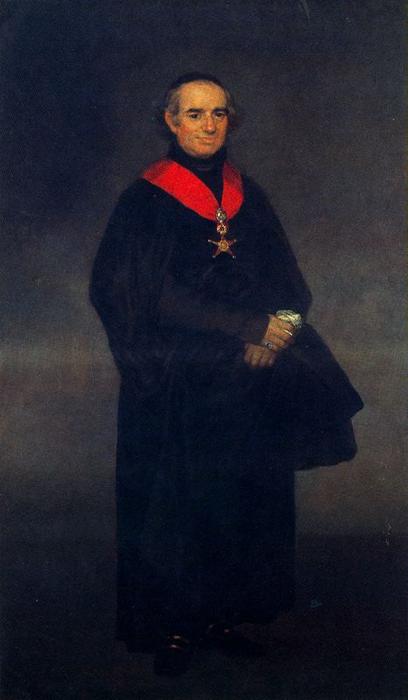
A Portrait of Influence: Juan Antonio Llorente by Francisco Goya
This striking black and white photograph captures a moment frozen in time – a portrait of Juan Antonio Llorente, meticulously rendered by the masterful hand of Francisco de Goya. The image presents a man of evident stature, draped in a formal cape and adorned with a red ribbon, suggesting a position of authority, perhaps within the clergy or academia. His clasped hands convey a sense of solemnity and poise, indicative of someone accustomed to being observed and respected.
Goya’s Style & Technique
While often celebrated for his paintings, Goya's foray into portraiture through mediums like this photograph (or more likely, early photographic processes influenced by his artistic eye) demonstrates his versatility. The composition is classically structured, reminiscent of the formal portraiture prevalent in the 18th and 19th centuries. Goya’s skill lies not just in *representation*, but in capturing a psychological depth within his subjects. Though a photograph, it echoes Goya's painterly approach to light and shadow – creating volume and emphasizing the subject’s features with subtle yet effective contrast. The vintage quality of the image adds another layer of texture and intrigue.
Historical Context & The Subject
Juan Antonio Llorente (1756-1823) was a fascinating, and at times controversial, figure in Spanish history. A priest turned historian, he served as secretary to the Spanish Inquisition before dramatically shifting allegiances during the Napoleonic Wars. He became a staunch supporter of Joseph Bonaparte, leading him into exile after Ferdinand VII’s restoration. Llorente is best known for his groundbreaking *Historia crítica de la inquisición de España*, a meticulously researched and damning account of the Spanish Inquisition – a work that challenged established narratives and sparked considerable debate. Goya's portrait, therefore, isn't merely an image of a man; it’s a depiction of someone who dared to question power and rewrite history. The timing of this portrait is crucial, likely created during Llorente’s period of influence or shortly thereafter, reflecting Goya’s engagement with the intellectual currents of his time.
Symbolism & Interpretation
- The Cape: Symbolizes authority and status, common in depictions of important figures.
- The Red Ribbon: Its color could signify religious affiliation (if representing a clerical order) or denote an honor bestowed upon Llorente.
- Clasped Hands: Suggest composure, piety, and perhaps a degree of self-assurance – or even defensiveness.
- The Gaze: Llorente’s direct gaze engages the viewer, inviting contemplation about his character and motivations.
Emotional Impact & Aesthetic Appeal
This portrait evokes a sense of gravitas and intellectual curiosity. It's not merely a likeness; it’s an invitation to delve into the life and times of a man who challenged convention. The image possesses a timeless quality, making it suitable for a variety of interior design styles – from traditional studies to modern minimalist spaces. The monochromatic palette lends itself well to creating a sophisticated and contemplative atmosphere.
It's a piece that speaks to those who appreciate history, intellectual courage, and the power of portraiture to capture not just appearance, but essence.
Collecting & Reproduction
As an original Goya work, this portrait is exceptionally rare and valuable. High-quality reproductions offer an accessible way to bring a piece of art history into your home or office. Consider framing the reproduction with a classic matte black frame to complement the monochromatic tones and enhance its historical feel. This image would be particularly impactful in libraries, studies, or any space designed to inspire thought and conversation.