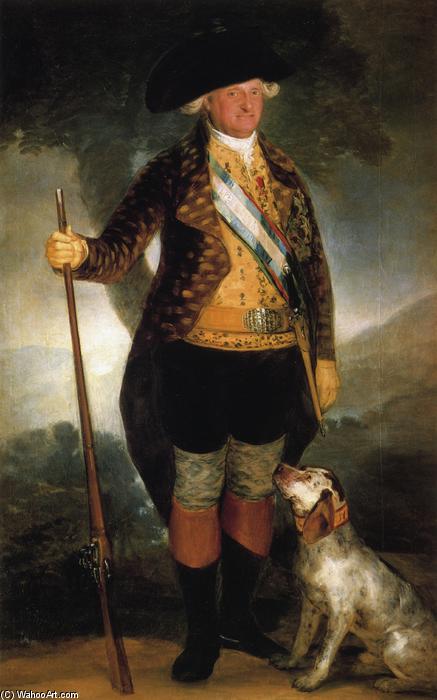
King Carlos IV in Hunting Costume
Francisco de Goya’s “King Carlos IV in Hunting Costume” stands as a cornerstone of Romanticism, capturing not merely a portrait but an essence of aristocratic life and the anxieties of its time. Painted in 1799, this monumental oil on canvas resides at the Palacio Real (Madrid, Spain), offering viewers a glimpse into Goya’s masterful command of artistic vision and technique. More than just depicting a king engaged in his leisure activity—hunting—the painting delves into themes of power, vulnerability, and the encroaching shadow of societal change.
Artistic Style and Period
The Romantic movement rejected Neoclassical ideals of reason and order, favoring emotion, imagination, and individualism. Goya’s decision to employ oil paint on canvas – a technique favored for its luminosity and ability to convey texture – perfectly embodies this stylistic shift. Unlike the polished surfaces of earlier portraits, “King Carlos IV” presents a palpable sense of atmosphere, mirroring the rugged beauty of the Spanish countryside. The brushstrokes are loose and expressive, prioritizing feeling over precise representation, reflecting the Romantic preoccupation with capturing subjective experience.
Composition and Details
Measuring 210 x 130 cm, the painting’s scale immediately commands attention. Goya meticulously arranges his subjects within a carefully constructed landscape backdrop. King Carlos IV is positioned centrally, dominating the frame with regal composure, yet he's subtly undermined by the presence of a hunting dog at his feet—a symbol of loyalty and subservience, but also hinting at the animal kingdom’s inherent unpredictability. The inclusion of two additional figures – one partially obscured in the upper left corner and another positioned on the lower right – adds depth to the composition and creates a dynamic interplay between human and natural elements. These subtle additions aren't merely decorative; they contribute to Goya’s exploration of narrative and psychological complexity.
Artistic Significance
Goya’s work is renowned for its unflinching realism, particularly evident in his depiction of human anatomy and emotion. “King Carlos IV” exemplifies this commitment to portraying subjects with honesty and sensitivity. The artist skillfully blends portraiture with landscape, creating a harmonious balance that elevates the painting beyond a simple likeness. Goya's gaze directs towards the viewer, inviting contemplation on themes of nobility, duty, and perhaps even melancholy—a characteristic mood prevalent in Romantic art.
Other Notable Works by Francisco De Goya
Goya’s prolific artistic career produced an astonishing array of masterpieces spanning genres from history painting to etchings and prints. Among his most celebrated works are “The Duke of Osuna and His Family,” a haunting portrayal of aristocratic decadence; “The Fair at Madrid,” capturing the vibrant energy of Spanish society; and “Queen María Luisa Wearing a Mantilla,” showcasing regal elegance and grace. For those seeking further insight into Goya’s artistic legacy, "The Museum Escuelas Pias De España Tercera Demarcacion (Madrid, Spain)" offers invaluable resources for exploring his oeuvre and its broader historical context. At
ArtsDot, we pride ourselves on offering exceptional reproductions of Goya's paintings—hand-painted masterpieces that bring the artist’s vision to life in stunning detail. Explore our collection today and discover the beauty of Romantic art!