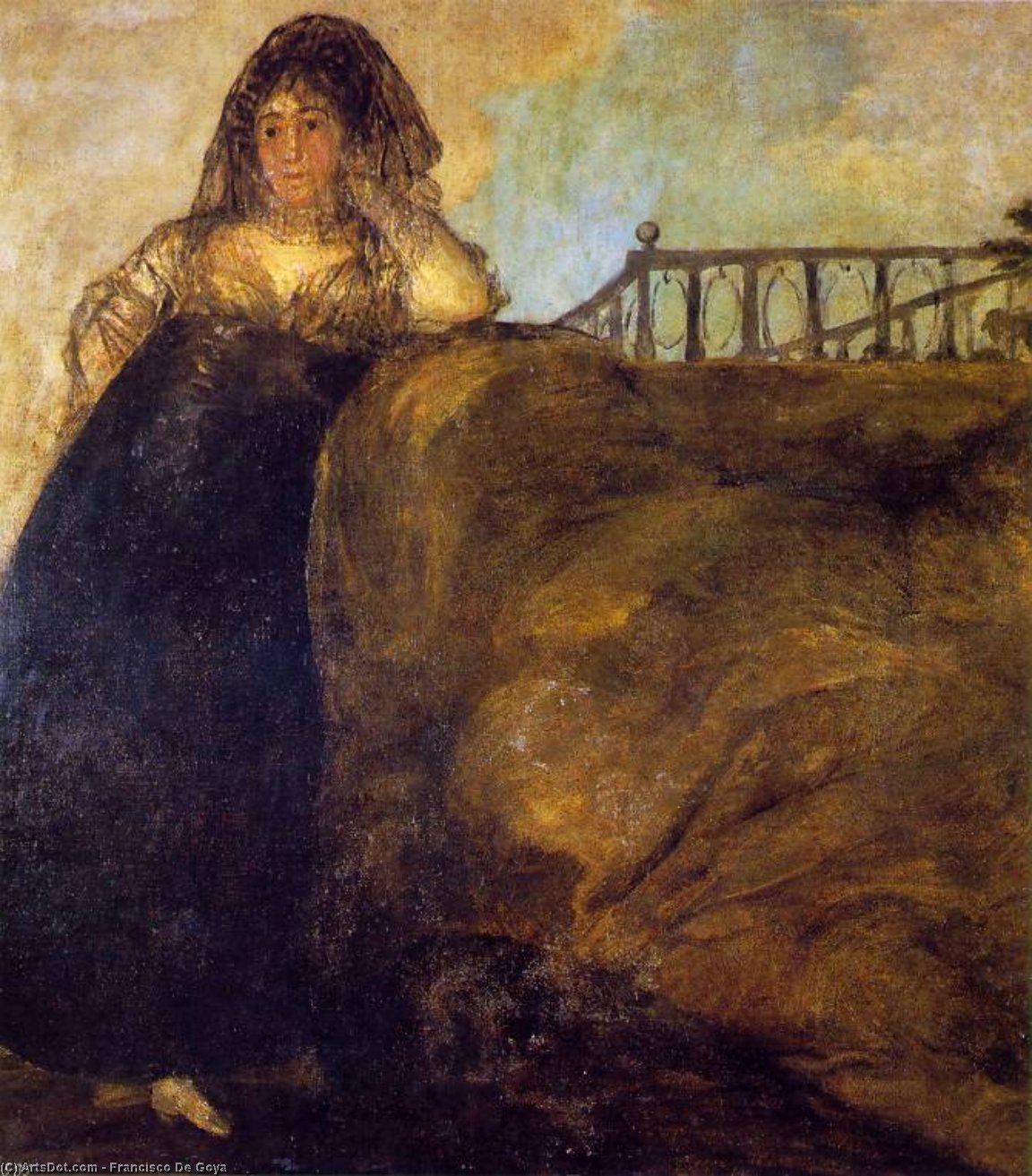
Discover Francisco Goya's haunting 'Leocadia,' a poignant Black Painting exploring themes of love, loss, and the human condition. A masterpiece of Romanticism.
Francisco Goya (1746-1828): Explore the life & work of Spain's Romantic master. Known for portraits, dark satire & 'Disasters of War'. A pivotal figure in art history.
Leocadia: A Portrait of Melancholy in Goya’s Black Paintings
Francisco de Goya's *Leocadia*, painted between 1819 and 1823, is not merely a portrait; it’s a haunting meditation on love, loss, and the shadowed corners of the human heart. Created during a turbulent period in Goya’s life – marked by political upheaval, deafness, and profound personal sorrow – this mural, now housed within the Quinta del Sordo, his secluded country estate near Madrid, embodies the artist's signature shift towards darker, more emotionally charged themes. The painting immediately draws the viewer into a scene of quiet contemplation, dominated by a woman seated on a weathered rock, her face averted and her hands gently resting upon her head. This deliberate concealment, coupled with the somber palette and the stark simplicity of the composition, speaks volumes about the subject’s inner state – a poignant expression of grief and perhaps even resignation.
The painting's genesis is inextricably linked to Goya’s relationship with Leocadia Weiss, his maid and a woman significantly younger than himself. Rumors swirled around their connection, fueled by whispers of an illicit affair and the subsequent separation from her husband, Isidore. While the exact nature of their bond remains debated – some scholars suggest a purely platonic affection, others hint at a deeper, more passionate entanglement – *Leocadia* undeniably captures the complex emotions associated with this unconventional relationship. The figure’s posture, the slight slump of her shoulders, and the downward gaze all convey a sense of profound sadness, as if burdened by unspoken sorrows. The dark dress she wears, reminiscent of funeral attire, further reinforces this atmosphere of mourning.
Beyond its intimate narrative, *Leocadia* is a quintessential example of Goya’s Romanticism. The painting diverges sharply from the idealized depictions of aristocratic subjects that characterized much of his earlier court portraiture. Instead, he presents an ordinary woman in a humble setting, stripped bare of artifice and confronted with her own vulnerability. This shift reflects the Romantic movement's fascination with the emotional experience, the power of nature, and the exploration of darker aspects of human existence. The background, featuring a simple metal fence or railing – a recurring motif in Goya’s Black Paintings – provides a stark contrast to the woman’s isolation, emphasizing her solitude and vulnerability. The subtle inclusion of birds, one perched near the top left corner and another on the right side, adds an element of natural beauty that paradoxically underscores the scene's melancholy mood; they are witnesses to her quiet despair.
Furthermore, *Leocadia* is deeply rooted in Goya’s broader artistic context. His Black Paintings, created largely during his self-imposed exile from Madrid, were painted directly onto the walls of his home, utilizing a technique that allowed for immediate and expressive application of paint. This immediacy is evident in the raw emotion conveyed through the brushstrokes and the intense colors. Goya’s work shares thematic resonances with other Romantic artists like Eugène Delacroix and Caspar David Friedrich, who similarly explored themes of mortality, disillusionment, and the sublime power of nature. The influence of Francisco de Goya's earlier works, such as *The Colossus* and *The Drunk Mason*, which often depicted everyday people in unsettling or psychologically complex situations, is also palpable. His exploration of human psychology, particularly the darker aspects of the human condition, anticipates many of the concerns that would later define Expressionism.
Artistic Technique and Composition
Goya’s masterful use of light and shadow contributes significantly to the painting's emotional impact. The muted palette – dominated by dark browns, grays, and blues – creates a sense of gloom and foreboding. However, a subtle yellow light illuminates the woman’s face and hands, drawing attention to her features and emphasizing her vulnerability. The composition is remarkably simple yet powerfully effective. The figure's placement on the rock establishes a sense of groundedness while simultaneously isolating her from the viewer. The averted gaze reinforces this feeling of detachment and introspection. Goya’s loose brushwork and expressive application of paint further enhance the painting’s raw emotional intensity, creating a visceral experience for the viewer.
Symbolism and Interpretation
The symbolism within *Leocadia* is layered and open to interpretation. The rock upon which she sits could represent both stability and isolation, while the metal fence or railing in the background may symbolize confinement or the barriers that separate her from society. Some scholars have suggested that the painting reflects Goya’s own feelings of disillusionment with the Spanish monarchy and his growing sense of alienation from the world around him. The woman's posture and expression evoke a range of emotions, including sadness, resignation, and perhaps even a hint of defiance. The very act of concealing her face suggests a desire to protect herself from judgment or vulnerability.
Reproductions and Legacy
Handmade oil paintings reproductions of *Leocadia* are now available through ArtsDot.com, offering art lovers the opportunity to own a piece of this iconic work. These meticulously crafted reproductions capture the painting’s rich textures, dramatic lighting, and emotional intensity with remarkable fidelity. As seen on ArtsDot.com, these reproductions allow viewers to experience Goya's masterpiece in their own homes, fostering a deeper appreciation for his artistic genius and the profound insights he offered into the human condition. The work continues to resonate today as a powerful testament to the enduring power of art to capture and convey the complexities of human emotion. It stands as a poignant reminder of Goya’s ability to transform personal experiences into universal expressions of sorrow, longing, and the search for meaning in a world often marked by darkness and uncertainty.