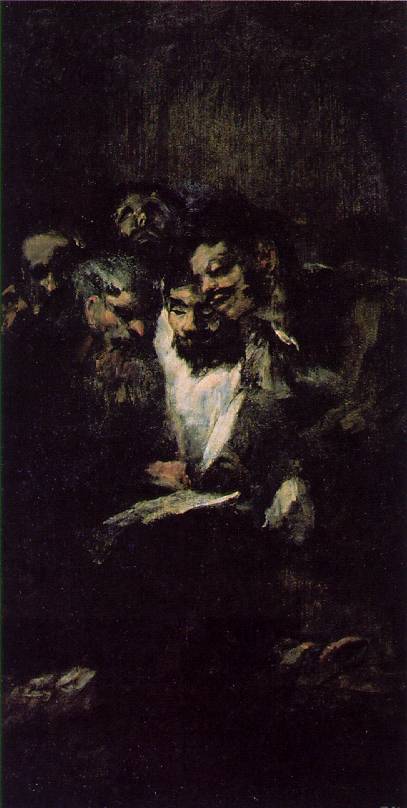
Men Reading: A Study in Dramatic Silence
Francisco José de Goya y Lucientes’ “Men Reading,” completed in 1823, stands as a haunting testament to the artist's final years and a profound meditation on human intellect amidst encroaching darkness. Painted during a period of debilitating illness and disillusionment with Spain’s political trajectory – a time when Goya wrestled with physical pain alongside spiritual torment – this fresco embodies the essence of his signature style: raw emotion conveyed through masterful technique and unsettling visual language. Located within the Quinta del Sordo, Goya's solitary retreat outside Madrid, “Men Reading” is not merely a depiction of men engaged in scholarly pursuits; it’s an exploration of contemplation, secrecy, and the psychological burden of knowledge.
- Composition & Perspective: The painting’s tightly cropped frame immediately establishes a claustrophobic atmosphere, mirroring Goya's own confinement during his illness. Figures are densely packed, overlapping subtly to create a sense of immediacy and unease. Notably, the flattened perspective eschews traditional spatial depth, prioritizing intimacy and focusing the viewer’s gaze on the faces of the participants – a deliberate choice that amplifies their expressions and underscores the painting’s emotional core.
- Color Palette & Lighting: Strikingly monochromatic in shades of gray, black, and white, “Men Reading” rejects opulent color schemes characteristic of earlier Baroque art. This austere palette serves to heighten dramatic contrasts between light and shadow, originating from an unseen source above or to the left. The chiaroscuro technique – Goya’s masterful manipulation of tonal values – sculpts the figures' forms and casts deep shadows across their faces, conveying a palpable sense of melancholy and introspection.
- Technique & Texture: Executed in oil paint on canvas, “Men Reading” showcases Goya’s distinctive impasto technique—thickly applied paint that creates visible brushstrokes and textural irregularities. These marks aren't merely accidental; they actively contribute to the painting’s physicality and imbue it with a visceral quality, mirroring the artist’s own suffering and conveying a sense of urgency.
- Style & Symbolism: “Men Reading” firmly anchors itself within Goya’s late Romantic style, rejecting academic conventions in favor of expressive lines and emotionally charged imagery. The painting's symbolism is subtle yet potent—the enclosed space representing intellectual isolation, while the shadowed faces hinting at hidden anxieties and unspoken truths. It speaks to a broader theme of human vulnerability confronting the complexities of thought and societal pressures.
- Historical Context: Created during Spain’s turbulent reign under Ferdinand VII – a period marked by repression and censorship – “Men Reading” reflects Goya's profound disillusionment with political authority. The painting serves as a poignant commentary on the dangers of conformity and celebrates the courage to pursue intellectual freedom despite societal constraints, cementing its place as an enduring emblem of artistic defiance.
Salvador Martínez Cubí’s masterful transfer of Goya's fresco onto canvas ensures that this iconic artwork continues to captivate audiences today.