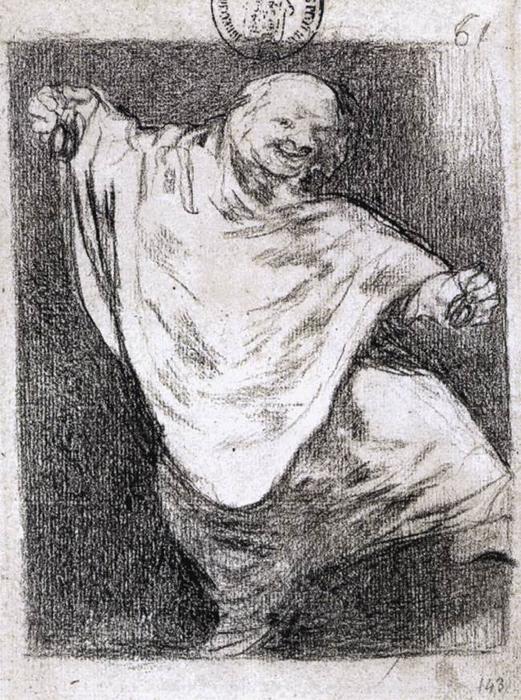
Francisco José de Goya y Lucientes: Phantom Dancing with Castanets
Francisco José de Goya y Lucientes, a name synonymous with the twilight of Spanish Romanticism and the dawn of modern art’s darker impulses, remains one of the most profoundly influential figures in European painting. Born in 1746 amidst the pastoral landscapes of Fuendetodos, Aragon, his artistic journey charted an extraordinary course from provincial draftsman to court painter—a role that paradoxically afforded him unparalleled access to both aristocratic patronage and the turbulent currents of political upheaval.
“Phantom Dancing with Castanets,” created circa 1824-1828, encapsulates Goya’s distinctive late style – a style characterized by an unsettling blend of observation and imagination, informed by his experiences documenting the Peninsular War. This drawing isn't merely a depiction; it’s a psychological portrait rendered in graphite and charcoal on paper, reflecting Goya’s preoccupation with human vulnerability and societal decay.
Composition & Technique: A Dance Between Light and Shadow
The artwork’s central focus is an elderly man engaged in vigorous dancing. Positioned at a slight angle, he dominates the frame, conveying dynamism despite his age. Goya employs rapid, expressive lines to delineate the figure's form—lines that eschew meticulous precision for a looser, gestural quality—a hallmark of his artistic temperament. The minimal background is sculpted by tonal shading, establishing depth and enhancing the dramatic effect.
Hatching and cross-hatching techniques are skillfully utilized to generate texture and volume, particularly evident in the robe and face. These meticulous marks create a palpable sense of physicality, mirroring Goya’s fascination with capturing fleeting moments of human behavior. The placement of light—originating from the upper left—casts shadows on the right side of the figure, highlighting facial features and emphasizing the contours of his clothing.
Symbolism & Emotional Resonance: Madness and Joyful Abandon
Beyond its formal execution, “Phantom Dancing with Castanets” resonates with potent symbolic meaning. The man’s open mouth and wide eyes convey an expression of manic glee—a jarring juxtaposition that speaks to Goya's exploration of human folly and the darker side of existence. The flowing robe symbolizes freedom and movement, yet simultaneously hints at vulnerability and disorientation.
The castanets themselves – percussion instruments traditionally used in flamenco music – serve as a visual motif representing rhythm, dance, and perhaps even delusion. Together, they contribute to an unsettling atmosphere that compels contemplation on themes of sanity versus madness, beauty versus grotesque horror—themes central to Goya’s artistic vision.
Historical Context & Artistic Legacy
Created during the waning years of Goya's life and amidst the horrors of the Napoleonic Wars, “Phantom Dancing with Castanets” embodies the anxieties of its time. It stands as a testament to Goya’s ability to transform personal observation into universal commentary on human condition—a feat that cemented his position as one of the progenitors of Romanticism and profoundly influenced subsequent generations of artists.
This drawing, meticulously reproduced in high-quality prints by ArtsDot.com, offers a captivating glimpse into Goya’s artistic genius and invites viewers to engage with the complexities of human emotion and experience. Its enduring power lies not only in its masterful technique but also in its unsettling portrayal of the human psyche—a portrait that continues to fascinate and provoke discussion today.