A Surreal Encounter: Unpacking Francisco Goya’s “Pretty Teacher”
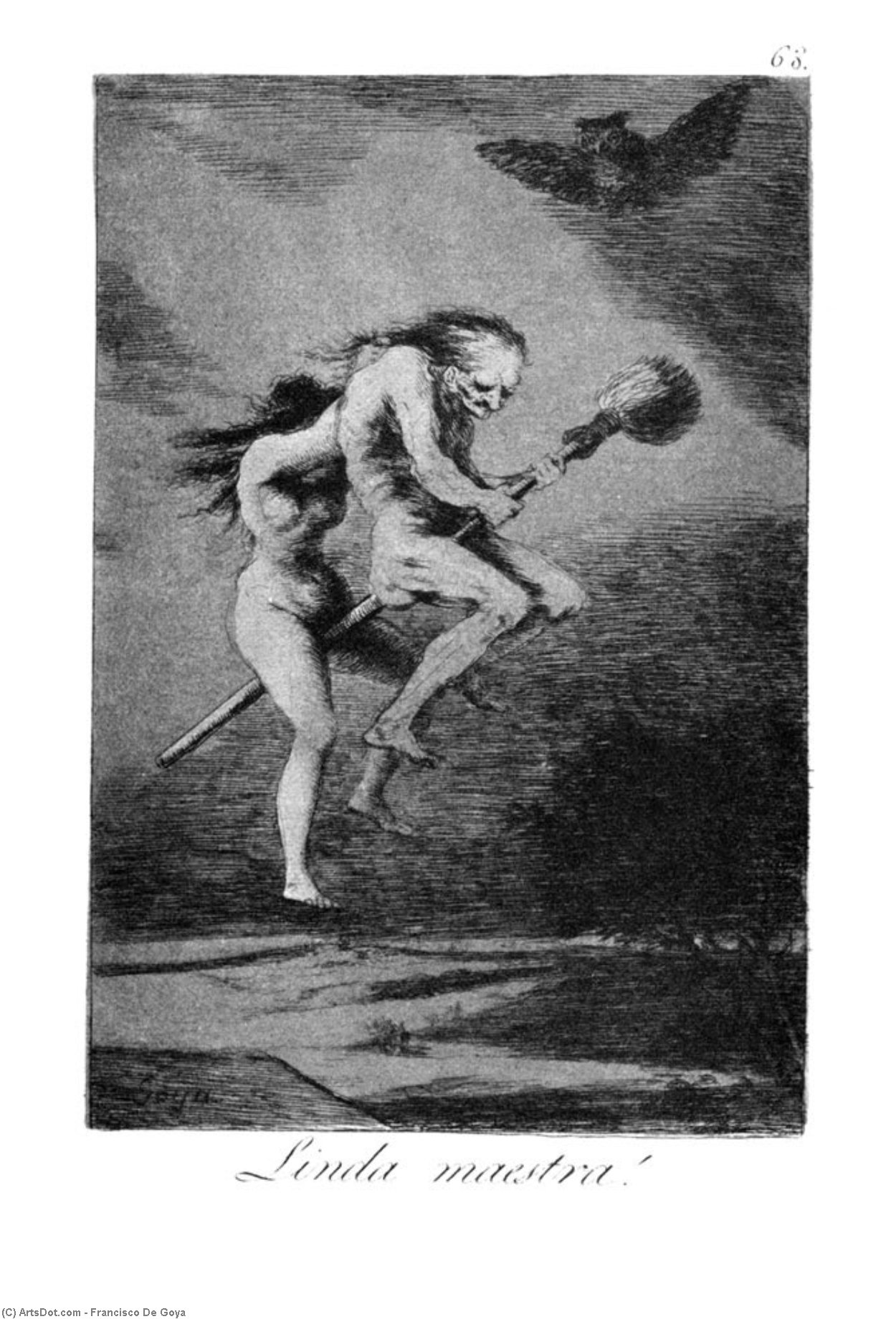
Francisco José de Goya y Lucientes' "Pretty Teacher" (1799) is not merely an etching; it’s a carefully constructed visual riddle, a haunting tableau that invites endless interpretation. This captivating work, now meticulously reproduced by ArtsDot.com, transcends the limitations of its monochrome palette and drypoint technique to deliver a potent blend of folklore, social commentary, and unsettling psychological depth. Initially conceived as part of Goya's “Los Caprichos,” a series of satirical prints critiquing Spanish society, "Pretty Teacher" stands alone as a powerful exploration of female agency, superstition, and the precarious boundaries between innocence and corruption.
The scene unfolds with arresting dynamism: a young woman, seemingly caught mid-flight on a broomstick, is guided by a cackling witch. Birds circle overhead, adding to the dreamlike quality of the composition. Goya’s masterful use of diagonal lines—the sweeping arc of the broom, the figure's tilted posture—creates an immediate sense of movement and instability. The background isn’t a simple landscape; it’s a swirling vortex of hatching and cross-hatching, suggesting turbulent skies or perhaps the chaotic realm of witchcraft itself. Notice how Goya employs varying line weights – bold outlines defining the central figure and broom, delicate lines rendering the feathers and atmospheric haze – demonstrating his exceptional control over the etching process.
Decoding Symbolism: Witchcraft, Innocence, and Social Critique
The title itself is deliberately ironic. The “pretty teacher” isn’t conventionally attractive; she's depicted with a partially concealed face, hinting at shame or perhaps a nascent corruption. Goya frequently used the figure of the witch in his work, but here, it’s not simply a monstrous stereotype. Instead, he presents a complex scenario – is this woman being initiated into a dark practice, or is she actively choosing her path? The presence of the night owl (a Spanish term for prostitute) adds another layer of intrigue, suggesting a connection between female sexuality and the supernatural. Art historians often interpret this print as a critique of societal pressures on women during the late 18th century, where traditional roles were increasingly challenged.
The etching’s overall atmosphere is profoundly unsettling. Goya's skillful manipulation of light and shadow – achieved through meticulous hatching – creates a dramatic effect, emphasizing the figure’s vulnerability and the witch’s menacing presence. The open mouth and wide eyes of the young woman convey surprise, fear, or perhaps even a disturbing acceptance of her fate. The use of monochrome amplifies this sense of unease, stripping away any potential distractions and focusing attention on the raw emotion conveyed through line and tone.
Technique and Craftsmanship: A Masterclass in Etching
"Pretty Teacher" is a testament to Goya’s extraordinary technical skill. As an etching, it relies entirely on the artist's ability to manipulate lines – scratching into a copper plate with etching needles, then carefully applying ink before pressing the print onto paper. The resulting texture is remarkably rich and varied, ranging from the dense, grainy hatching that defines the background to the smoother areas where lines are less concentrated. This textural contrast not only adds visual interest but also contributes significantly to the sense of dynamism within the composition.
The meticulous layering of aquatint – a technique used to create tonal variations – further enhances the print’s depth and atmosphere. Goya's mastery of these techniques is evident in every detail, from the precise rendering of the birds’ feathers to the swirling patterns of the background. The reproduction offered by ArtsDot.com faithfully captures this intricate craftsmanship, allowing viewers to appreciate the full beauty and complexity of Goya’s original work.
Bringing “Pretty Teacher” Home: A Reproduction for Collectors
ArtsDot.com's hand-painted reproductions offer a unique opportunity to own a stunning representation of this iconic etching. Unlike traditional prints, our reproductions capture the nuances of Goya’s style with unparalleled accuracy and detail, faithfully recreating the print’s dramatic lighting, intricate textures, and haunting atmosphere. Whether you are an art collector, interior designer seeking a statement piece, or simply an admirer of Goya's genius, a ArtsDot reproduction of “Pretty Teacher” is a captivating addition to any collection – a window into the mind of one of history’s most visionary artists.