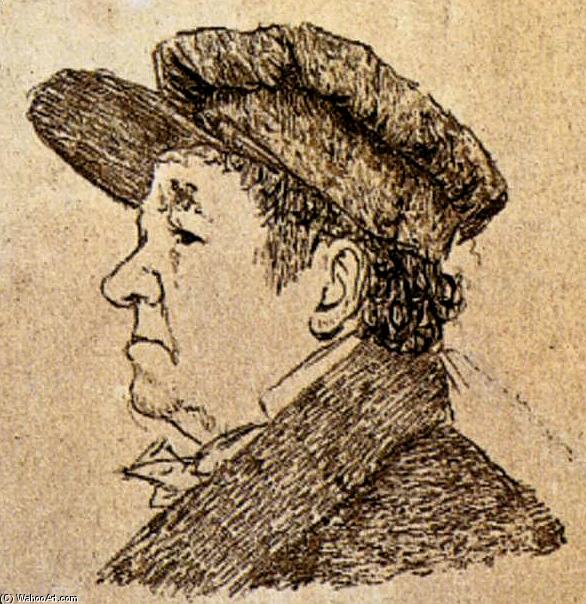
Delve into Goya’s poignant self-portrait—a masterful ink drawing capturing the artist's introspective gaze and embodying Romanticism’s emotive spirit. Explore this iconic piece from 1824, a testament to Goya’s enduring legacy and an invitation to enrich your art collection.
Francisco Goya (1746-1828): Explore the life & work of Spain's Romantic master. Known for portraits, dark satire & 'Disasters of War'. A pivotal figure in art history.
A Window Into Soul: Examining Francisco Goya’s Self Portrait
Francisco José de Goya y Lucientes (1746 – 1828), born in Fuendetodos, Spain, stands as a monumental figure in European art—a painter who simultaneously upheld artistic tradition and bravely confronted the anxieties of his time. His legacy transcends mere visual beauty; it resides in his unflinching portrayal of human experience, marked by both exquisite craftsmanship and profound psychological insight. This self-portrait, executed in 1824, isn’t simply a depiction of an aging artist—it's a meticulously crafted meditation on identity, vulnerability, and the inescapable burden of observation.
The Artistic Context: Romanticism’s Embrace of Emotion
Goya’s artistic trajectory mirrored the burgeoning Romantic movement, which rejected Neoclassical ideals in favor of subjective feeling and imaginative exploration. Unlike the polished surfaces and idealized forms favored by earlier generations, Romantic artists sought to capture the turbulent currents of human emotion—fear, despair, joy, passion—with uncompromising honesty. Goya's self-portrait embodies this ethos perfectly; it eschews conventional portraiture conventions, prioritizing a raw depiction of his inner state over an illusion of composure. The pervasive influence of thinkers like Rousseau and Wordsworth fueled a desire to express the complexities of human consciousness, rejecting didacticism for visceral experience—a stance powerfully articulated in Goya’s oeuvre.
Technical Mastery: Ink Drawing as Vehicle for Emotion
The medium chosen by Goya – ink drawing – speaks volumes about his artistic intentions. Unlike oil paint, which strives for illusionistic realism, ink offers a remarkable capacity to convey texture and nuance through subtle tonal variations. The artist skillfully utilizes hatching and cross-hatching techniques to sculpt the contours of his face and torso, creating an impression of depth and solidity that belies the simplicity of the materials involved. This deliberate restraint enhances the emotional impact of the image; it forces the viewer to confront the subject directly, fostering a sense of intimacy and vulnerability. The meticulous attention to detail—the furrowed brow, the downward gaze—suggests a man wrestling with internal demons, attempting to capture the essence of his own troubled spirit on paper.
Symbolism Within Simplicity: A Reflection of Inner Turmoil
Beyond its technical prowess, the Self Portrait is laden with symbolic significance. The artist’s posture – slumped shoulders and averted eyes – conveys a palpable sense of melancholy and introspection. The downward gaze isn't merely a stylistic choice; it symbolizes a preoccupation with mortality and an awareness of the limitations inherent in human perception. Furthermore, the inclusion of his beard and mustache—symbols of age and experience—underscores Goya’s contemplation of time’s passage and the inevitable decay that accompanies life. These subtle gestures invite viewers to consider not just what is seen but also what is felt—a testament to Goya's genius in transforming a seemingly straightforward depiction into a profound statement about the human condition.
Legacy and Resonance: An Inspiration for Contemporary Art
Goya’s Self Portrait continues to resonate with artists today, demonstrating the enduring power of psychological portraiture. Its influence can be traced across movements from Surrealism to Expressionism, where artists sought to convey inner turmoil and emotional intensity through unconventional techniques. The image serves as a reminder that art doesn't merely reflect reality; it interrogates it—challenging viewers to confront uncomfortable truths about themselves and the world around them. Like many Romantic masterpieces, Goya’s Self Portrait transcends its historical context, offering timeless insights into the complexities of human emotion and the enduring quest for self-understanding.