A Portrait of Vulnerability Amidst Brutal Force
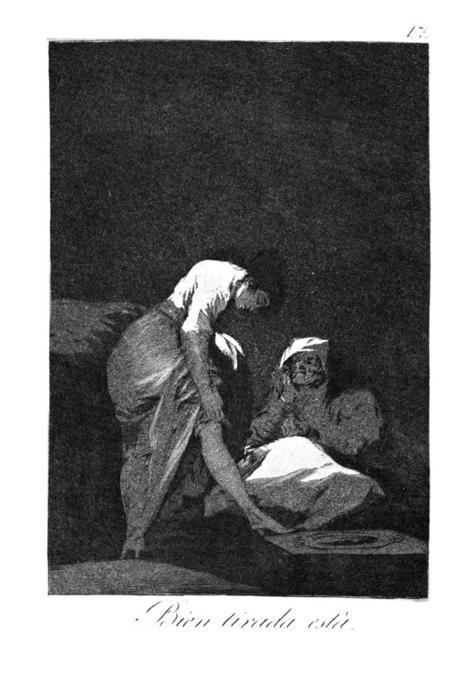
Francisco José de Goya y Lucientes’s “She is Well Pulled Down,” created in 1799 during his prolific Romantic period, stands as a haunting testament to the anxieties and moral complexities of its time. More than just an etching—a technique favored by Goya for its ability to convey nuanced tonal variations—it's a visceral depiction of struggle, coercion, and the precarious balance between power and subjugation. The artwork immediately commands attention with its stark monochrome palette dominated by shades of gray and black, mirroring the somber mood it seeks to evoke.
- Composition & Perspective: The image is meticulously framed, prioritizing a claustrophobic intimacy that amplifies the drama unfolding within. Diagonal lines created by the pulling arm guide the viewer’s gaze across the canvas, emphasizing asymmetry and highlighting the central figure's vulnerability. Flattened perspective—characteristic of etching—further contributes to this sense of confinement, mirroring the psychological pressures depicted.
- Technique & Texture: Goya masterfully employs hatching and cross-hatching techniques, layering lines with astonishing precision to sculpt shading and texture. These dense areas of hatching convey a palpable roughness, contrasting sharply with lighter zones where subtle gradations create an illusion of depth. The etching process itself—scratching into copper plate, transferring ink, and pressing onto paper—is crucial to achieving this textural richness and dramatic tonal range.
- Symbolism & Emotional Impact: Beyond its formal elements, “She is Well Pulled Down” resonates with profound symbolic significance. The depiction of a woman being forcibly pulled downwards speaks volumes about societal imbalances and the vulnerability inherent in confronting oppressive forces. The overall atmosphere—characterized by fear, anxiety, and palpable tension—reflects Goya’s unflinching engagement with human suffering and his willingness to expose uncomfortable truths.
Romantic Style: Line as Emotional Conduit
Goya's stylistic choices firmly situate “She is Well Pulled Down” within the Romantic movement, a period marked by an obsession with emotion and imagination—a reaction against the rationalism of the Enlightenment. Like many works from his Los Caprichos series, this etching isn’t merely aesthetically pleasing; it serves as a powerful commentary on human nature and social ills. The expressive lines—boldly defined and imbued with tonal variation—are not simply descriptive but actively convey emotion, mirroring the turbulent psychological landscape of the era.
Historical Context: Reflections of Societal Disillusionment
Created during Goya’s tumultuous years as court painter to Ferdinand VII, “She is Well Pulled Down” captures a spirit of disillusionment and moral questioning. The etching reflects anxieties surrounding political instability and the erosion of aristocratic ideals—themes prevalent in Romantic art. It stands alongside other depictions of violence and oppression within Goya's oeuvre, demonstrating his unwavering commitment to portraying the darker side of human experience.
Detailed Analysis: Line Weight & Tonal Modulation
The artist’s meticulous attention to line weight—ranging from delicate linework delineating clothing folds to thicker lines emphasizing musculature and pressure—further enhances the artwork's dramatic impact. Equally important is Goya’s masterful modulation of tonal values, utilizing a full spectrum of gray shades to sculpt form and create an illusion of depth. This technique elevates “She is Well Pulled Down” beyond mere visual representation; it becomes a conduit for conveying psychological intensity and capturing the essence of human vulnerability.