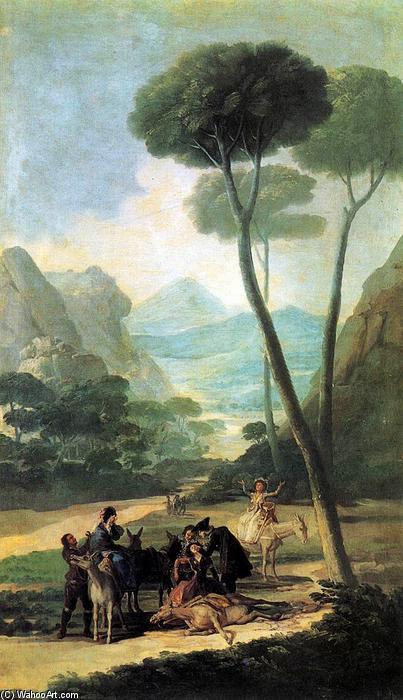
The Fall or The Accident
Francisco de Goya’s
The Fall or The Accident is a captivating oil on canvas painting that showcases the artist's mastery of Romanticism. Created in 1787, this piece measures 169 x 89 cm and is a testament to Goya’s ability to evoke emotions through his art.
Composition and Symbolism
The painting depicts a woman standing next to a tree with her horse, appearing distressed as she looks down at the ground. The scene includes several other people on horseback and walking around, creating a sense of movement and activity. A dog is also present in the center of the image, adding to the dynamic atmosphere. The use of light and shadow in
The Fall or The Accident is noteworthy, as it creates a sense of depth and volume. Goya’s skillful application of chiaroscuro, a technique that uses strong contrasts between light and dark, draws the viewer’s eye through the composition. This emphasis on light is a hallmark of Romanticism, as seen in other works by Goya, such as
Village Procession and
The Snowstorm (Winter). The woman’s gaze downwards symbolizes vulnerability and sorrow, while the fallen man represents mortality and loss—themes central to Romantic artistic expression.
Artistic Context
Goya's work can be contextualized within the broader artistic movements of his time. The Museo de Bellas Artes de Santander, a fine arts museum in Spain, houses an impressive collection of works spanning different periods and styles. Goya’s contributions to Spanish art are significant, and his influence can be seen in various styles, including Romanticism. He was considered one of the most important Spanish artists of the late 18th and early 19th centuries. His paintings, drawings, and engravings reflected contemporary historical upheavals and influenced important 19th- and 20th-century painters.
Techniques and Style
Goya’s use of oil on canvas allows for rich textures and vibrant colors, which he employs effectively in
The Fall or The Accident. His brushstrokes are bold and expressive, capturing the emotions of the subjects. This painting is a prime example of Goya’s ability to balance realism with emotional intensity. He meticulously rendered the horse's musculature and fur texture, alongside the woman’s clothing and facial expression—a hallmark of his meticulous observation and artistic skill. The dramatic lighting enhances the scene's mood, emphasizing the sorrowful posture of the woman and highlighting the stark contrast between life and death.
Conclusion
The Fall or The Accident by Francisco De Goya is a powerful and evocative painting that showcases the artist’s mastery of Romanticism. Through his use of light, composition, and symbolism, Goya creates a captivating scene that draws the viewer in. This piece is a testament to Goya's skill as an artist and his enduring influence on Spanish art.
Light in painting is a fundamental element that has been explored throughout the history of art. Techniques such as shading, chiaroscuro, sfumato, and tenebrism have been used to capture light effectively. The emphasis on light expression in painting is referred to as
luminism, which can be seen in various styles like Baroque tenebrism and impressionism.