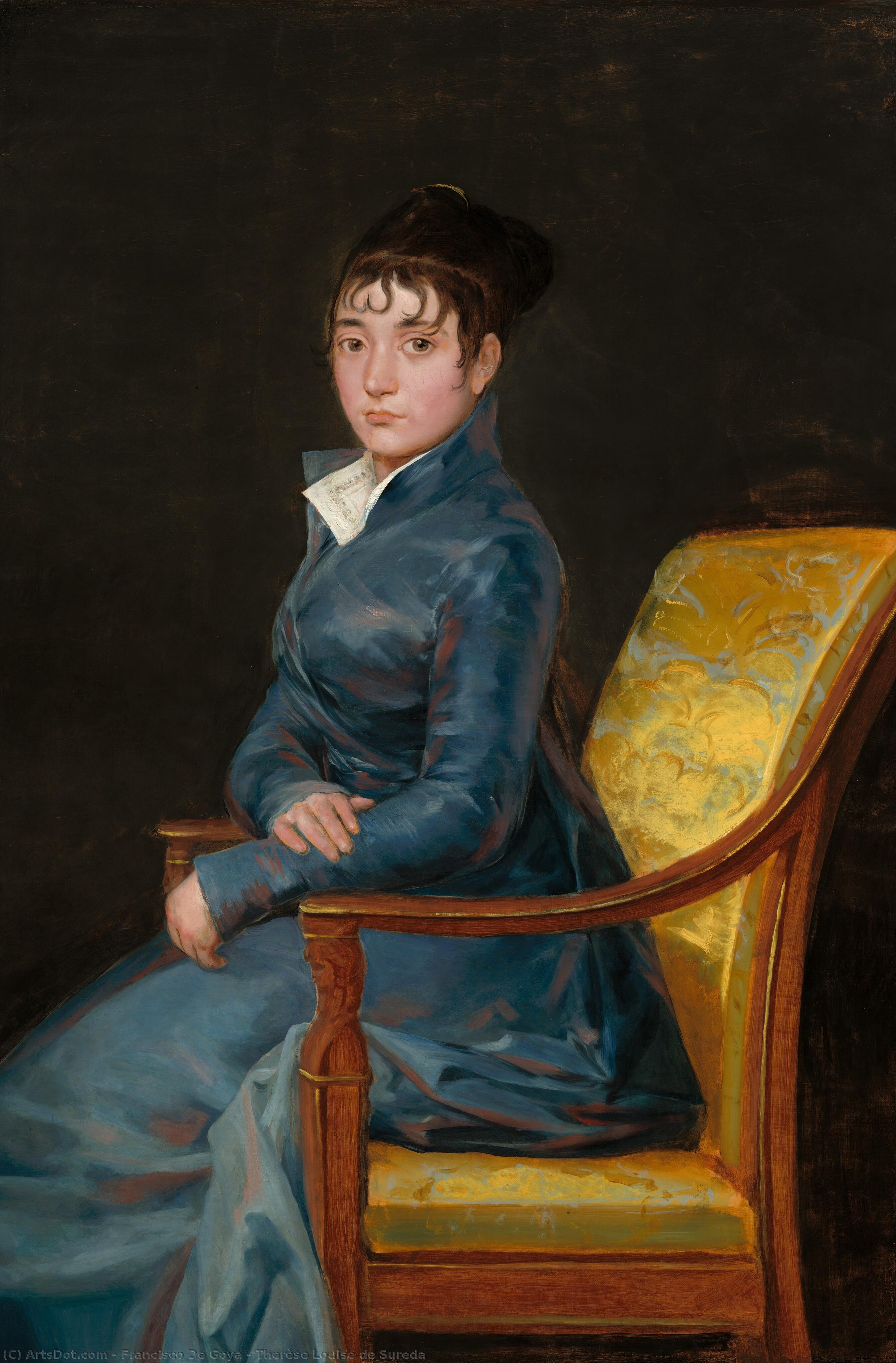
A Gaze Through the Veil of Melancholy
In the quietude of Francisco José de Goya y Lucientes’ 1804 masterpiece, Thérèse Louise de Sureda, we encounter more than a mere aristocratic portrait; we step into a profound psychological landscape. The central figure, a noblewoman of striking presence, sits with a posture that is simultaneously poised and heavy with unspoken emotion. Her gaze, directed toward the viewer, carries a palpable weight of sadness—a haunting stillness that seems to bridge the gap between the early nineteenth century and our modern era. Goya, a master of capturing the human soul, utilizes this portrait to explore the delicate tension between outward social grace and inward emotional turmoil.
The composition is a masterful study in chiaroscuro, where the interplay of light and shadow does not merely illuminate the subject but sculpts her very essence. Bathed in a soft, directional light, Thérèse’s pale skin and the deep, sapphire hues of her gown emerge from a somber, atmospheric background. Goya employs a palette dominated by muted blues, rich browns, and earthy tones, creating an environment that feels both intimate and profoundly isolated. The loose, expressive brushstrokes characteristic of his maturing style lend a sense of movement to the fabric and a lifelike vitality to her features, ensuring that the painting breathes with a restless, quiet energy.
Symbolism and the Architecture of Solitude
Every element within the frame serves as a visual metaphor for the subject's internal state. The arrangement of the furniture is particularly telling; the two chairs flanking Thérèse act as anchors to her physical presence, yet their placement suggests a certain detachment. One chair sits directly behind her, providing a sense of stability, while another, positioned further in the shadows, evokes a feeling of emptiness or abandonment. This spatial arrangement, combined with the discreetly placed couch on the right, creates an enclosed, almost claustrophobic space that reinforces the theme of emotional confinement.
<
p>This sense of isolation is deeply rooted in the historical context of the era. Painted during a period of immense upheaval in Spain, following the Napoleonic conquest, the artwork reflects the broader spirit of
Spanish Romanticism. This movement was defined by a grappling with disillusionment and a fascination with the darker, more turbulent aspects of the human condition. In Thérèse’s melancholic expression, we see the reflection of a nation—and an individual—navigating the shadows of war and political instability.
An Eternal Inspiration for the Discerning Collector
For the art lover or interior designer, Thérèse Louise de Sureda offers an unparalleled opportunity to introduce a sense of historical depth and emotional gravity into a space. As a reproduction, this piece serves as a sophisticated focal point, capable of anchoring a room with its dramatic lighting and profound narrative. Its ability to evoke contemplation makes it an ideal selection for curated collections that value the intersection of classical technique and psychological complexity.
Whether placed in a formal study, a quiet library, or a contemporary living space, this painting brings with it the legacy of Goya—the artist who transitioned from the light of the Rococo to the visceral truths of modernity. To possess such a work is to invite a piece of history into one's home, a timeless reminder of the beauty found within the depths of human sorrow and the enduring power of the artistic gaze.