A Descent into Darkness: Unveiling ‘They Carried Her Off’ by Francisco Goya
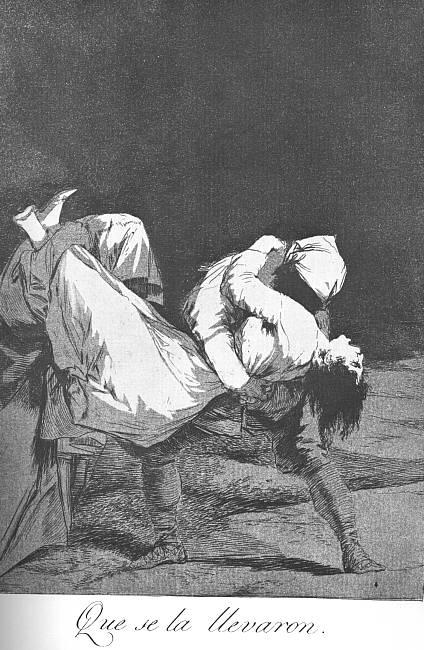
Francisco José de Goya y Lucientes, a name synonymous with the turbulent heart of Spain's 18th and early 19th centuries, possessed an unparalleled ability to capture both the grandeur and the grotesque. His oeuvre is a sprawling landscape of human experience – from courtly portraits brimming with aristocratic charm to harrowing depictions of war and madness. Within this vast body of work, ‘They Carried Her Off’ (Que se la llevaron!), created in 1799, stands as a particularly potent example of his evolving style and profound engagement with the darker aspects of human nature. This etching, rendered in stark monochrome on paper, isn't merely a scene of abduction; it’s a meticulously constructed tableau of vulnerability, power, and unsettling complicity – an image that continues to resonate powerfully today.

The Anatomy of a Dramatic Scene: Composition and Technique
Goya’s masterful control over etching technique is immediately evident in ‘They Carried Her Off.’ The composition is aggressively dynamic, driven by diagonal lines that surge forward from the central action – the forceful removal of a woman. These lines, born from the deliberate scratching of acid-resistant ground into the metal plate, create a palpable sense of urgency and movement, pulling the viewer directly into the scene’s chaotic heart. The figures are arranged with a calculated asymmetry; the two men carrying the victim dominate the foreground, while the observer – positioned slightly to the side – is rendered smaller and more distant, fostering a feeling of voyeurism or helpless witness. The use of hatching and cross-hatching is particularly noteworthy, building up tonal variations that imbue the figures with remarkable depth and texture. The stark contrast between light and shadow, characteristic of Goya’s style, amplifies the drama and heightens the emotional intensity.
Symbolism and Historical Context: A Portrait of Societal Decay
‘They Carried Her Off’ is deeply rooted in the social and political climate of late 18th-century Spain. Created during a period of increasing instability and reform, Goya used his art to critique the abuses of power and expose the moral decay within Spanish society. The abduction itself carries significant symbolic weight – it represents not just a violent act but also a violation of innocence and a disruption of social order. The presence of the observer is crucial; he isn’t merely a bystander, but potentially an accomplice, suggesting that complicity in injustice can take many forms. This element adds layers of complexity to the image, prompting viewers to question their own roles within systems of power and control. The work aligns with Goya's broader engagement with themes of social commentary found throughout his *Los Caprichos* series.
A Voice from the Shadow: Goya’s Legacy
‘They Carried Her Off’ is a cornerstone of Goya’s artistic legacy, demonstrating his evolution from a court painter to a profoundly introspective and socially critical artist. His ability to convey raw emotion through meticulously rendered lines and dramatic contrasts remains unparalleled. The etching's enduring power lies in its capacity to evoke a visceral response – a sense of unease, vulnerability, and the unsettling awareness of human cruelty. It’s a testament to Goya’s genius that this single image continues to provoke debate and inspire interpretation centuries after its creation. A hand-painted reproduction offers an exceptional opportunity to experience the full force of Goya's vision, capturing the intricate details and emotional depth of this unforgettable masterpiece.