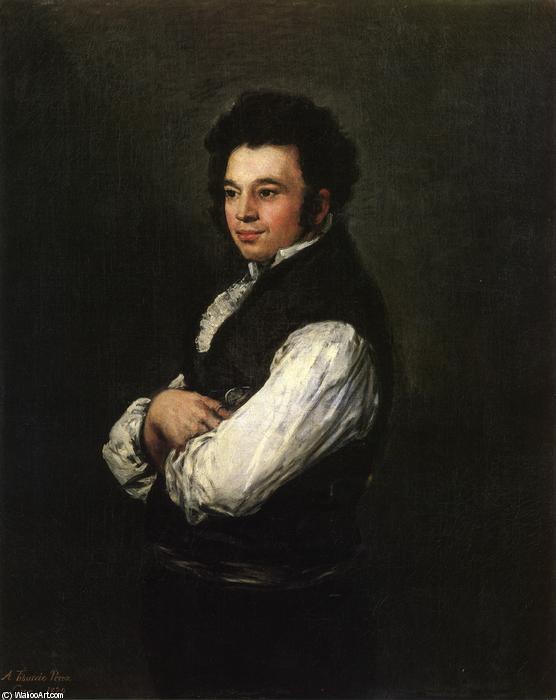
Admire Francisco Goya’s ‘Tubercio Pérez Cuervo,’ a neoclassical portrait brimming with drama & detail. Explore this 1820 oil on canvas masterpiece – a captivating study of form and shadow.
Francisco Goya (1746-1828): Explore the life & work of Spain's Romantic master. Known for portraits, dark satire & 'Disasters of War'. A pivotal figure in art history.
Explore The Metropolitan Museum of Art: 5,000 years of art from around the world! Discover masterpieces, ancient artifacts & immersive exhibitions – a global art destination awaits.
Tubercio Pérez Cuervo: A Portrait of Friendship Illuminated by Goya’s Dramatic Vision
Francisco José de Goya y Lucientes's “Tubercio Pérez Cuervo,” completed in 1820, transcends mere representation; it embodies a profound exploration of human connection and artistic innovation within the framework of neoclassical painting. This intimate portrait captures Tiburcio Pérez y Cuervo, an architect and lifelong friend to Goya, presenting him with remarkable immediacy and psychological depth—a stylistic departure from the grand formality prevalent in royal commissions during Goya’s time.
The artwork's composition centers on a subtly off-center depiction of Pérez’s face and upper torso, prioritizing direct observation over elaborate staging. Goya skillfully employs directional lighting – originating from the left – to sculpt Pérez’s features with meticulous detail while simultaneously casting deep shadows across his clothing and background. These shadows aren’t merely decorative; they contribute significantly to the painting's mood, conveying a sense of solemn contemplation and hinting at inner turmoil—a characteristic hallmark of Goya’s artistic sensibility. Lines delineate the contours of the face, hair, and garments with precision, mirroring the stylistic conventions of neoclassical art while simultaneously prioritizing expressive realism.
The color palette is deliberately restrained, dominated by muted browns and blacks that evoke a contemplative atmosphere. Strategic use of creamy whites highlights Pérez's complexion and draws attention to his gaze—a gaze directed upwards, suggesting confidence mingled with introspection. Texture plays an important role; visible brushstrokes imbue the fabric and hair with palpable materiality, grounding the portrait in tangible reality. This textural richness underscores Goya’s commitment to capturing not just likeness but also the essence of human presence.
Beyond its aesthetic qualities, “Tubercio Pérez Cuervo” speaks volumes about the artist's personal relationships and artistic evolution. The choice to portray Pérez alongside his uncle—a fellow architect—reflects Goya’s admiration for intellectual pursuits and underscores the importance of camaraderie within the artistic milieu. Furthermore, the painting exemplifies Goya’s masterful technique: oil on canvas allows for layering and blending pigments with unparalleled subtlety, achieving a luminous surface that captures the nuances of light and shadow. The subdued palette and contemplative pose align perfectly with the broader stylistic trends of neoclassical art—a movement characterized by idealized beauty and rational order—yet Goya infuses it with an emotional resonance that distinguishes it from its peers.
The artwork’s historical context is crucial to understanding its significance. Created during a period marked by political instability and social upheaval in Spain, “Tubercio Pérez Cuervo” serves as a poignant reminder of Goya's engagement with the darker side of human experience—a preoccupation evident in his monumental series on the Peninsular War ("Los Desastres de la Guerra"). However, unlike those harrowing depictions, this portrait offers solace through its quiet intimacy and unwavering focus on human connection. It stands as a testament to Goya’s ability to transform personal observation into enduring artistic achievement.