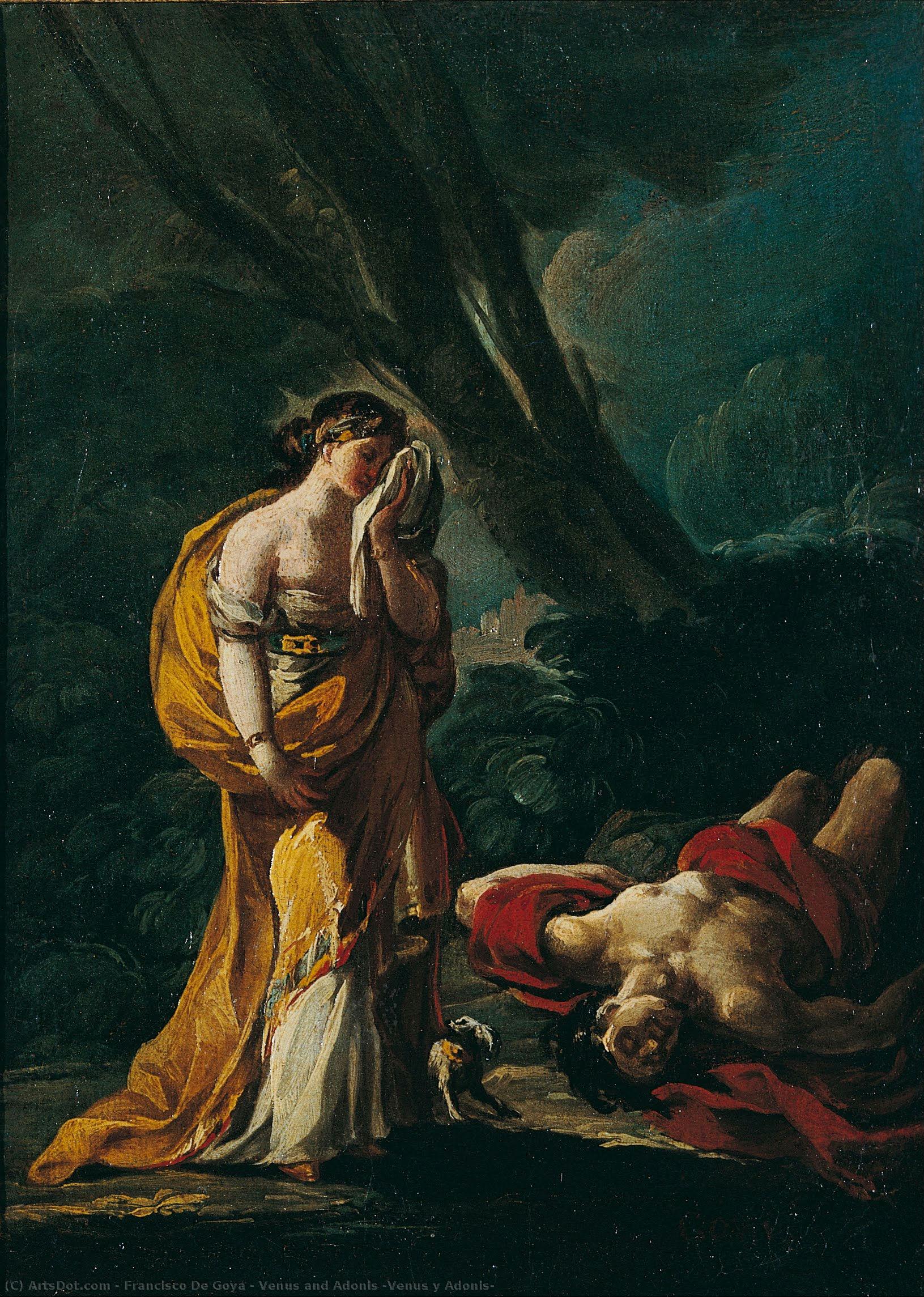
A Tragic Encounter: Delving into Goya’s *Venus and Adonis*
This intimate oil painting by Francisco Goya depicts a poignant moment from classical mythology – the farewell of Venus to the fatally wounded Adonis. Though small in scale (12 x 23 cm), the work resonates with dramatic intensity, showcasing Goya's mastery of Romanticism and foreshadowing his later, darker explorations of human emotion.
Subject & Narrative
The scene captures the heart of the myth: Venus, draped in luxurious fabrics, kneels beside the lifeless form of Adonis. Her gesture is one of profound grief and despair. A small dog, a frequent companion to Adonis during his hunts, remains faithfully by his side, seemingly sensing the tragedy. The background reveals a dense, shadowy forest hinting at the wildness that led to Adonis’s demise, with distant city lights offering a stark contrast between civilization and nature's harsh realities.
Style & Technique
Goya employs a Baroque-influenced style characterized by strong *chiaroscuro* – dramatic contrasts of light and shadow – which heightens the emotional impact. His brushwork is loose and expressive, particularly evident in the rendering of fabrics and skin tones, creating a sense of movement and texture. The composition, while somewhat flattened in perspective, utilizes layering to create depth and atmospheric effect. The artist’s skillful use of line defines forms and emphasizes the flowing drapery, adding to the overall dynamism.
Historical Context & Influences
While the exact date of this work is unknown, it likely falls within Goya's period as a court painter (1786 onwards). However, even in his earlier works, Goya demonstrated an ability to move beyond purely decorative styles. The subject itself – Venus and Adonis – was popular throughout art history, with notable interpretations by artists like Titian and Veronese.
Comparing this work to those predecessors reveals Goya’s unique approach: a focus on raw emotion rather than idealized beauty. He wasn't simply illustrating the myth; he was exploring its psychological weight.
Symbolism & Emotional Impact
The painting is rich in symbolic meaning. Venus represents love and beauty, but also vulnerability and loss. Adonis embodies youthful vitality cut short by fate. The dog symbolizes loyalty and companionship in the face of tragedy. The dark forest alludes to the dangers lurking beneath a beautiful surface.
Ultimately, the artwork evokes feelings of pathos, sorrow, and the fleeting nature of life. It’s a meditation on mortality and the pain of separation.
For Collectors & Designers
This piece, or a high-quality reproduction, would be a striking addition to any collection. Its intimate scale makes it suitable for smaller spaces, while its dramatic composition and rich color palette (dominated by warm golds, ochres, and reds contrasted with cool blues and greens) will command attention. The painting’s Romantic sensibility lends itself well to interiors seeking a touch of drama, sophistication, and emotional depth. It would complement both traditional and contemporary settings, serving as a powerful focal point and conversation starter.
- Artist: Francisco Goya
- Period: Likely late 18th/early 19th Century (Romanticism)
- Medium: Oil on Canvas
- Dimensions: 12 x 23 cm