Witness Goya’s ‘The Third of May 1808’! A powerful Romantic masterpiece depicting Spanish resistance & war's brutality. Explore its symbolism, technique & historical impact.
Francisco Goya (1746-1828): Explore the life & work of Spain's Romantic master. Known for portraits, dark satire & 'Disasters of War'. A pivotal figure in art history.
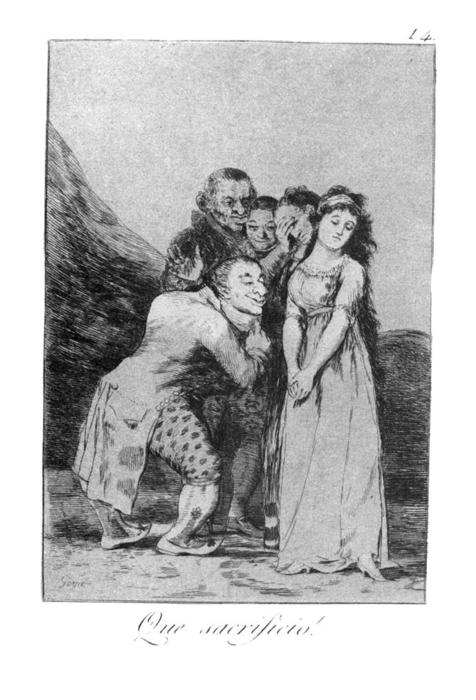
What a Sacrifice!: A Dramatic Portrait of Suffering and Critique
Francisco José de Goya y Lucientes’s “What a Sacrifice!” – Plate 14 from “Los Caprichos” – transcends mere visual representation; it embodies the spirit of Romanticism itself, capturing a moment fraught with psychological tension and social commentary. Executed in 1799, this etching showcases Goya's masterful command of chiaroscuro and expressive linework, cementing his place as one of Spain’s most influential artists.
Composition and Style: A Symphony of Contrasts
The artwork presents a meticulously crafted scene featuring five figures against a simplified mountainous backdrop. Dominating the composition is a woman positioned centrally, conveying palpable distress – her gaze fixed downwards, suggesting resignation or perhaps despair. Kneeling before her is a man extending his hand in an exaggerated gesture of supplication, highlighting the vulnerability inherent in human interaction. Flanking them are two additional figures: one observes with amusement, subtly undermining the seriousness of the situation; the other expresses concern, hinting at apprehension regarding the unfolding drama. Goya’s stylistic choices prioritize dynamism and tension through rapid hatching and cross-hatching, skillfully building tonal values to delineate forms and creating a palpable sense of unease. The angular shapes contribute to this unsettling atmosphere, mirroring the anxieties prevalent during Goya's time.
Technique: The Art of Etching – Precision and Texture
The etching process itself—utilizing a copper or steel plate etched with acid-resistant ground and incised lines—is testament to Goya’s technical prowess. Skilled engravers meticulously transferred the artist’s vision onto metal, resulting in an image characterized by remarkable detail and textural richness. The rough surface achieved through this method underscores the materiality of the artwork and reinforces its emotional impact. Lines are employed with deliberate precision, conveying movement and emphasizing key elements within the scene—particularly the woman's face, illuminated from the front to maximize dramatic effect.
Historical Context and Symbolism: Satire Amidst Societal Disillusionment
“Los Caprichos,” Goya’s seminal satirical series, reflects the turbulent political climate of Spain following Napoleon’s invasion. Plate 14 serves as a poignant critique of societal conventions and human behavior, exploring themes of sacrifice, deception, and manipulation. The figures embody anxieties surrounding power dynamics and moral compromise—questions that resonate powerfully even today. Goya's deliberate use of grotesque imagery underscores the artist’s unflinching gaze upon the darker aspects of humanity.
Emotional Resonance: Anxiety, Resignation, and Moral Ambiguity
Ultimately, “What a Sacrifice!” compels viewers to confront uncomfortable truths about human nature. The artwork evokes feelings of anxiety, resignation, amusement, and moral ambiguity—elements that align seamlessly with Goya’s broader artistic mission: to expose hypocrisy and challenge established norms. It stands as a haunting reminder of the psychological complexities inherent in human relationships and the enduring power of art to provoke contemplation and inspire empathy.