A Descent into Darkness: Analyzing Francisco Goya’s “Who Could Believe It!”
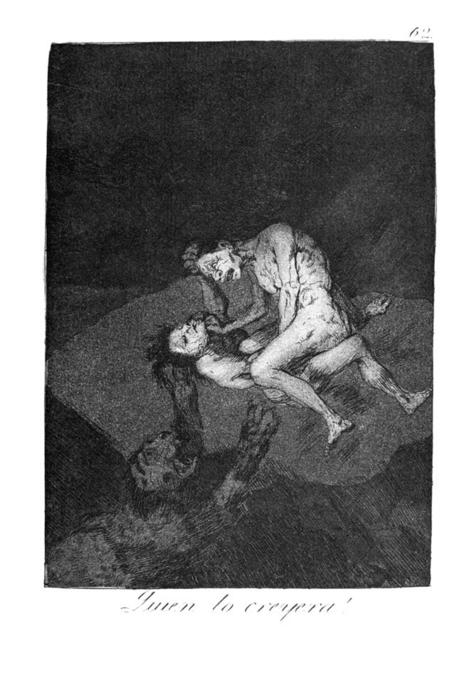
“Who could believe it!”, created in 1799 by Francisco José de Goya y Lucientes, stands as a chilling testament to the Romantic spirit's fascination with morbidity and psychological torment. More than just an etching—it’s a visceral confrontation with death itself—the artwork plunges viewers into a landscape of despair rendered with masterful precision and unsettling emotional depth. Immediately recognizable for its dramatic composition and stark black-and-white palette, “Who Could Believe It!” embodies Goya's signature style: a blend of meticulous observation and expressive distortion that anticipates the anxieties simmering beneath the surface of European society during the Napoleonic Wars.
- Style & Influence: The piece firmly anchors itself within Romanticism, inheriting the tradition’s penchant for sublime terror and emotional intensity from artists like Francisco Goya himself. Notably influenced by Goya's own harrowing depictions of human suffering—particularly his “Disasters of War” series—the etching eschews idealized beauty in favor of unflinching realism, capturing a moment of profound anguish with uncompromising honesty.
- Technique: Goya’s mastery lies in the etching process itself. Utilizing aquatint and burin techniques, he achieved remarkable textural complexity through careful manipulation of acid bites onto a metal plate. This meticulous craftsmanship resulted in a surface riddled with fine lines and ridges—a deliberate choice that amplifies the artwork's unsettling atmosphere and contributes to its palpable sense of unease.
- Composition & Perspective: The scene unfolds on an uneven rocky surface, emphasizing instability and vulnerability. Two figures intertwine in a grotesque embrace, their bodies contorted into positions of agony. Flattened perspective further intensifies the claustrophobic feeling, drawing attention directly to the immediate interaction between the subjects—a deliberate tactic designed to heighten emotional impact.
Symbolism: A Reflection of Societal Decay
Beyond its formal qualities, “Who Could Believe It!” is laden with symbolic significance. The intertwined bodies represent not merely physical closeness but also a profound loss – grief, despair, and perhaps the futility of human endeavor. This imagery speaks to the broader anxieties of the time—the crumbling edifice of aristocratic privilege confronted by the burgeoning forces of revolution—reflecting Goya’s disillusionment with Enlightenment ideals and his unwavering commitment to portraying the darker side of human experience. The stark lighting casts deep shadows, highlighting the figures' tormented expressions and reinforcing the artwork’s overarching mood of horror.
- Color Palette: The monochrome palette – predominantly black and white – serves as a powerful tool for conveying emotion. Absence of color amplifies the dramatic impact of the scene, stripping away any distractions and focusing solely on the visceral portrayal of suffering.
- Line Quality: Goya’s use of jagged, expressive lines underscores the chaos and anguish at the heart of the composition. These lines aren't merely descriptive; they actively communicate emotion—a deliberate stylistic choice that aligns perfectly with Romantic sensibilities.
Historical Context & Legacy
Created during a period marked by political upheaval and social unrest—the Napoleonic Wars reshaping Europe’s geopolitical landscape— “Who Could Believe It!” captures the zeitgeist of its era. Goya's unflinching gaze confronts viewers with uncomfortable truths about human vulnerability and mortality, challenging conventional notions of beauty and heroism. The etching remains a cornerstone of Romantic art history, influencing generations of artists who sought to explore the depths of human emotion and grapple with existential questions. Its enduring power lies in its ability to provoke contemplation—to compel us to confront our own fears and anxieties alongside Goya’s tormented subjects.
- Influence on Later Artists: “Who Could Believe It!” served as a catalyst for artistic innovation, inspiring subsequent generations of artists to embrace expressive distortion and psychological realism.
- Critical Reception: Initially met with controversy—some critics deemed it vulgar and disturbing—the etching quickly gained recognition as a masterpiece of Romantic art, cementing Goya’s reputation as one of the era's most visionary figures.