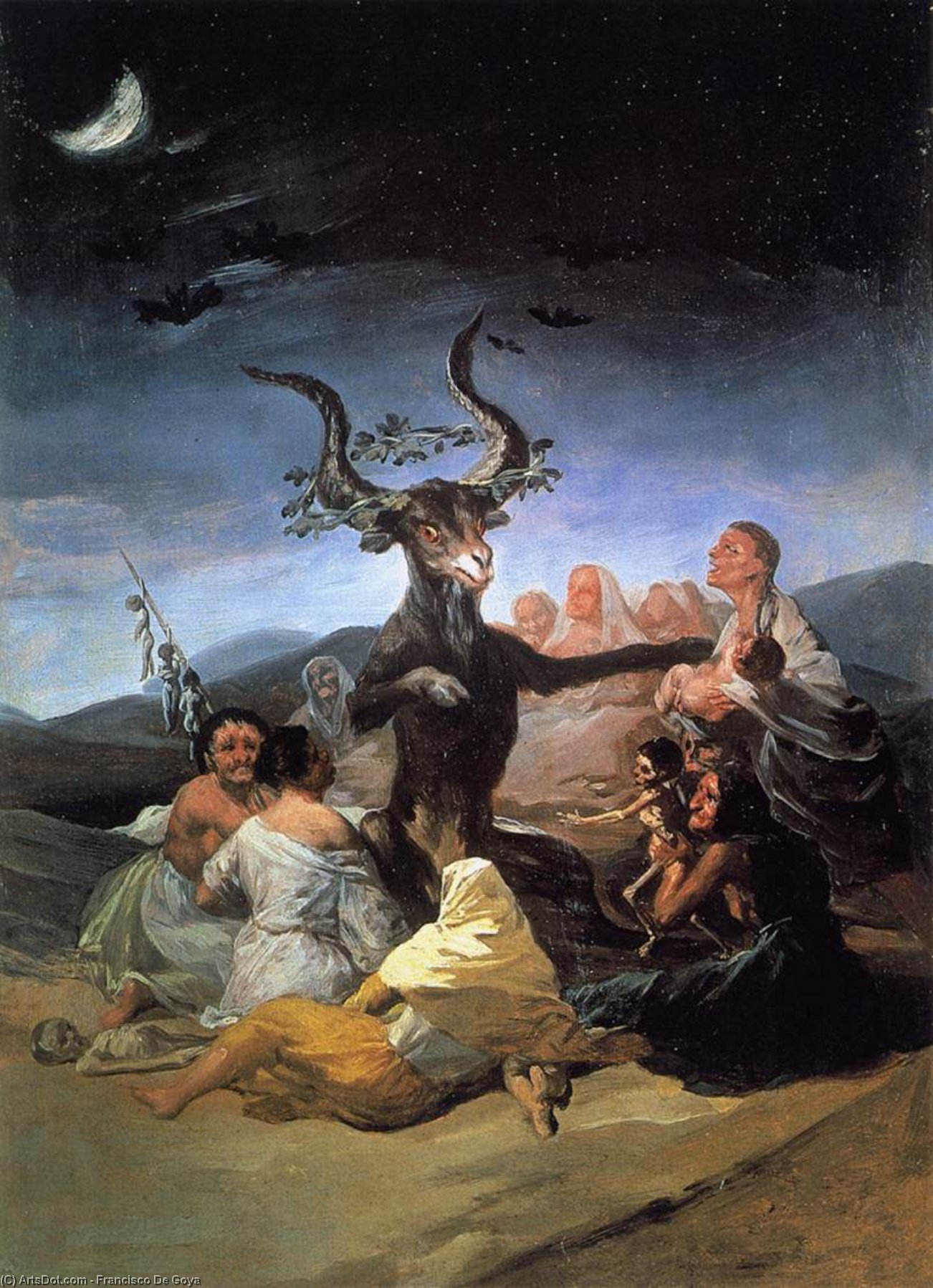
A Descent into Shadow: Exploring Goya's Witches Sabbath
To stand before Francisco José de Goya y Lucientes’ depiction of the Witches Sabbath is not merely to observe a painting; it is to be drawn into a vortex of primal energy and human transgression. This work, dating from 1789, plunges the viewer into a night where the veil between worlds thins, revealing a gathering steeped in arcane ritual. Goya, ever the unflinching chronicler of humanity’s darker impulses, captures a scene that is both terrifyingly vivid and disturbingly theatrical. The composition itself seems to breathe with malevolent life, drawing the eye inexorably toward the central, demonic figure around whom all activity revolves.
The Choreography of the Occult
What immediately strikes the contemporary viewer is the sheer density of the action. We see figures engaged in a macabre ballet—a man brandishing a pitchfork, another holding a knife, and yet others gathered in close proximity, their forms entangled in the ritualistic fervor. The inclusion of the two birds, positioned like silent witnesses on either flank, adds an unsettling symmetry to the chaos. Goya masterfully orchestrates these elements; they are not simply placed upon the canvas but seem integral to the narrative tension. The black and white tonality, while perhaps influenced by reproduction techniques or the original medium's dramatic contrast, heightens the sense of timeless dread, stripping away the comfort of color to leave only stark form and gesture.
Symbolism and the Human Psyche
Historically, such scenes tapped into deep-seated societal anxieties regarding superstition, witchcraft, and the wild edges of human nature. For Goya, however, this was never just folklore; it was a profound meditation on the darker recesses of the collective psyche. The demonic centerpiece acts as a focal point for these suppressed fears—the irrational, the forbidden knowledge, the surrender to base instinct. Owning a reproduction of this piece allows one to contemplate that tension: the fragile veneer of civilization against the raw power bubbling just beneath the surface. It speaks to the eternal struggle between order and chaos.
Technique and Enduring Impact
Goya’s technique here showcases his evolving genius. While his early training provided him with a mastery of composition, in works like this, he employs a dramatic chiaroscuro that sculpts the figures out of the surrounding gloom. The brushwork, even when viewed through reproduction, suggests an immediacy, a feverish energy that belies the careful planning required for such a complex scene. For the collector or designer, this piece offers unparalleled dramatic weight. It is not merely decorative; it is an emotional anchor, capable of lending an air of brooding intellectualism and gothic romance to any space.