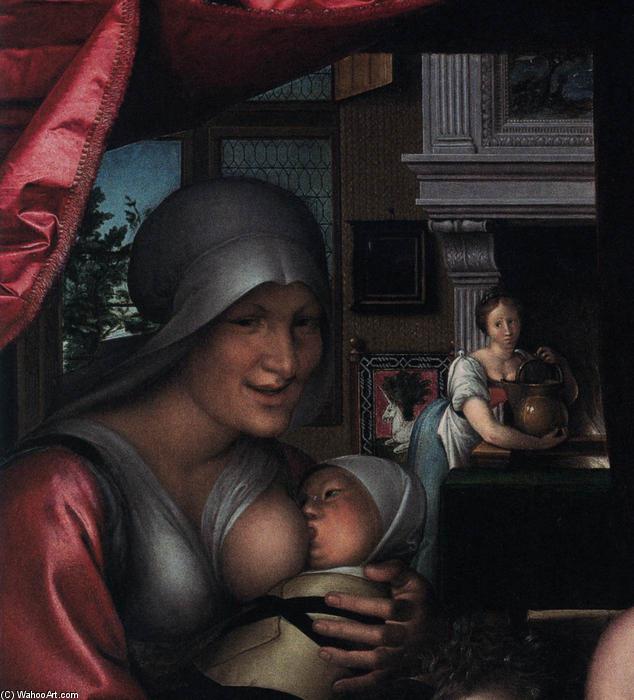
The Enigmatic Beauty of a Renaissance Moment
François Clouet’s “A Lady in Her Bath” (detail), painted around 1571, isn't merely a depiction of a woman enjoying a moment of repose; it’s a carefully constructed tableau brimming with the elegance and subtle anxieties of the French court. Housed within the National Gallery of Art in Washington D.C., this oil on wood panel offers a rare glimpse into the private lives of nobility during the reign of Charles IX, inviting us to contemplate themes of beauty, status, and perhaps even veiled secrets.
The painting immediately draws the eye to the central figure – a woman bathed in muted tones, her face partially obscured by a delicate white headdress. This deliberate ambiguity is key; Clouet masterfully avoids offering a straightforward portrait, instead presenting a carefully crafted image that begs interpretation. The rich crimson of her dress and the luxurious fabrics surrounding her hint at considerable wealth and influence, while the restrained palette – dominated by browns, greys, and subtle blues – speaks to the formality and decorum expected within aristocratic circles. Notice the meticulous detail in the rendering of the drapery; it’s not simply draped but sculpted, conveying a sense of weight and texture that adds immense realism to the scene.
A Flemish Influence & Italian Grace
Clouet's artistic style is a fascinating blend of influences. He inherited a strong tradition from his father, Jean Clouet, a Netherlandish artist known for his portraiture, and adopted many of his techniques – particularly the use of sfumato, that subtle blurring of edges characteristic of Renaissance painting. However, he skillfully integrated these Flemish elements with emerging Italianate grace, creating a style uniquely his own. The careful attention to detail, evident in the rendering of the woman’s hands holding the baby, and the intricate patterns on the fabrics, are hallmarks of both traditions.
The background figures – a man standing by a window and another seated at a table – further enrich the scene, suggesting a domestic setting within a palace or noble household. The inclusion of these secondary characters adds depth to the narrative, hinting at the complex social dynamics that governed life in the French court. The fruit on the table, rendered with exquisite detail, is not just decorative; it’s a potent symbol of fertility and abundance – a visual representation of the family's prosperity and lineage.
Symbolism & The Unresolved Mystery
Scholars have long debated the identity of the woman in the bath. While often speculated to be Diane de Poitiers, a prominent mistress of King Henry II, the painting’s ambiguity is deliberate. Clouet was known for his ability to capture not just physical likeness but also the essence of his subjects – their personalities and social standing. The masklike quality of her face, combined with the subtle expressions on the faces of the other figures, creates a sense of intrigue and invites us to project our own interpretations onto the scene.
The painting’s emotional impact is profound. Despite its formal composition, “A Lady in Her Bath” evokes a powerful sense of intimacy and tenderness. The mother-child bond depicted is both touching and subtly melancholic, suggesting a fleeting moment of peace amidst the pressures and responsibilities of court life. It's a testament to Clouet’s skill in capturing not just the outward appearance but also the inner lives of his subjects – a remarkable feat for a portrait from the 16th century.
A hand-painted reproduction by ArtsDot offers an unparalleled opportunity to experience the beauty and artistry of this iconic masterpiece, bringing its timeless elegance into your home or studio.