A Symphony of Symbolism: The Allegory of Music
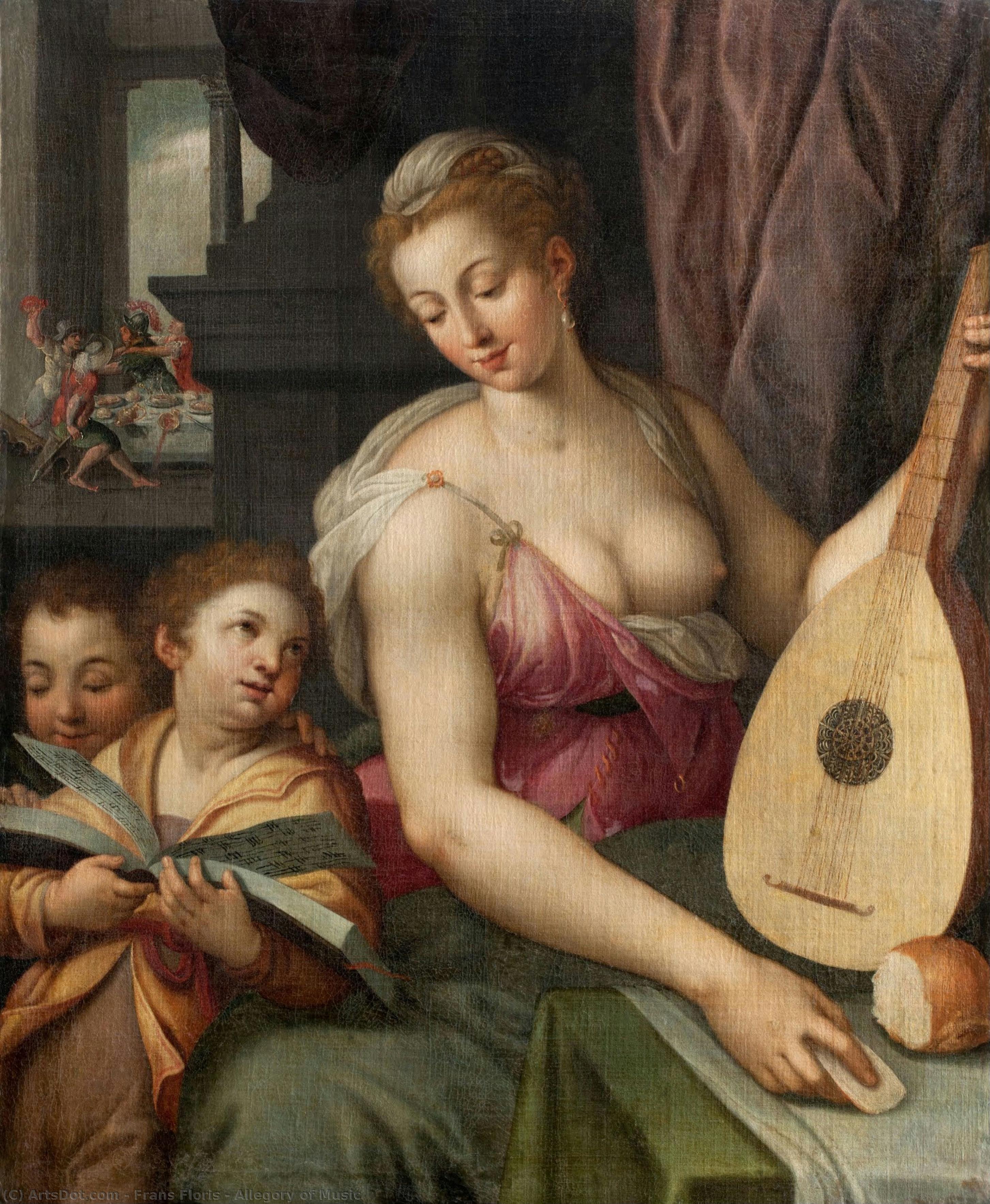
In the delicate interplay of light and shadow within Frans Floris’s Allegory of Music, we encounter a masterpiece that transcends mere portraiture to become a profound meditation on the senses. At the heart of this composition sits a graceful lady, her presence commanding yet serene, cradling a lute in her right hand. As she reaches with her left to grasp a slice of bread from the table before her, the painting weaves together the auditory beauty of melody with the primal, earthly satisfaction of sustenance. This juxtaposition of the ethereal—music—and the material—bread—invites the viewer into a world where every gesture carries a hidden weight, characteristic of the intellectual depth found in Northern Renaissance allegories.
The scene is far from a solitary moment of quietude; behind this central figure, a secondary narrative unfolds. In the background, a troupe of drunken soldiers, clad in the evocative costumes of ancient Rome, provides a chaotic, earthly contrast to the lady's poised elegance. This tension between the disciplined harmony of music and the unbridled disorder of excess is a hallmark of the Romanist style. Through his mastery of composition, Floris utilizes these contrasting elements to explore the duality of human nature—the struggle between our higher, spiritual aspirations and our more base, instinctive impulses.
Technically, the work serves as a testament to Floris’s position as a pioneer of the Flemish Renaissance. His ability to infuse monumental history painting with the fluid grace of Italian masters like Raphael is evident in the soft modeling of the lady's skin and the rich, tactile rendering of the fabrics. The palette, though grounded in the earthy tones of the period, possesses a luminous quality that draws the eye toward the central interaction. For the discerning collector or interior designer, this piece offers more than just visual splendor; it provides a sophisticated focal point that brings a sense of historical gravity and narrative complexity to any curated space.
Beyond its aesthetic allure, the Allegory of Music carries a storied provenance that adds layers of historical prestige to the work. There is much speculation that this painting once graced the illustrious collection of Rudolf II of Habsburg in Prague, a monarch renowned for his profound devotion to the arts and his vast Kunstkammer. The idea that such a treasure might have been swept away as war booty during the looting of 1648 adds a poignant, almost melancholic dimension to its history. To possess a high-quality reproduction of this work is to invite a piece of European heritage into one's home—a fragment of a lost era of imperial splendor and humanist discovery.