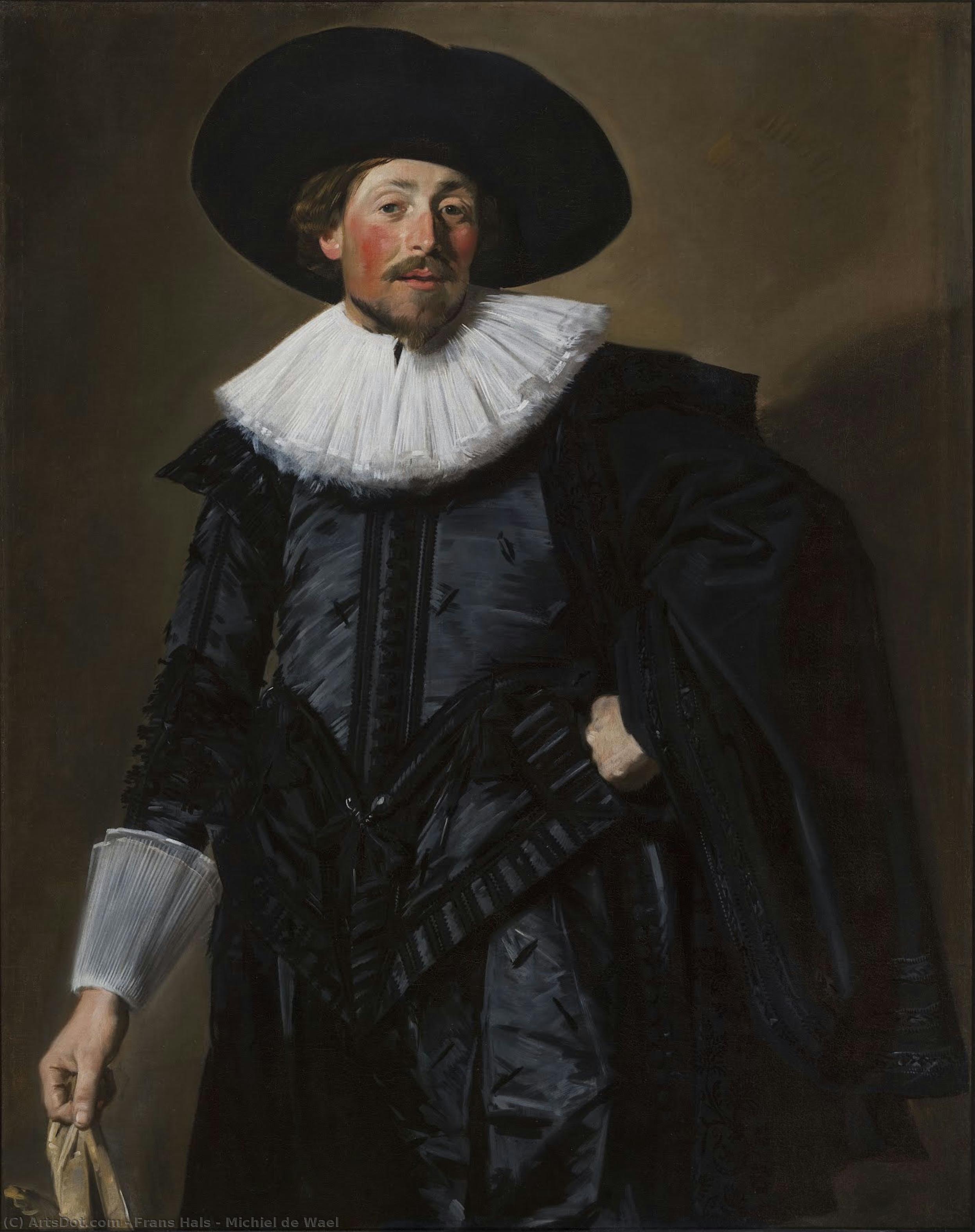
A Portrait of Dignified Resolve: Michiel de Wael by Frans Hals
Frans Hals’s portrait of Michiel de Wael, completed in 1628, isn't merely a likeness; it’s a carefully constructed tableau of status, wealth, and the quiet contemplation characteristic of the Dutch Golden Age. The painting immediately commands attention with its formal composition – De Wael occupies nearly the entire frame, an assertion of his importance within the social landscape of Haarlem. Yet, this formality isn't cold or austere; rather, it’s imbued with a palpable sense of humanity, achieved through Hals’s masterful manipulation of light and shadow, and most notably, his signature loose brushwork.
The subject himself is presented as a man of considerable standing – a brewer and civic guard captain. His dark velvet coat, rich in detail thanks to Hals' meticulous rendering of the fabric’s texture, speaks volumes about his prosperity. The voluminous white ruff collar, a fashionable extravagance of the period, further emphasizes his elevated position. He holds a small pouch or bag in his left hand – a subtle emblem of trade and wealth, hinting at the tangible rewards of his endeavors. But it's De Wael’s expression that truly captivates; a serious, almost melancholic gaze suggests an inner life, a thoughtful observer of the world around him. This isn’t a boisterous celebration of success, but rather a moment of quiet reflection – a rare and compelling quality in portraiture of this era.
The Language of Dutch Portraiture: Style and Technique
Hals's approach to portraiture was revolutionary for his time. He deliberately eschewed the meticulous detail favored by many of his contemporaries, opting instead for a vibrant, expressive style characterized by loose brushstrokes and an emphasis on capturing fleeting moments. This technique isn’t haphazard; it’s carefully controlled, creating a sense of immediacy and dynamism within the painting. Notice how Hals uses light to sculpt De Wael's face – strong directional lighting casts dramatic shadows that define the contours of his features, adding depth and volume. The subtle gradations in tone create an illusion of three-dimensionality, pulling the viewer into the scene.
The composition itself is a testament to Hals’s skill. The shallow perspective focuses primarily on De Wael's face and upper body, creating an intimate yet imposing presence. Linear elements – the precise lines of his clothing and the architectural background – are balanced by softer, more organic shapes within the folds of the fabric. This interplay between structure and fluidity is a hallmark of Hals’s style, lending a sense of both order and vitality to the painting.
Historical Context: A Glimpse into 17th-Century Haarlem
To fully appreciate this portrait, it's essential to understand the social and economic context in which it was created. The Dutch Golden Age (roughly 1600-1700) witnessed an unprecedented flourishing of art, commerce, and intellectual life. Haarlem, a thriving port city, became a center for brewing, trade, and civic engagement – industries that fueled the rise of prosperous merchants like De Wael. Portraits during this period weren’t simply representations of individuals; they were statements of social status, economic success, and civic responsibility.
The inclusion of symbolic elements—the pouch representing trade, the elaborate clothing signifying wealth—reinforces this message. Hals subtly communicates De Wael's position within the hierarchical structure of 17th-century society, while simultaneously capturing his individual character and personality. Further research reveals that Michiel de Wael was a prominent figure in Haarlem’s civic life, serving as captain of the St. George Civic Guard – a role that would have further elevated his status and contributed to the painting's significance.
Beyond the Canvas: Reproduction and Legacy
The original portrait, now housed at the Taft Museum of Art in Cincinnati, is a remarkable example of Hals’s genius. High-quality reproductions offer an opportunity to experience this masterpiece firsthand, bringing its rich colors, dramatic lighting, and profound emotional depth into any space. Consider how the painting's muted palette—dominated by dark browns and greys—creates a sense of gravitas and introspection, while subtle highlights on De Wael’s face draw attention to his thoughtful expression.
Frans Hals’s portrait of Michiel de Wael stands as a testament to the enduring power of art to capture not just likenesses but also the essence of human experience. It's a painting that invites contemplation, prompting us to consider the complexities of wealth, status, and the quiet dignity of a man navigating the challenges and triumphs of his time.