A Glimpse into the Soul of Haarlem
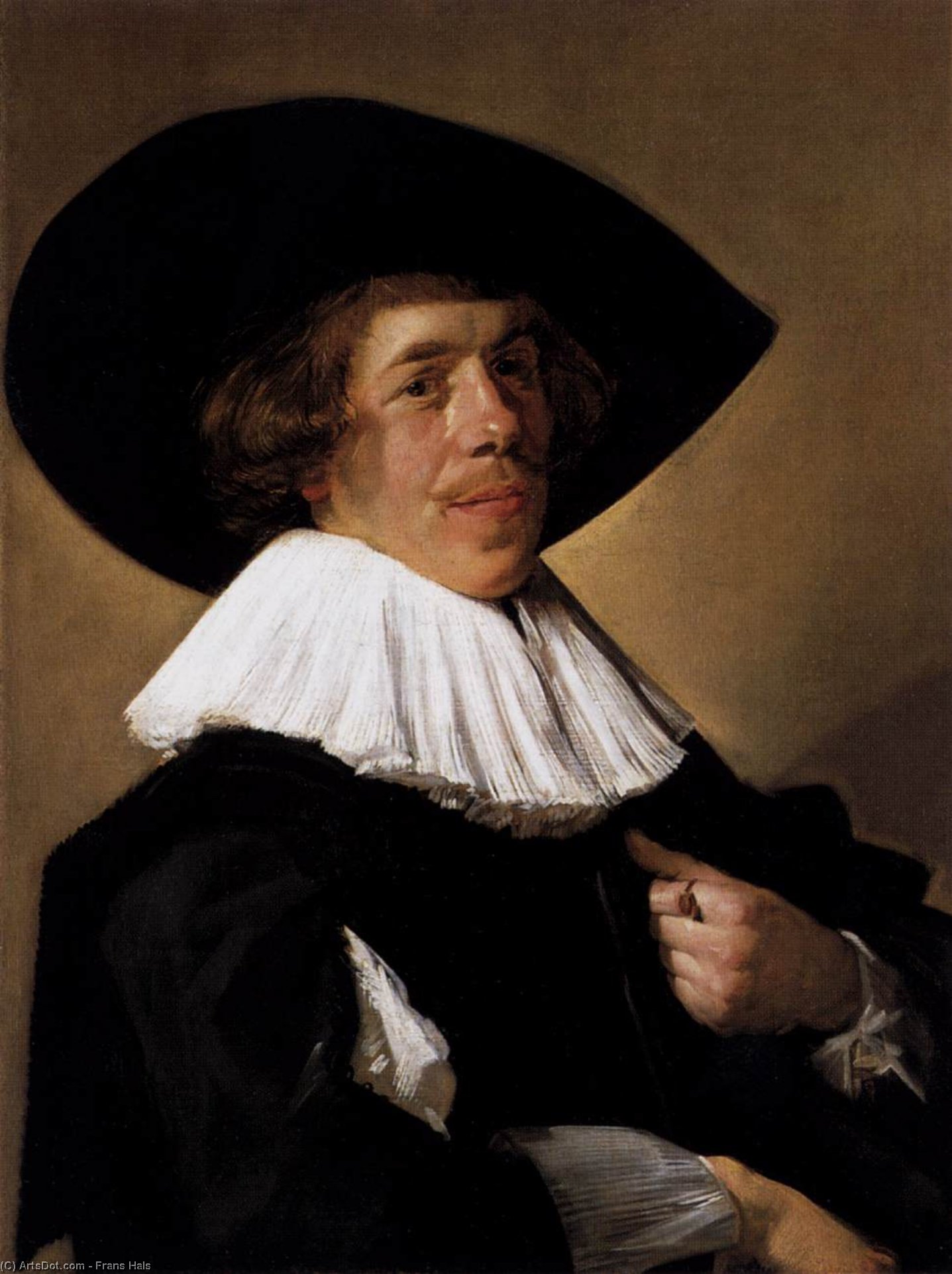
In the heart of the Dutch Golden Age, amidst the burgeoning prosperity of the seventeenth century, Frans Hals I captured more than just faces; he captured the very pulse of life. His "Portrait of a Man," painted circa 1630, serves as an exquisite window into the social fabric of Haarlem’s aristocracy. This is not a static, frozen image of a gentleman, but rather a vibrant encounter with a man who seems to step directly from the canvas into our contemporary space. The subject, adorned in the somber yet dignified elegance of his era, gazes at the viewer with an unmistakable presence, inviting us to share in a silent, momentary connection that has endured for nearly four centuries.
The painting’s composition is masterfully balanced, presenting a figure of quiet confidence. Clad in a dark, commanding hat accented by a delicate white feather and a meticulously rendered ruffled collar, the man embodies the refined taste of the Dutch merchant class. The subtle textures of his attire—the weight of the fabric and the crispness of the lace—are brought to life through Hals’s legendary ability to manipulate light and shadow. Behind him, the inclusion of a wall adorned with a prominent clock adds a layer of profound historical resonance. In an age obsessed with the burgeoning science of time and the accumulation of fortune, the clock serves as a memento mori, a gentle reminder of the fleeting nature of existence even amidst the height of worldly success.
The Mastery of Spontaneous Brushwork
What truly distinguishes this work is the revolutionary technique employed by Hals, a method that would later inspire the Impressionists. Eschewing the stiff, overly polished surfaces favored by many of his contemporaries, Hals embraced a style of spontaneous brilliance. He utilized rapid, expressive brushstrokes that appear almost sketch-like upon close inspection, yet coalesce into a breathtakingly realistic depiction when viewed from a distance. This "alla prima" approach allows for a sense of movement and texture that breathes life into the subject's beard, mustache, and the soft plume of his hat.
For the discerning collector or interior designer, this technique offers an unparalleled emotional depth. The painting does not merely sit upon a wall; it vibrates with energy. There is a palpable sense of immediacy—as if the artist had caught the subject in a fleeting moment of thought. This kinetic quality makes the piece an extraordinary focal point for any curated space, providing a sophisticated anchor that balances classical tradition with a modern, dynamic spirit. To possess a reproduction of such a masterpiece is to bring a piece of the Dutch Golden Age’s living energy into one's own environment, offering a continuous dialogue between the historical past and the aesthetic present.