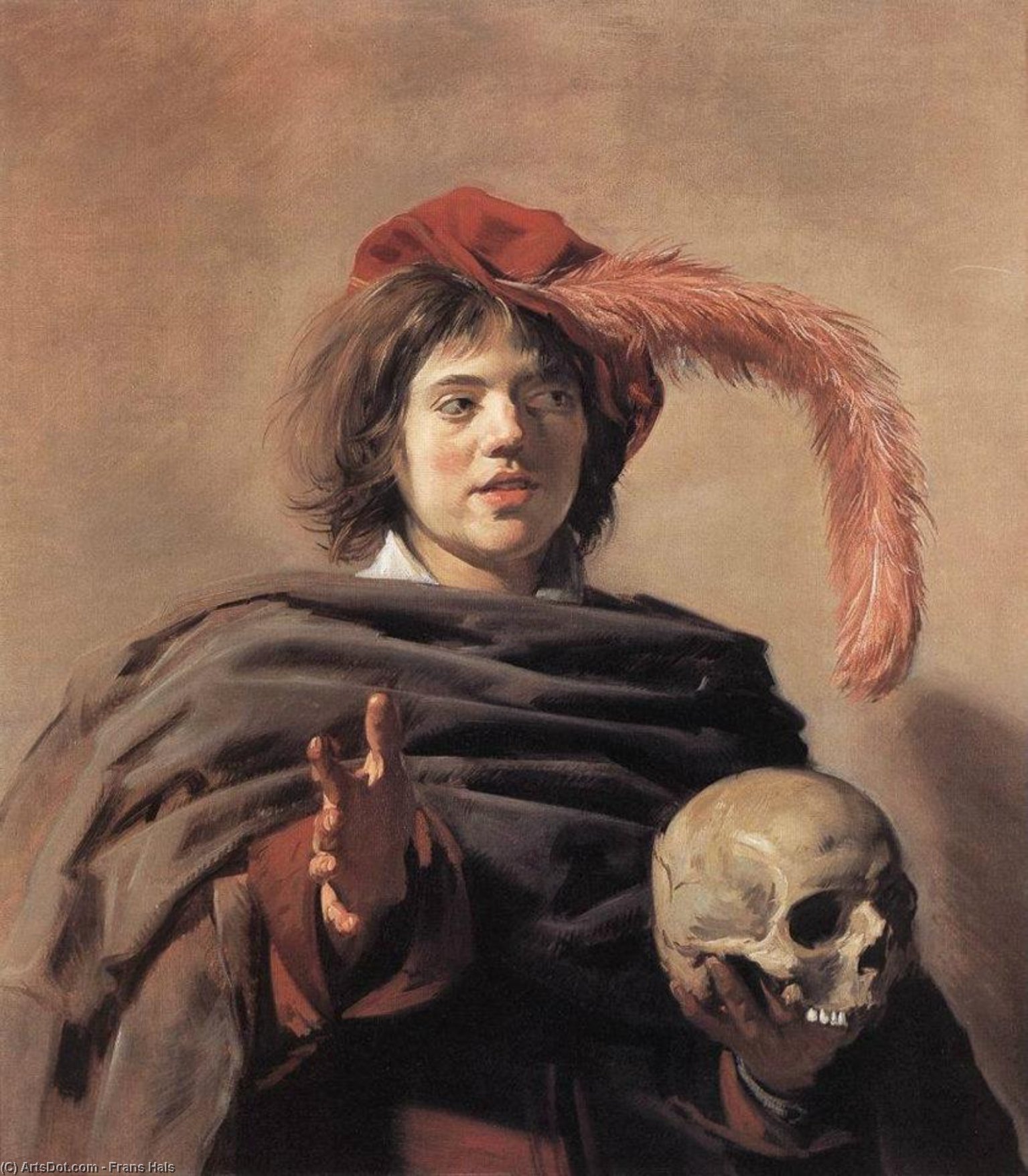
A Haunting Portrait: Frans Hals’ ‘Young Man with a Skull’ – A Vanitas Meditation
Frans Hals' “Young Man with a Skull” (1626-1628), now residing in the National Gallery, London, is far more than a simple portrait; it’s a powerfully evocative meditation on mortality, a quintessential example of the Dutch Golden Age’s fascination with vanitas – the deliberate contemplation of life's transience. This arresting image captures a young man, dressed in the flamboyant attire of the period, holding aloft a stark white skull, his gaze direct and challenging to the viewer. The painting immediately commands attention, not through idealized beauty, but through its unsettling honesty and the palpable sense of drama it conveys.
Hals’ signature style is brilliantly displayed here – a remarkable departure from the meticulous detail favored by many of his contemporaries. Instead, he employs a loose, almost frenetic brushstroke, imbuing the scene with an immediacy and vitality that feels remarkably contemporary. The paint seems to dance across the canvas, capturing not just the likeness of the subject but also the fleeting nature of expression itself. Notice how the reddish ground shows through in places, a testament to Hals’s rapid technique – he wasn't striving for photographic realism, but rather for an intensely felt representation.
The Symbolism of Vanitas
The inclusion of the skull is central to understanding the painting’s deeper meaning. Within the context of 17th-century Dutch art, particularly influenced by the rise of Calvinist thought, vanitas paintings served as potent reminders of humanity's mortality and the futility of worldly pursuits. The skull isn’t merely a symbol of death; it represents the inevitable end that awaits all, regardless of wealth, status, or earthly pleasures. The young man’s gesture – pointing directly at the viewer – forces us to confront our own vulnerability and contemplate our place within the larger scheme of things.
Beyond the skull, subtle details contribute to the overall message. The feathered red hat, a symbol of youthful exuberance and perhaps even vanity, contrasts sharply with the stark simplicity of the skull. The draped cloak adds another layer of visual complexity, suggesting both protection and concealment – a futile attempt to shield oneself from the inevitable. The background is deliberately muted, drawing all attention to the central figure and his confronting gaze.
A Portrait Beyond Representation
While often categorized as a portrait, “Young Man with a Skull” transcends traditional genre conventions. It’s not simply a likeness of an individual; it's a carefully constructed visual argument about life, death, and the human condition. The identity of the young man remains somewhat enigmatic – he is likely Vincent Laurensz van der Vinne, a Dutch Mennonite painter and diarist who served as a student to Frans Hals. This connection adds another layer of intrigue, suggesting that Hals may have been exploring themes of mortality through the lens of his own artistic lineage.
The painting’s enduring power lies in its ability to resonate with viewers across centuries. It's a poignant reminder of our shared vulnerability and a testament to Frans Hals’s extraordinary talent for capturing not just appearances, but also the profound emotions that lie beneath the surface. A reproduction of this captivating work offers a unique opportunity to bring this powerful meditation on mortality into your home or office – a timeless piece that continues to provoke thought and inspire reflection.