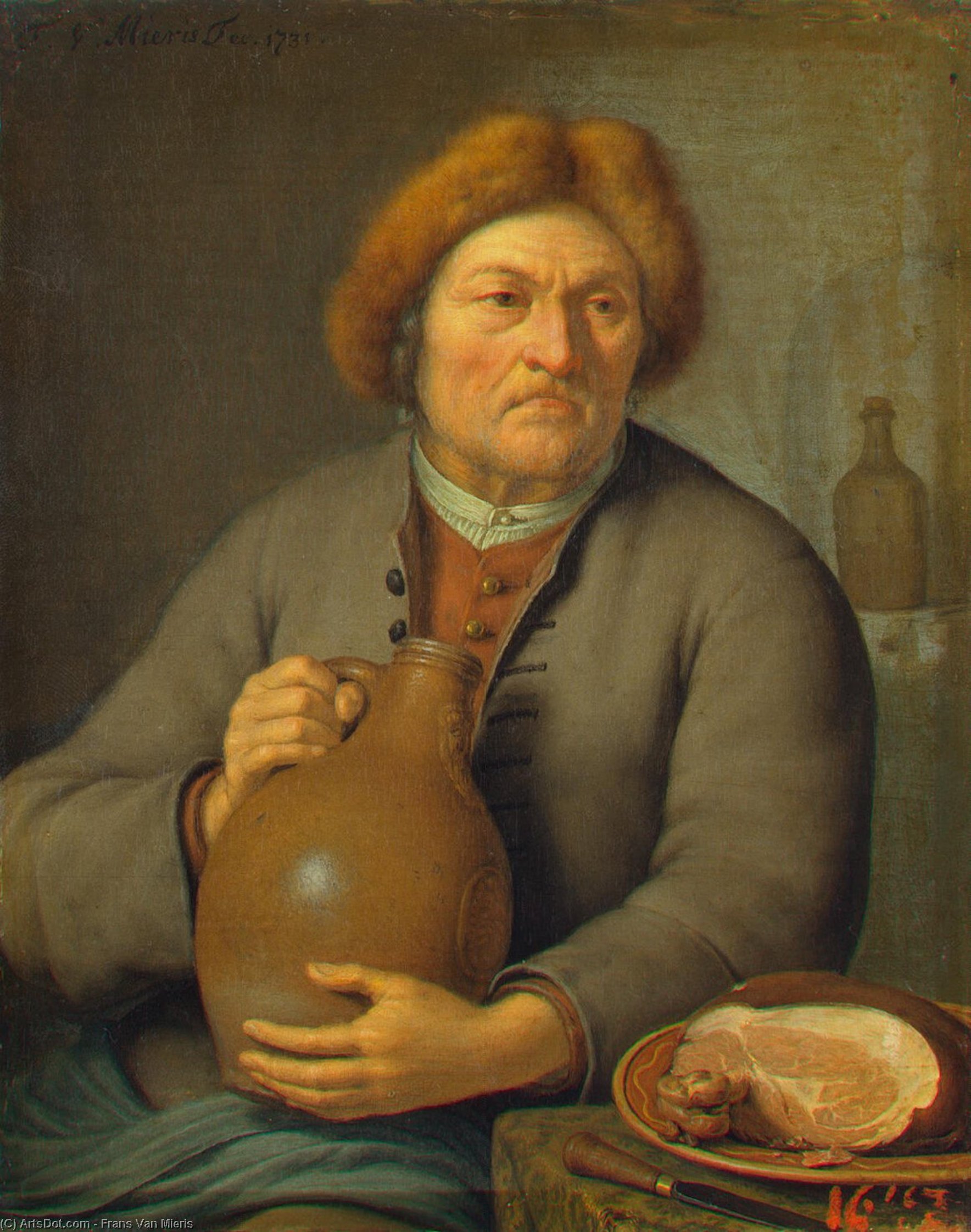
Old Peasant Holding a Jug by MIERIS, Frans van, the Younger
Frans van Mieris the Younger’s “Old Peasant Holding a Jug” stands as a quintessential example of Leiden fijnschilder style—a testament to meticulous observation and subtle tonal manipulation that defines Dutch Baroque painting. Executed in 1731, this unassuming genre scene transcends its simple subject matter to convey profound emotional resonance and intellectual contemplation.
The composition centers around an elderly man, rendered with remarkable anatomical accuracy, clutching a jug aloft. His posture exudes quiet dignity, while his gaze directs upwards—a gesture that invites the viewer to share in his contemplative awareness. The artist’s masterful use of chiaroscuro – dramatic contrasts between light and shadow – sculpts the figure's form, emphasizing musculature and conveying an impression of weathered resilience.
Stylistically, Mieris adheres closely to the precepts established by Gerard Dou and Abraham van den Tempel. The painting’s surface is remarkably smooth, achieved through painstaking layering of thin glazes—a technique that captures the nuances of light reflection with breathtaking fidelity. Notice how the subtle gradations of color illuminate the jug’s metallic sheen and cast delicate shadows across the man's face and torso.
Historically, “Old Peasant Holding a Jug” reflects the burgeoning interest in psychological realism during the Baroque period. Artists sought to depict not merely what was seen but also what was felt—to capture inner states of mind through visual representation. The scene’s stillness speaks volumes about the contemplative spirit of its time, aligning with broader philosophical currents exploring themes of solitude and introspection.
Symbolically, the jug itself represents sustenance – both physical and spiritual – while simultaneously serving as a focal point for the artist's compositional strategy. Its upward tilt directs the viewer’s eye towards the heavens—a visual allusion to divine grace and enlightenment. The painting’s understated beauty underscores Mieris’s belief that art could elevate the human spirit, fostering contemplation and promoting moral virtue.
Ultimately, “Old Peasant Holding a Jug” remains an enduring masterpiece because it succeeds in conveying both technical brilliance and emotional depth. Its quiet dignity and luminous tonal palette continue to inspire admiration—a timeless reminder of the power of art to illuminate the human condition.