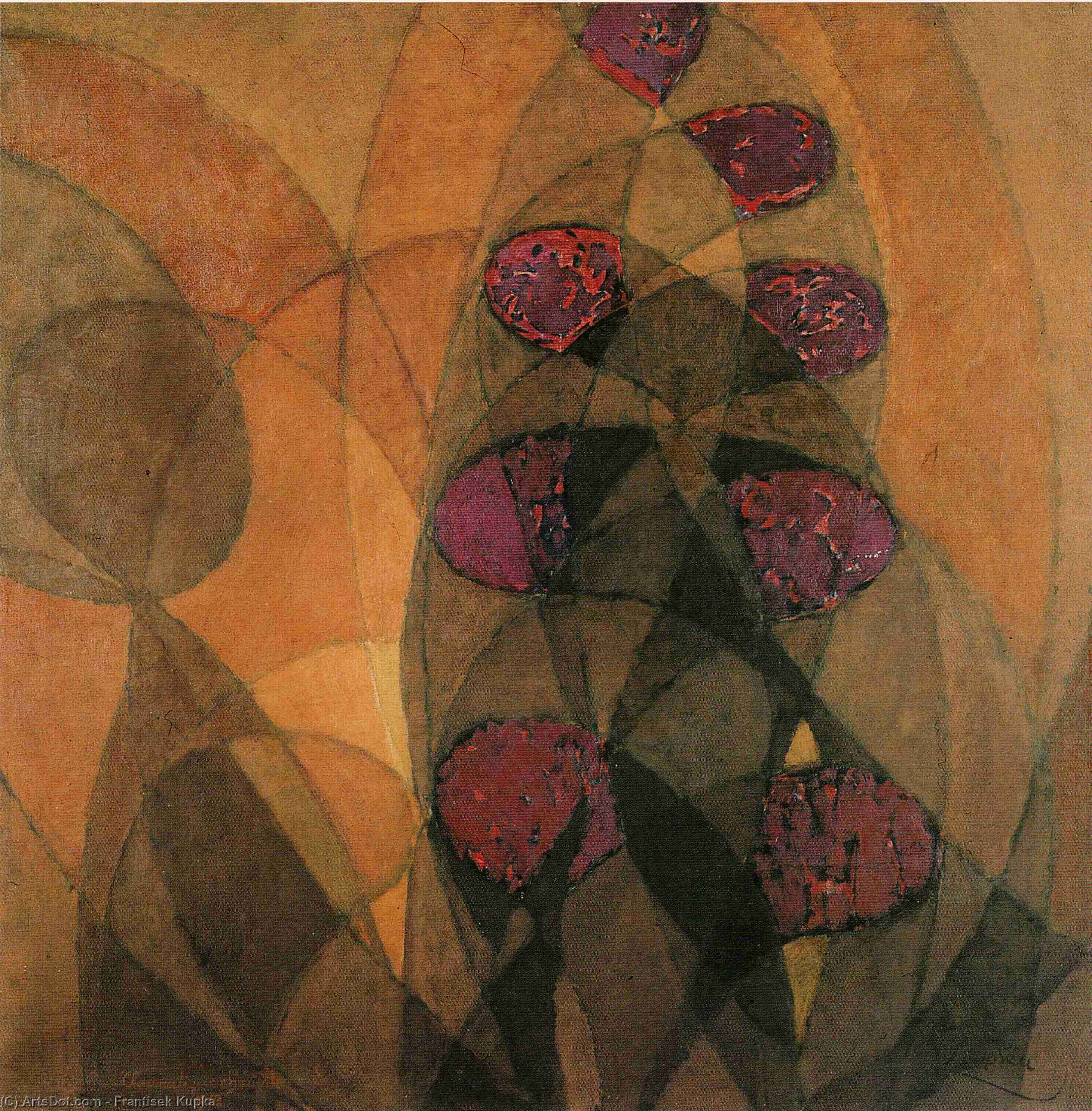
František Kupka’s ‘Warm Chromatics,’ an Orphism masterpiece from 1912, explodes with vibrant red, purple, and other hues in a captivating abstract floral composition. Discover this iconic artwork by the pioneer of abstraction and bring its beauty into your space.
František Kupka’s ‘Warm Chromatics’: A Pioneering Exploration of Orphism
“Warm Chromatics,” painted in 1912 by František Kupka, stands as a pivotal work in the nascent movement of Orphism. This vibrant canvas, measuring 105 x 105 cm, immediately captivates with its audacious use of color and form – a radical departure from the representational traditions that dominated European art at the turn of the century. Kupka, a key figure in the development of abstract art, was driven by a profound desire to capture not just what he *saw*, but rather the very essence of color itself, anticipating movements like Cubism and Fauvism decades before their formal emergence.
- Orphism’s Genesis: The painting exemplifies Orphism, a style developed by Kupka and his contemporaries that prioritized the visual impact of pure color and geometric forms. Rejecting traditional perspective and illusionistic techniques, these artists sought to create purely aesthetic compositions based on the emotional resonance of color combinations.
- Technique & Materials: Executed in oil on canvas, “Warm Chromatics” showcases Kupka’s meticulous layering of pigment. The artist employed a technique of ‘alla prima,’ applying paint directly onto the canvas with broad brushstrokes and rapid gestures, building up complex color relationships through successive glazes. This approach maximized luminosity and saturation, characteristic of Orphism's emphasis on vibrant hues.
A Symphony of Color: Deconstructing Form
The composition itself is a carefully orchestrated dance of chromatic elements. The central focus is a flower rendered in bold reds and purples, immediately drawing the eye with its intensity. Surrounding it are three additional flowers – one pink, one orange, and one green – each contributing to the overall harmonic tension. Kupka deliberately deconstructed traditional floral representation, reducing forms to their essential color components. The overlapping planes and ambiguous spatial relationships contribute to a sense of dynamism and movement, reflecting the artist’s interest in capturing fleeting visual sensations.
- Color Theory: Kupka was deeply influenced by contemporary theories of color, particularly those of Michel Eugène Chevreul, who explored the principles of simultaneous contrast. The juxtaposition of complementary colors – red and green, orange and blue – creates a visually stimulating effect, enhancing the vibrancy and depth of the painting.
- Abstraction as Emotion: The deliberate abstraction serves not merely as an aesthetic exercise but as a vehicle for expressing emotional states. The intense color palette evokes feelings of passion, energy, and perhaps even spiritual yearning—reflecting Kupka’s own philosophical explorations.
Historical Context & Symbolism
Created in 1912, “Warm Chromatics” emerged during a period of immense artistic and intellectual ferment. The rise of modernism challenged established norms, and artists like Kupka were at the forefront of this revolution. While the painting lacks overt symbolic meaning – a hallmark of Orphism – it can be interpreted as an exploration of the fundamental building blocks of visual experience: color. The flower itself, a recurring motif in Kupka’s work, may represent the ephemeral beauty of nature or the blossoming of artistic creativity.
Artist Biography Snippet: František Kupka (1871-1957) was a pioneer of abstraction, his early works demonstrating a gradual shift from historical themes to increasingly non-representational forms. His time in Paris proved crucial, exposing him to the radical ideas circulating within the artistic community.
A Timeless Masterpiece: Reproduction & Collection
"Warm Chromatics" by František Kupka is more than just a painting; it’s a testament to the power of color and form. A hand-painted reproduction offers an unparalleled opportunity to experience the full impact of this seminal work in your own space. ArtsDot's meticulous reproductions capture every nuance of Kupka’s technique, ensuring that you possess a faithful representation of this important piece of art history.