An Architectural Whisper: The Elegance of the Living Room Cabinet
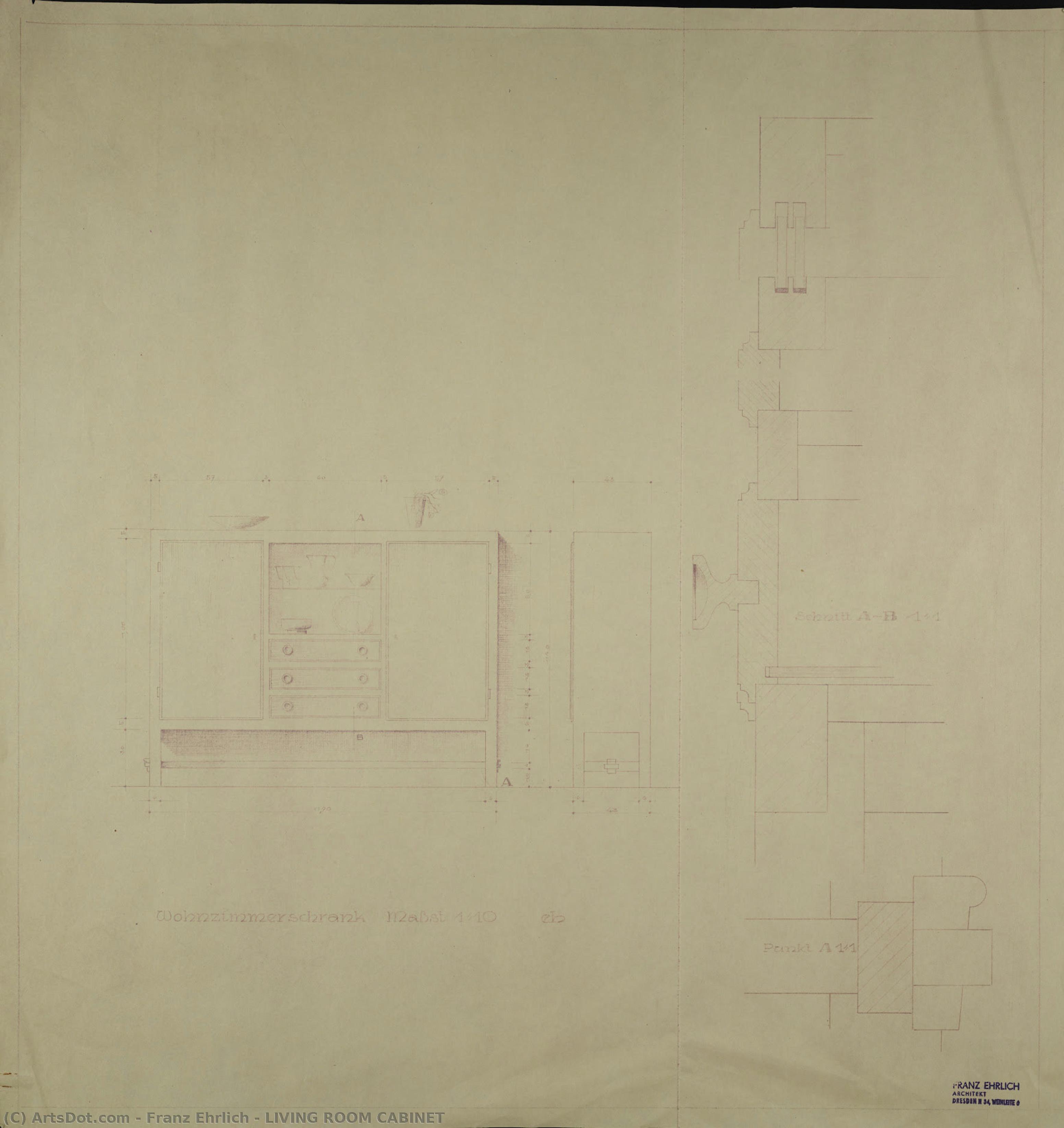
In the quiet intersection of functional design and artistic expression lies the Living Room Cabinet, a captivating study by the German master Franz Ehrlich. This particular piece, extracted from a larger compositional context, serves as a profound testament to the precision and grace inherent in early twentieth-century modernism. The cabinet, rendered in a pristine, luminous white, presents a silhouette that is both structurally disciplined and visually light. Through its delicate arrangement of two drawers and a singular door, it invites the viewer into a dialogue about the beauty of order. The inclusion of three strategic windows—positioned on the sides and at the summit—allows for a play of perceived depth, suggesting a transparency that defies its solid form. It is not merely a piece of furniture; it is a sculptural element that breathes life into any interior space.
The technique employed in this work reflects Ehrlich’s deep-rooted connection to the Bauhaus tradition, where the boundary between fine art and functional design was intentionally blurred. The drawing possesses a clean, graphic clarity that speaks to his training as an architect and calligrapher. Every line is deliberate, contributing to an aesthetic of "less is more" that remains timelessly relevant for contemporary collectors. The starkness of the white palette is balanced by the subtle shadows that define its edges, creating a sense of tactile reality. For the interior designer, this piece offers a masterclass in how minimalist forms can serve as focal points, providing a sophisticated anchor for both avant-garde and classical decor settings.
Beyond its physical attributes, the Living Room Cabinet carries an emotional resonance rooted in the era of its creation. Born from the intellect of a man who navigated the turbulent political landscapes of mid-century Germany, Ehrlich’s work often embodies a search for stability and structural truth. There is a serene, almost meditative quality to this drawing; it evokes a sense of domestic tranquility and the quiet dignity of well-ordered living. To possess a reproduction of this work is to bring a fragment of historical modernism into one's home—a piece that does not shout for attention but rather commands respect through its understated elegance and the enduring strength of its design.